



CMO Chapters Podcast
Series 3
Season 3 of CMO Chapters is here, and we’re going a layer deeper.
This time, it’s less about the title and more about what it really takes to do the job. The decisions, the pressure, the trade-offs, and the moments you don’t always see from the outside.
Across the season, we sit down with marketing leaders in the thick of it. The ones shaping brands, leading teams, and navigating change in real time. It’s honest, practical, and a bit unfiltered, the kind of conversations you’d normally only hear behind closed doors.
If you’ve ever wondered what sits behind the CMO title, this is it.
Listen now!
Watch on YouTube!
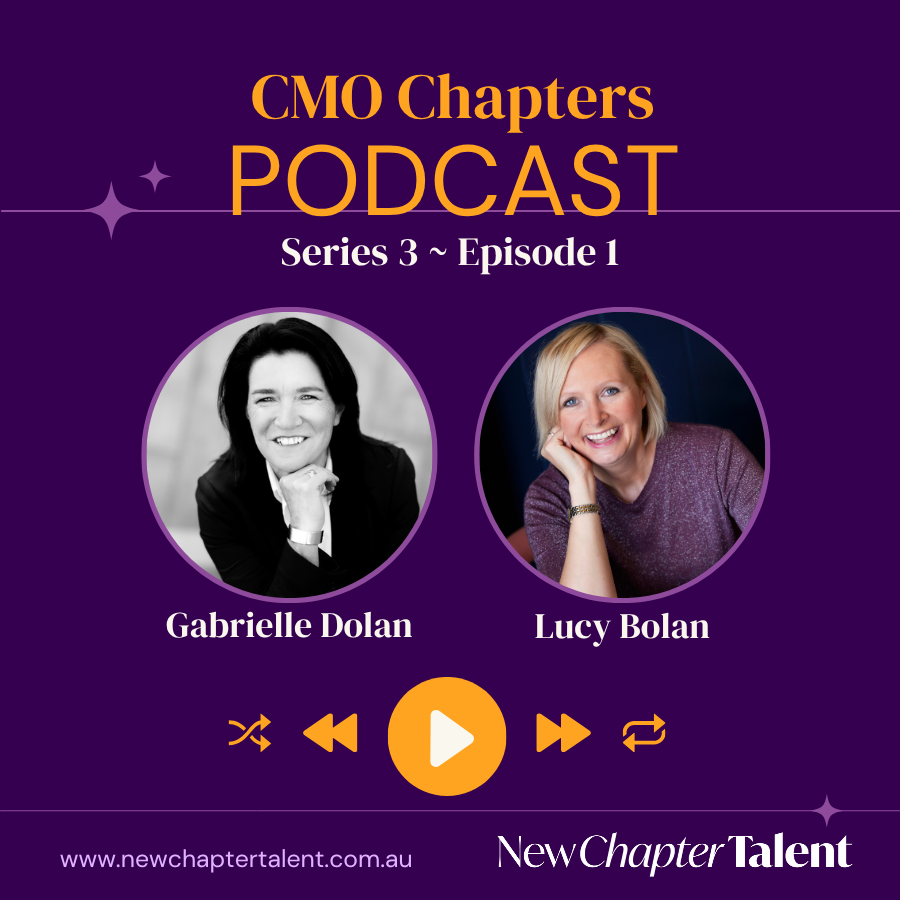
Episode 1 ~ Storytelling That Sticks: Influence, Trust & Standing Out in a Noisy World with Gabrielle Dolan
In the Season 3 opener of CMO Chapters, Lucy Bolan sits down with storytelling expert Gabrielle “Ral” Dolan for a refreshingly honest conversation about why storytelling isn’t just a “nice to have” - it’s a core leadership skill.
From leaving corporate to build a business around storytelling (long before it was fashionable), to unpacking how stories drive emotion, trust and decision-making, Ral shares what actually works - and what doesn’t.
They explore how storytelling cuts through in a world of AI and content overload, why most leaders get it wrong, and how marketers, candidates and executives can use simple, human stories to connect, influence and stand out.
If you’ve ever been told to “tell your story” but weren’t quite sure how - this episode makes it feel a whole lot clearer.
What You’ll Learn in This Episode:
- Why storytelling is one of the most underrated leadership skills
- The real reason stories influence decisions (hint: it’s not logic)
- How to make your message land - and actually be remembered
- The difference between telling a story and just talking for too long
- How CMOs can use storytelling to bring values and culture to life
- Practical ways to use storytelling in job interviews
- Why personal stories often carry more weight than professional ones
- How to avoid sounding like everyone else in a world full of AI-generated content
- The simple structure that keeps your stories clear, sharp and impactful
Resources & Mentions:
- Story Intelligence by Gabrielle Dolan
- Stephen Denning - The Leader’s Guide to Storytelling
- Aristotle’s model of influence: Logos, Ethos, Pathos
Connect with Our Guest:
Join the Conversation:
- Got thoughts on this episode? Drop us a message ~ lucy@newchaptertalent.com.au
- Don’t forget to subscribe and leave a review if you enjoyed this episode!
Listen now!
Watch on YouTube!
-
Transcript
Lucy Bolan
Welcome to the CMO Chapters Podcast where we dive deep into the dynamic world of chief marketing officers. Join us as we explore the careers, insights and strategies of top marketing
executives who shape the brands we know and love. Whether you're a seasoned marketer, aspiring CMO or simply just curious to understand what it really takes to step into the shoes
of a CMO, this podcast is your backstage pass to discovering what it's like to really lead and innovate in the ever evolving landscape of business stay tuned as we uncover the stories of the visionaries behind the
brand okay so i am delighted to have the fabulous gabrielle dolan on i think we're now on episode one for the cmo chapters podcast so gabrielle welcome i'm so excited to be speaking to you, Lucy. I can't wait.
Yeah, excellent. Thank you so much for coming on. I really, really appreciate it. Thank you. Really excited to have you on, actually, because, I mean, I feel like I've known you for, I want to say, I don't know now, six months, maybe, I think about, on and off.
Yes, hasn't been long. No, it hasn't been too long.
Gabrielle Dolan
It feels longer than six months.
Lucy Bolan
It does. It does indeed, in a good way. I've got a lot of questions. We've got a little bit to get through because, I mean, as we know, you've obviously written a book recently on story intelligence. So I've got a
bit there that I want to sort of dive into. But before we get into it, can you please introduce
Gabrielle Dolan
yourself? Well, my name is Gabrielle Dolan, as you said in the intro. Most people call me Rel. My little sister could never pronounce my name and she'd call me Gabriel. So Rel has stuck.
But I've spent the last 21 years of my career teaching business people how to communicate more effectively through stories. So prior to that, I worked at National Australia Bank. I worked in senior leadership roles and change management roles towards the end. And it was think storytelling is something people need to learn how to do better so I thought what the hell maybe
I could be that person to teach people having never run a business before or never taught storytelling before but I had actually done a lot of designing and delivering of leadership program so I knew I could design and deliver a leadership program around storytelling and yeah, that was 21 years ago. I thought I would, you know, just see if it worked out. If it didn't work out, I'd go back and get another job in corporate.
It'd be fair to say it's worked out.
Lucy Bolan
I think it's worked out really well. I mean, you've, what, 20 years now, 21 years?
Gabrielle Dolan
It's 21 years and counting. So, yeah, I worked in corporate for 20 years. And so now I've been out. But, yeah, clearly I still work very, very closely with corporate.
Yeah, absolutely.
Lucy Bolan
So why do you think, why storytelling? I mean, I'm just trying to think because, I mean, from my perspective, I feel like I'm only really getting into this now, if I'm being completely honest, since I've certainly got to know you
and obviously from reading your book and, you know, following you on LinkedIn. But let's go back 20 years ago. I can imagine storytelling back then. Was that a bit of a new sort of, oh, my God, what is this?
Gabrielle Dolan
The typical reaction I got was, what the hell is storytelling got to do with business? It was like, ooh, once upon a time. And people just, the amount of times people said to me, hang on a minute,
you left your corporate job, well-paid job, to teach people storytelling. Like, are you mad? And so, yes, that was very much the general reaction back then. When I was still at NAB and I sort of had this feeling,
you know, I just, I was in change management roles, right? So, you know, you're going out to the business units and you're explaining why we need to change. And of course, every business unit says, no, we don't need that because we're special and blah, blah, blah. Everyone says it.
And what I found is when I shared a story, and look, it wasn't a magical silver bullet, but it sort of put people's defences down a bit and they sort of at least listened. And I would, you know, often get, well, I guess that makes sense or I never thought about it that
way. And I started to reflect that it's when I shared a story that got through. And then I actually started to notice around me that I would see people speak
on stage and go, they're brilliant presenters. And then I was thinking, the reason they're brilliant presenters is because they're sharing stories. So I sort of started to notice the great presenters were sharing stories, the brilliant leaders that I wanted to work with were sharing
stories. Like we always know great salespeople share stories and great teachers share stories. So I had this inkling that it was a skill. And then I came across this book written by Stephen Denning.
I think it was called the Organisational Guide to Storytelling. And he was an ex-World Bank. He was an ex-senior exec at the World Bank. And I just seriously read that book.
And I was thinking, I knew it. I knew it. I knew there was something in this. And the fact that he was an ex-senior executive at the world bank i'm thinking if someone in that position is writing a book on the power of storytelling then there's absolutely
something in this so um yeah so i like i said 21 years ago i thought what the hell i'm gonna give this a crack the um our kids were two and five at the time and i just seriously thought if it doesn't work out,
I'll have a couple of years home with the kids and I'll just go back and get another job.
Lucy Bolan
Yeah, yeah, yeah, yeah. Good on you. Good on you. And it was a risk, obviously, that paid off. So here we are. Yeah, yeah.
Gabrielle Dolan
It was a risk. Yes. You know, it's funny. It didn't feel like a risk at the time. I'm not sure why. I think because I just had the attitude, well, I'll give it a go and if it doesn't work out you know I'm home you know a
year or two with the kids and then I'll just go back and get another job I had no no I knew I could come back and get another job so that wasn't an issue so it didn't overly feel like a risk but you know I mean it was in hindsight we
we decided me my husband collectively decided to reduce our income by 60% because I was you know earning more money than and that the so but yeah that
was a joint decision.
Lucy Bolan
So when I look at someone yourself, I mean, I see you as a bit of the guru when it comes to all things stories. So, I mean, is this something naturally that you've been really good at that you've, I guess, identified yourself with and gone, you know what,
as you said earlier, okay, there's something in this and off I go? Or have you yourself had to also, like, you know, really, I guess, hone in on your own craft and keep developing that as well.
Gabrielle Dolan
A bit of both. My mates that I went to school with and I still keep in contact with, so they've known me since I was 12. And, you know, they just think it's so appropriate that
I'm doing what I do because they would say, you were the one that was always telling the funny stories at the pub. But it was like one of my oldest mates, we lived together for a while and something would happen during
the day at home and I would just start chuckling to myself. And she goes, you were going to retell this story at the pub tonight and it's going to be so much more funnier than what had actually happened. I go, yeah, I know.
Because I'm kind of, so there was a bit of that. But the reality is we're all storytellers. We actually all tell stories. And some people are absolutely better at telling stories than others, just naturally, like just naturally.
You know, some people are naturally better at tennis than others. Okay. So that's a given, but everyone can get better at it. So yes, I have over the last 21 years gone through, figured out why, what works and what
doesn't work. And sometimes when you tell a joke and you could tell a joke and everyone laughs and you can tell a joke, you know, to the different people next week this and you think it's the same way but no one laughs and and there'll be elements that you forgot to say or
didn't say or was in the delivery and so it's the same with the story there's there's things that you i can i can hear a story and people go i don't know why it didn't work and i'll go this is why it
didn't work and so it's teaching people the process that hopefully a repeatable framework that will increase their chances of their stories landing and being effective.
Lucy Bolan
Yeah. And on that, why are stories so effective? Like, you know, why is it that when we listen to a story, and I mean, you've got a job doing this, why is it so important?
Gabrielle Dolan
Yeah. So there's a whole heap of research done by neuroscientists, very smart people, that say that when our brains hear a story, it taps into emotion and the brain processes emotion different to logic in two
different ways. So first of all, we actually make decisions based on emotion and business need to realise this because business just goes, oh, we're not making decisions based on emotion.
It's on logic and blah, blah, blah. We always make decisions based on emotion. It's like, you know, whether it's buying the latest iPhone or a new pair of shoes or a house or buying or working for a company or working for you or, you know, in a job interview, deciding.
People are walking out going, I reckon, I think we could really work with them. I think they'd be a really great fit. And that's their emotional decisions. Now, yes, it needs to logically make sense. So you still, I'm not saying you don't have the logic,
you'd still need the logic there, but we're human beings and all human beings make decisions based on emotion. So a story taps into emotion and what else, what the brain also does with emotion,
it stores it in the long-term part of our brain. So if a story, a well-told story, not all stories, if it taps into emotion, now I'm not saying emotional, like it's going to be really sad or anything, but it taps into emotion and therefore you remember the stories. So,
and look, when I speak to people, we sort of know this. Like you go, yeah, like people go, I remember I saw this great presenter and he told a story and they can retell me the story and I go how long ago was
this and I go that would have been over 10 years ago and I go what else what else can you remember from that presentation nothing nothing except the story so that's why stories are really powerful
on several things it helps people understand the message um it helps people remember the message because they've remembered the story and ultimately they can retell the story without losing its meaning.
Lucy Bolan
Yeah. I mean, it's interesting. So I was reading the, cue the book, the fabulous story intelligence here last night and I found it so interesting because as we know, we're in a world of AI now.
And I think something that you mentioned in that book, which I really resonated with was we are in a world of distrust now. Absolutely. Where naturally there's so many of us out there that see so much content on LinkedIn
or we hear stories and we go, yeah, no, that didn't really happen. Or LinkedIn or, you know, AI wrote that. So, you know, the book that you recently wrote, I mean, God, it's just so
interesting. And I loved all these individual different stories in there as well. And the exercise that you did around, you know, did AI write it or did I? I think what you did i could tell i won't spoil it but anyway so i mean and i love the analogy
as well when you said batman and robin it's kind of like you know your story batman and then robin see it as ai so i guess my question is you know if you were speaking to say marketers because i mean
there's going to be marketers listening to this how can they best would you say use storytelling when they say it's a CMO when they're in their role they're often talking generally about a brand and promoting that brand
story how best can they perhaps use it more so internally even when they're
Gabrielle Dolan
working with their own team yeah so the vast majority of the work I do Lucy is I go into organizations and how and teach the leaders how to tell stories. And it's normally around the values or the brand or the culture,
but you know, it's whatever you call it. It's like, this is what we value. These are the behaviors we expect. This is what we want to be known for. And my focus is on personal stories. So they didn't happen at work because I think they're the most powerful and they're the most,
but they're the most underutilized. So a lot of the times when companies talk about their values, they talk about, you know, work-related stories. So if they, you know, if one of their values is exceptional customer service, they'll share stories of their employees delivering great
customer service, which is fine. There's nothing wrong with that. And I call them professional stories, but you can add on the public story. So going back to your question, if you've got a CMO
or CEO or any senior exec, and they want to talk, they're either talking internally to their people, as in this is the behaviour we want, this is the culture we want, this is, you know, the values we value.
Or even if it's external people, like you're trying to recruit people. And like, seriously, I've been sharing these stories in a job interview, for example, because as we know, or as you would know, you know, it's you're selling the job as much as the people are trying to want the job.
They're having a decision on whether they work for you as well and it's an emotional decision remember that so I would say to any any executive that's trying to communicate values is first of all list the values and it doesn't necessarily need to be
only the company values it could be your own values as well and what people tend to do initially is go, oh, we value integrity. We value transparency. We value collaboration.
And it's just words, right? Words, words, words, words. And you're like, seriously, you throw a blanket over every corporate organizational values and 95% of them are
exactly the same, just worded differently. So that's where we start. But then I go, well, what does that mean to you? So you've just said we value collaboration i would go well what does that mean to you and
and i say to people what does it mean to you personally because the straight away they go well you know that the team works towards a you know shared goal blah blah blah again like what
does that mean so i keep asking them personally and you would be surprised how many senior execs have i say what does it mean to you personally? And they'll have a think about it and they'll say something.
And I go, what else does it mean to you personally? And they'll go, ooh, good point. You've really, yeah, you've put me on the spot here. I haven't thought about it before. So the real challenge, before we even get to the story,
is what does collaboration really mean to you personally? And ask yourself. And then you'll drill down and instead of saying things like working as a team, there'll be elements like seeking everyone's feedback or at least listening to
people's feedback or concerns about whatever it is, right? And then we find a story. And then, so my advice is you find a personal story and the really powerful ones. Let's just say there's an
example about it's actually seeking and listening to people's feedback is the messy. I would say, think of a personal story as it didn't happen at work when you
didn't do that. A lot of people go, well, why would I share a story when I didn't do it? Because sharing stories about when you didn't do it, and it could be like, you know, you're on holidays with friends and someone suggested, oh, it wouldn't go that way. And
you go, no, no, it'll be fine. It'll be fine. And then you've gone that way and, you know, crap happened, right? It can be as simple as that. It doesn't have to be these big major stories. And then when you're sharing the story, of course,
you're getting across the fact that you've either regretted that decision or you've learned a really valuable lesson and things like that, which now means that value is really important to you.
I know that value is really important to you.
Lucy Bolan
I think, and I find as well myself, because, I mean, I personally, you know, practice this myself, and I find it's the bridge isn't it it's the leap between the personal story and then getting it across to exactly what it means from a business perspective
the commercials and I think as well if you get that right if you nail it then it's going to really pack a punch and resonate yeah I've also personally listened to a lot of I'm gonna my
friends are gonna hate this but I've got friends I'm still in the go oh my gosh this happened the other day oh it was hilarious and they'll be on for 30 minutes about this bloody story and you're like my god like it can't be that funny and actually you've lost me
you lost me at 10 minutes actually so there's a bit of an art with it isn't there and i'm sure part of what you're doing is obviously getting people to tailor how to structure the story yeah
Gabrielle Dolan
the one of a common mistake is that people their stories just go way too long. So way too long. My advice is your story should be roughly around about 60 to 90 seconds. You can tell some brilliant stories in 30 seconds,
but if your stories are going two minutes or longer, they're just too long. And there's a real discipline in getting your story succinct. And part of the process I teach is if you're really clear on that single message, really clear on the single message, then that
will determine what information you put in your story and what, and most importantly, what, what you leave out. Wow. And sometimes people get full, you know, they, they telling the story and
everyone's listening. So they start adding more and they start adding more. And it was just like, just, you know, and I think the more senior people get, the more inclined to do this so it's um you know there's the saying i often say you didn't
get any funnier you just got more senior it's the same with your stories your stories didn't get any more engaging you just got more senior and people are politely nodding when they're really thinking
Lucy Bolan
get to the point so true so true so in this market i mean obviously as a recruiter i mean I do a lot of work with marketers who are, I mean, as we know, there's a lot of people out there looking for work right now, unfortunately.
And it's a really competitive story. And, you know, I see a lot of CVs where we've got fantastic key achievements. I mean, the CVs look great. But, and I said this to so many people all the time, know your narrative, know how to, you know, tell your story, how to, you know, articulate yourself.
But there's a lot that don't. And I don't know if that comes down to confidence, but how can, how can these people listening, how can they use storytelling to better
themselves, especially in an interview as well? Because I'm sure this would be very helpful.
Gabrielle Dolan
Yeah. Yeah. I mean, job interviews are the perfect opportunity to share stories. Like, you know, often, you know, when I work with people and like, I'm going, I share a story in a presentation with your team and they go what what you just start your story
and it's like well yes you do but you clear on the message job interviews are the perfect perfect opportunity because you know um i assume people still follow the bi process do they the
behavioral event you know tell us a time when yeah the style technique situation yeah yeah so what i what i would say if i was going advising people going for a job interview. The point is you don't want to use the job interview
to regurgitate your entire CV or resume. You've got the job interview. So I think the fact that you've got a job interview, you're ticking quite a few of the technical boxes or the skill or the
experience boxes. I would go and be very clear on what values that the company, look at the company values and what they value. I think have a good idea of what values or behaviors would be
expected in the role as well. And then I would go through the process of having both personal story and a professional story to communicate them. So again, if, you know, one of the values they
talk about is collaboration, I would have a professional story of when you've done that and potentially a personal story. Now you may not not you may not share both but i would be prepared
for that because they could sort of go well why is collaboration important to you now that's a perfect time to go and share their personal story personal stories are really valuable to if you're
lacking a little bit of industry experience so you might not have or you're quite young so you know, if this is your first or second job, you're not going to have as many work-related stories as, you know, someone in their 40s or 50s.
But you've probably got these amazing experiences, you know, when you're in, you know, Girl Guides or Scouts or, you know, going on a school excursion.
And you did. So you think about those lateral stories that still demonstrate, they still demonstrate collaboration or they still demonstrate risk making and you're sharing the personal stories.
You could, you know what, you can even share stories about your parents or your growing up that show that this, this is part of you. This is, you were raised with this value because your parents instilled it in you.
Lucy Bolan
Yeah, it's so true. And it's really funny. We're talking about this. So I, I've got my parents visiting at the moment from the UK, which is fun, fun and games. And I was chatting
to my dad actually last night and I said, oh, I'm interviewing, you know, Gabrielle. And he, you know, he's like, who's Gabrielle? Anyway, we went through the whole background, et cetera, storytelling. And he said, it's really funny, you know, he said, because he used to be quite
senior at British Airways Space and he was there for about 40 odd years. And he got his last job, which was overseeing, I think, customer service. Because he mentioned in that job interview that when he was younger,
he saw how important customer service was, working in his dad's DIY shop, where they were measuring nails and scales and all that kind of stuff.
And the HR director actually said to him afterwards, oh, you got that job because we love that story and how much customer service and how much you valued that as a child. And I said, well, there you go. You know, this is why it's so important.
And I think you're right. You're so right. It makes it, you know, when people tell me stories that are articulate, they get to the point, you know, they resonate with exactly what we're talking about.
You know, it really packs a punch. You know, it's so important.
Gabrielle Dolan
That's a great example. So it's a great example because what a story does is, I want to go back aristotle's model of influence where he said the three most important things when you're trying to influence people and you look at a job interview that is
the ultimate you're trying to influence people to hire you um you need logos ethos and pathos which which is logic personal credibility and emotional connection and what we tend to do with a cb or
is we go on logic oh i've done this before, these are the results. And that the approach with the STAR technique, where this was the situation, this is the task, and this is the result.
And that's all very logical, right? So I'm not saying you don't need that, it's logical. But the real, the most important thing when it comes to logic, personal credibility, or emotional connection, is credibility and emotional connection.
So what the story has done, your dad's story about measuring nails when he was a kid working in his dad's factory, it's created that emotional connection. We spoke about before, a good story taps into emotion, so it's already done the emotional
connection. What it's given him is credibility. Now it's not credibility in everything, but it's credibility in the message of he takes customer service serious.
So he's talking about that and it's through the story that builds credibility. It's only through the story that builds credibility. Because every single person going for that job interview, if they knew customer service was a big thing, they would all go,
customer service is really important to me. I'm really behind. I think the customers, and they would say it all, but sharing the story of him working in his dad's factory gives him credibility
that words alone will not do.
Lucy Bolan
Yeah, yeah, absolutely. It's like a reference there and then in itself, isn't it?
Gabrielle Dolan
Yeah, absolutely.
Lucy Bolan
I guess part of this podcast as well, I mean, I try and, you know, if anything, speak to people like yourself or the leaders, et cetera, to educate, you know, the next generation of marketers coming up on how to,
I guess, if they want to become a leader, how to better themselves, you know. One thing that does concern me and that I do see a lot is there's and I'm going to say maybe it's the COVID era to a degree you know there's this generation coming through
that unfortunately I find perhaps aren't as confident articulating or talking about who they are or what they're doing is there any advice for those guys that you can tap into like I mean
what would you say to these you know these, these younger generation coming through, like how they can better start to at least, you know, listen and take note of what you're talking about when it comes to storytelling?
Gabrielle Dolan
Yeah. So I think you're right. Like, like some people don't like selling themselves.
Lucy Bolan
They don't.
Gabrielle Dolan
It's like people often go to me, oh, I'd like to tell a story, but I don't want to brag. And I go, okay, well, don't brag. Like we don't, we don't want to be the bragger. well, don't brag. Like we don't want to be the bragger, but sharing stories about what you learned from that, the lesson I learned from that was the importance of whatever. That's a really
good way to share a story because it's not feeling like it's bragging. I love the advice from our respective mate, Jack Phillips. And she sort of said, when people go, well, what are your strengths?
What are you good at? And literally saying, well, people have told me that i'm very good at this so that it becomes like oh i'm good at this well well this is what people say about me people told me i'm good
so i love that technique i know i know that's not a story but you could do something like that and back it up with the story so people have told me that i'm you know very good at collaborating and making decisions, really being decided with decisions.
Okay, so share a story that does that. And again, they can be really powerful. And the stories can be both the personal stories and all the professional stories.
Lucy Bolan
Yeah, absolutely. And I think as well, especially when I've got clients within the world of HR, you know, chief people officers that are looking at, you know, we talk about now how actual employees are the brand advocates now, I mean you're probably going well
we knew that from way back when this is you know that they're the storytellers within the business but then you go on these websites and it's about us or it's our story and it's not their story at all because they're using a load of
jargon like we are innovative and we are collaborative and it's all blah blah blah so I mean what would you advise me to these people like I mean you know I mean I'm thinking if I was in a HR director role, I'd be going, right, let's get storytelling people.
Gabrielle Dolan
Yeah, a couple of things I would say to those. First of all, as we've spoken about, storytelling is an absolute skill, right? It's a skill. And so if you're in, you know, whether you're a CEO or chief people officer or whatever,
and you're going, okay, we want our people to be better at storytelling, you've got to teach them how to do it. And I know I might be biased because this is my job, but you can't just go, oh, start telling stories and not teach them how to do it because I've seen that done and it's
absolutely setting them up for failure. And then, and then the same, you know, senior exec will go, oh, we tried storytelling. It was like, yeah, you tried storytelling without learning how to do it
properly, which means you were always going to fail. So it's an absolute skill. You might have seen some articles come out the last six months or so
from the Wall Street Journal about biggest increase in job titles has got storyteller in the title. They did all this research on LinkedIn. Now, part of me goes, I told you so.
I knew storytelling was a skill. But part of me is really concerned that they're thinking storytelling, there's now a storytelling department.
And you know what it is, it's going to be the marketers. The marketers are now saying they're chief storytelling officers. My concern is that we almost outsource it because like you said, the best brand ambassadors
any organisation has is their employees. A hundred percent. You know, whether they're the front, you know, whether they're the leaders sharing stories internally or whether they're the
sales people sharing stories externally to clients or potential clients or they're the customer facing people right it's how they share your employees are the best brand ambassadors so i i see the companies that implement storytelling really well yes they train their leaders and they
train their senior leaders and they train the marketers and comms people but they train the marketers and comms people, but they train other people as well within the organization because learning how to tell, and you know what, learning how to tell a story well
is an absolute career skill. So I always say like, why wouldn't you just give, invest your employees and give them that skill? This is a skill that is going to benefit for them for the rest of their and even in their personal life as well it's like invest in them and don't just
look that the marketing department is gonna come up with stories then other people share and that and that's when exactly right Lucy you're listening them and yeah oh my god could you put any more jargon into that and you know what
most of the time it's not a story it's like and I see that all the time on websites it's our story or our stories. And I get in and have a look and I go, none of them were stories.
Lucy Bolan
Yeah.
Gabrielle Dolan
You know, there may be case studies or they're just not stories.
Lucy Bolan
No, no, exactly. Yeah, I've seen it myself actually a lot. And I think it's since our last chat, you know, I've become a lot more wiser to it as well. Those people out there that, you know, they've been doing this,
but they've got the top three stories and they keep regurgitating the good old top three stories on that conveyor belt. Off they pop. Because that can be hard trying to constantly come up with new ones, you know,
like that are still going to have the same impact.
Gabrielle Dolan
Yeah, it can be. And, you know, I'm going to answer this two ways. If you're a leader and you know you've got a story and it's almost become part of your signature story,
you would use it all the time. Now, the problem is when it gets the same audience, hears it again and again and again, everyone's going, oh, my God, if I hear this story one more time. But, you know, there's, I mean, and I can give you an example too
of a leader that shared a great signature story and she shares it all the time. And a lot of people have, in fact, I might give it to you because I haven't given an example. and this will talk about some of the things were spoken about how
you can communicate values that give you credibility so I worked you know was organizing or working with an organization that you know they wanted
to teach their leaders how to communicate the values through stories so great winning her name was Anne and she said one of the one of the values she was trying to communicate was doing the right thing so that was one of the one of the values she was trying to communicate was doing the right thing so that was one of their company values so went through that
process what does it mean what does it mean what does it mean maybe really think about it and she she said what it really means to me is doing the right thing all the time and not just when it suits us so the story she shared and I
shared the story and then we might just unpack why it works is um in the early 60s my dad was a professional swimmer and he reached the point in his career that he actually tried out for
the national swim team. And on the day of the meet, he was doing his race and he got to the end and did the tumble turn and he misjudged and he missed the wall. Now this was in the early 60s. So there was no census back then. There was judges, but with all that splashing and kicking, he knew
they wouldn't know if he touched the wall or not. So he had to make a split second decision. Does he go back and touch the wall or does he just keep swimming? Now he decided to go back and touch the wall. Now, you don't really recover from a race when you do that.
And Dad didn't. He never won. There was probably a whole lot of other reasons, but he never made the national swim team. And growing up as a kid, I would often hear Dad share that story and people would ask him, have you ever regretted going back and touching the wall?
And he'd always say, I've never regretted that because if I didn't go back and touch the wall, I'd have to spend the rest of my life knowing I did the wrong thing. And I'm sharing this with you because it reminds me of our value, doing the right thing. And I'm sharing this with you because it reminds me of our value doing the
right thing. It is only a matter of time before we come across our own go back and touch the wall moment. And I invite you to consider what my dad would do. Now, I want to put it there for,
go back to a couple of things. When Anne shares, every time someone comes and works for Anne, she shares that story. So it's sort of part of her personal
induction program because she has told me, I know the impact it has. I know the heavy lifting it does. She said that story demonstrates to them my leadership style. So she's not a, she's not a
win at all cost leader. She is, if we do the right thing and still don't achieve the outcome, I'll have your back. So she just shares that story every single time she's been on podcast and shared the story she's been on
panels around leadership and shares the story it's become part of her signature story we talked about you know logic uh credibility and connection so again can you see let's just say you were in a job
interview and she was interviewing you and you were talking about you know integrity and doing the right thing and she could say you all know that that's really important to us blah blah blah words but by
sharing the story I now truly believe and trust that she she delivers on that that that is her leadership but it's only through the story I get credibility now of course you do have to deliver
on that that's the other thing you've got to deliver on that but yeah that's a customer story that she has shared like this was 12 years ago I did the work with her and she still shares it in the last time I caught up with her was probably about this time last year okay
I said are you still sharing your dad's story and she went absolutely and then she said her dad had passed away like a three months prior and she had to do the eulogy and she shared that story so I was like oh that's very so lovely so so
if you've got a story that works, keep sharing it, but you also want to be on the lookout for other stories and that could potentially replace something like that or you might be just sharing a story about something else
and you need multiple ways, multiple stories. But part of what I do, Lucy, is once I help people realise it's not the bigger heart moments, it's not the big you know it's not the bigger heart moments it's not the climbing mount ever
it's not the recovering from cancer type stories it's just the little day-to-day ones once people realize that they will something will happen and they'll go oh oh that's a great story about making
assumptions or that's a great story around collaboration and they just start to use those
Lucy Bolan
stories yeah i love it and that story in particular i think really does hone in on you know I think coming down to someone's authentic you know their traits very much trusted um and and and you know to to your point you know when she's telling that
story she's saying you're like you can make mistakes but as long as you're honest and you know it's that that honesty and I'm just saying you know I'd be going well if I won that I would have won that race and I hadn't touched the wall and so actually I feel like a fraud, you know, so I'd rather do that.
It's doing the right thing, isn't it?
Gabrielle Dolan
And the other reason why that story works too is we spoke about this. It's a story about her dad. And when she tells it, what you see in her is pride. Like she's really proud of her dad. And so you know she was raised this way.
This is not just a company value she's towing the line to. You truly believe that this is important to her.
Lucy Bolan
I love it. So my next question, we're going to wrap things up but what is next for ral dolan i mean how many books have you done how eight is this going to be the
Gabrielle Dolan
last book well i said the last book was going to be the last book on storytelling but um you know i just felt comp well i felt compelled to write this one because people kept asking will story
will ai replace storytelling it's like God, no, it won't. And, you know, can you use AI to help with your stories? And my first response was, no, you cannot. That's cheating. That's not real.
That's not keeping it real. But anyway, yeah, you can. So what's next for me at the moment is I'm just marketing the book. I think this book, it's 20 years of my everything. And I do believe this will be my last storytelling book I write.
So I just, I think it's timely. I think it's relevant. I'm just on a mission to let as many people know about the power of storytelling and the book. So that's my focus at the moment.
On a personal level, I did turn 59 a few weeks ago, and I'm on a mission to be the fitness, healthiest, strongest I've ever been by the time I'm 60 so oh I love it yeah pumping a lot of weight good on you
Lucy Bolan
that's so good I feel like that now and I mean god it's it's kind of like mid-40s I'm like okay next year next year we'll get to it but good on you well I've been reading this and I think it's really weird honestly I think it's great and I'm really not just saying that I think for anyone
who's a leader I don't think you know it's and what I love about it I think it relates to anyone whether you're marketing or not you know anyone know, I think if you want to harness yourself, how you're going to be better even in like personal life, the barbecue conversation,
like really, you know, I think it's, it packs the punch for sure.
Gabrielle Dolan
Yeah, well, there was even, I mean, because I do believe this is a life skill as well. I mean, there's a whole chapter in that on, you know, what if you've got to give, you know, a 21st speech or a best man speech or a eulogy, just have stories, just have stories
for them.
Lucy Bolan
Yeah. Yeah, absolutely. Absolutely. Well, I've really enjoyed catching up. Thank you so much, Riel. It's been absolutely awesome. Love it. Love the energy. And honestly, I think there's going to be so much in this that people are going to go, ah, right, okay, that's how you do it. Right. The secret formula. Um, but thank you so much.
I really appreciate it.
Gabrielle Dolan
Thanks Lucy.
Lucy Bolan
Remember the road to CMO isn't always linear. It's filled with challenges, decisions, and moments of transformation. Whether you're charting your course or navigating a career shift, the experiences wisdom shared today as with our guests is invaluable. Thank you for joining
us. Keep dreaming big, keep pushing boundaries, and remember that your journey towards becoming a CMO is as much about the destination as it is about the growth you experience along the way.
Until next time, continue to innovate, evolve and carve out your path to CMO. Bolan
Welcome to the CMO Chapters Podcast where we dive deep into the dynamic world of chief marketing officers. Join us as we explore the careers, insights and strategies of top marketing
executives who shape the brands we know and love. Whether you're a seasoned marketer, aspiring CMO or simply just curious to understand what it really takes to step into the shoes
of a CMO, this podcast is your backstage pass to discovering what it's like to really lead and innovate in the ever evolving landscape of business stay tuned as we uncover the stories of the visionaries behind the
brand okay so i am delighted to have the fabulous gabrielle dolan on i think we're now on episode one for the cmo chapters podcast so gabrielle welcome i'm so excited to be speaking to you, Lucy. I can't wait.
Yeah, excellent. Thank you so much for coming on. I really, really appreciate it. Thank you. Really excited to have you on, actually, because, I mean, I feel like I've known you for, I want to say, I don't know now, six months, maybe, I think about, on and off.
Yes, hasn't been long. No, it hasn't been too long.
Gabrielle Dolan
It feels longer than six months.
Lucy Bolan
It does. It does indeed, in a good way. I've got a lot of questions. We've got a little bit to get through because, I mean, as we know, you've obviously written a book recently on story intelligence. So I've got a
bit there that I want to sort of dive into. But before we get into it, can you please introduce
Gabrielle Dolan
yourself? Well, my name is Gabrielle Dolan, as you said in the intro. Most people call me Rel. My little sister could never pronounce my name and she'd call me Gabriel. So Rel has stuck.
But I've spent the last 21 years of my career teaching business people how to communicate more effectively through stories. So prior to that, I worked at National Australia Bank. I worked in senior leadership roles and change management roles towards the end. And it was think storytelling is something people need to learn how to do better so I thought what the hell maybe
I could be that person to teach people having never run a business before or never taught storytelling before but I had actually done a lot of designing and delivering of leadership program so I knew I could design and deliver a leadership program around storytelling and yeah, that was 21 years ago. I thought I would, you know, just see if it worked out. If it didn't work out, I'd go back and get another job in corporate.
It'd be fair to say it's worked out.
Lucy Bolan
I think it's worked out really well. I mean, you've, what, 20 years now, 21 years?
Gabrielle Dolan
It's 21 years and counting. So, yeah, I worked in corporate for 20 years. And so now I've been out. But, yeah, clearly I still work very, very closely with corporate.
Yeah, absolutely.
Lucy Bolan
So why do you think, why storytelling? I mean, I'm just trying to think because, I mean, from my perspective, I feel like I'm only really getting into this now, if I'm being completely honest, since I've certainly got to know you
and obviously from reading your book and, you know, following you on LinkedIn. But let's go back 20 years ago. I can imagine storytelling back then. Was that a bit of a new sort of, oh, my God, what is this?
Gabrielle Dolan
The typical reaction I got was, what the hell is storytelling got to do with business? It was like, ooh, once upon a time. And people just, the amount of times people said to me, hang on a minute,
you left your corporate job, well-paid job, to teach people storytelling. Like, are you mad? And so, yes, that was very much the general reaction back then. When I was still at NAB and I sort of had this feeling,
you know, I just, I was in change management roles, right? So, you know, you're going out to the business units and you're explaining why we need to change. And of course, every business unit says, no, we don't need that because we're special and blah, blah, blah. Everyone says it.
And what I found is when I shared a story, and look, it wasn't a magical silver bullet, but it sort of put people's defences down a bit and they sort of at least listened. And I would, you know, often get, well, I guess that makes sense or I never thought about it that
way. And I started to reflect that it's when I shared a story that got through. And then I actually started to notice around me that I would see people speak
on stage and go, they're brilliant presenters. And then I was thinking, the reason they're brilliant presenters is because they're sharing stories. So I sort of started to notice the great presenters were sharing stories, the brilliant leaders that I wanted to work with were sharing
stories. Like we always know great salespeople share stories and great teachers share stories. So I had this inkling that it was a skill. And then I came across this book written by Stephen Denning.
I think it was called the Organisational Guide to Storytelling. And he was an ex-World Bank. He was an ex-senior exec at the World Bank. And I just seriously read that book.
And I was thinking, I knew it. I knew it. I knew there was something in this. And the fact that he was an ex-senior executive at the world bank i'm thinking if someone in that position is writing a book on the power of storytelling then there's absolutely
something in this so um yeah so i like i said 21 years ago i thought what the hell i'm gonna give this a crack the um our kids were two and five at the time and i just seriously thought if it doesn't work out,
I'll have a couple of years home with the kids and I'll just go back and get another job.
Lucy Bolan
Yeah, yeah, yeah, yeah. Good on you. Good on you. And it was a risk, obviously, that paid off. So here we are. Yeah, yeah.
Gabrielle Dolan
It was a risk. Yes. You know, it's funny. It didn't feel like a risk at the time. I'm not sure why. I think because I just had the attitude, well, I'll give it a go and if it doesn't work out you know I'm home you know a
year or two with the kids and then I'll just go back and get another job I had no no I knew I could come back and get another job so that wasn't an issue so it didn't overly feel like a risk but you know I mean it was in hindsight we
we decided me my husband collectively decided to reduce our income by 60% because I was you know earning more money than and that the so but yeah that
was a joint decision.
Lucy Bolan
So when I look at someone yourself, I mean, I see you as a bit of the guru when it comes to all things stories. So, I mean, is this something naturally that you've been really good at that you've, I guess, identified yourself with and gone, you know what,
as you said earlier, okay, there's something in this and off I go? Or have you yourself had to also, like, you know, really, I guess, hone in on your own craft and keep developing that as well.
Gabrielle Dolan
A bit of both. My mates that I went to school with and I still keep in contact with, so they've known me since I was 12. And, you know, they just think it's so appropriate that
I'm doing what I do because they would say, you were the one that was always telling the funny stories at the pub. But it was like one of my oldest mates, we lived together for a while and something would happen during
the day at home and I would just start chuckling to myself. And she goes, you were going to retell this story at the pub tonight and it's going to be so much more funnier than what had actually happened. I go, yeah, I know.
Because I'm kind of, so there was a bit of that. But the reality is we're all storytellers. We actually all tell stories. And some people are absolutely better at telling stories than others, just naturally, like just naturally.
You know, some people are naturally better at tennis than others. Okay. So that's a given, but everyone can get better at it. So yes, I have over the last 21 years gone through, figured out why, what works and what
doesn't work. And sometimes when you tell a joke and you could tell a joke and everyone laughs and you can tell a joke, you know, to the different people next week this and you think it's the same way but no one laughs and and there'll be elements that you forgot to say or
didn't say or was in the delivery and so it's the same with the story there's there's things that you i can i can hear a story and people go i don't know why it didn't work and i'll go this is why it
didn't work and so it's teaching people the process that hopefully a repeatable framework that will increase their chances of their stories landing and being effective.
Lucy Bolan
Yeah. And on that, why are stories so effective? Like, you know, why is it that when we listen to a story, and I mean, you've got a job doing this, why is it so important?
Gabrielle Dolan
Yeah. So there's a whole heap of research done by neuroscientists, very smart people, that say that when our brains hear a story, it taps into emotion and the brain processes emotion different to logic in two
different ways. So first of all, we actually make decisions based on emotion and business need to realise this because business just goes, oh, we're not making decisions based on emotion.
It's on logic and blah, blah, blah. We always make decisions based on emotion. It's like, you know, whether it's buying the latest iPhone or a new pair of shoes or a house or buying or working for a company or working for you or, you know, in a job interview, deciding.
People are walking out going, I reckon, I think we could really work with them. I think they'd be a really great fit. And that's their emotional decisions. Now, yes, it needs to logically make sense. So you still, I'm not saying you don't have the logic,
you'd still need the logic there, but we're human beings and all human beings make decisions based on emotion. So a story taps into emotion and what else, what the brain also does with emotion,
it stores it in the long-term part of our brain. So if a story, a well-told story, not all stories, if it taps into emotion, now I'm not saying emotional, like it's going to be really sad or anything, but it taps into emotion and therefore you remember the stories. So,
and look, when I speak to people, we sort of know this. Like you go, yeah, like people go, I remember I saw this great presenter and he told a story and they can retell me the story and I go how long ago was
this and I go that would have been over 10 years ago and I go what else what else can you remember from that presentation nothing nothing except the story so that's why stories are really powerful
on several things it helps people understand the message um it helps people remember the message because they've remembered the story and ultimately they can retell the story without losing its meaning.
Lucy Bolan
Yeah. I mean, it's interesting. So I was reading the, cue the book, the fabulous story intelligence here last night and I found it so interesting because as we know, we're in a world of AI now.
And I think something that you mentioned in that book, which I really resonated with was we are in a world of distrust now. Absolutely. Where naturally there's so many of us out there that see so much content on LinkedIn
or we hear stories and we go, yeah, no, that didn't really happen. Or LinkedIn or, you know, AI wrote that. So, you know, the book that you recently wrote, I mean, God, it's just so
interesting. And I loved all these individual different stories in there as well. And the exercise that you did around, you know, did AI write it or did I? I think what you did i could tell i won't spoil it but anyway so i mean and i love the analogy
as well when you said batman and robin it's kind of like you know your story batman and then robin see it as ai so i guess my question is you know if you were speaking to say marketers because i mean
there's going to be marketers listening to this how can they best would you say use storytelling when they say it's a CMO when they're in their role they're often talking generally about a brand and promoting that brand
story how best can they perhaps use it more so internally even when they're
Gabrielle Dolan
working with their own team yeah so the vast majority of the work I do Lucy is I go into organizations and how and teach the leaders how to tell stories. And it's normally around the values or the brand or the culture,
but you know, it's whatever you call it. It's like, this is what we value. These are the behaviors we expect. This is what we want to be known for. And my focus is on personal stories. So they didn't happen at work because I think they're the most powerful and they're the most,
but they're the most underutilized. So a lot of the times when companies talk about their values, they talk about, you know, work-related stories. So if they, you know, if one of their values is exceptional customer service, they'll share stories of their employees delivering great
customer service, which is fine. There's nothing wrong with that. And I call them professional stories, but you can add on the public story. So going back to your question, if you've got a CMO
or CEO or any senior exec, and they want to talk, they're either talking internally to their people, as in this is the behaviour we want, this is the culture we want, this is, you know, the values we value.
Or even if it's external people, like you're trying to recruit people. And like, seriously, I've been sharing these stories in a job interview, for example, because as we know, or as you would know, you know, it's you're selling the job as much as the people are trying to want the job.
They're having a decision on whether they work for you as well and it's an emotional decision remember that so I would say to any any executive that's trying to communicate values is first of all list the values and it doesn't necessarily need to be
only the company values it could be your own values as well and what people tend to do initially is go, oh, we value integrity. We value transparency. We value collaboration.
And it's just words, right? Words, words, words, words. And you're like, seriously, you throw a blanket over every corporate organizational values and 95% of them are
exactly the same, just worded differently. So that's where we start. But then I go, well, what does that mean to you? So you've just said we value collaboration i would go well what does that mean to you and
and i say to people what does it mean to you personally because the straight away they go well you know that the team works towards a you know shared goal blah blah blah again like what
does that mean so i keep asking them personally and you would be surprised how many senior execs have i say what does it mean to you personally? And they'll have a think about it and they'll say something.
And I go, what else does it mean to you personally? And they'll go, ooh, good point. You've really, yeah, you've put me on the spot here. I haven't thought about it before. So the real challenge, before we even get to the story,
is what does collaboration really mean to you personally? And ask yourself. And then you'll drill down and instead of saying things like working as a team, there'll be elements like seeking everyone's feedback or at least listening to
people's feedback or concerns about whatever it is, right? And then we find a story. And then, so my advice is you find a personal story and the really powerful ones. Let's just say there's an
example about it's actually seeking and listening to people's feedback is the messy. I would say, think of a personal story as it didn't happen at work when you
didn't do that. A lot of people go, well, why would I share a story when I didn't do it? Because sharing stories about when you didn't do it, and it could be like, you know, you're on holidays with friends and someone suggested, oh, it wouldn't go that way. And
you go, no, no, it'll be fine. It'll be fine. And then you've gone that way and, you know, crap happened, right? It can be as simple as that. It doesn't have to be these big major stories. And then when you're sharing the story, of course,
you're getting across the fact that you've either regretted that decision or you've learned a really valuable lesson and things like that, which now means that value is really important to you.
I know that value is really important to you.
Lucy Bolan
I think, and I find as well myself, because, I mean, I personally, you know, practice this myself, and I find it's the bridge isn't it it's the leap between the personal story and then getting it across to exactly what it means from a business perspective
the commercials and I think as well if you get that right if you nail it then it's going to really pack a punch and resonate yeah I've also personally listened to a lot of I'm gonna my
friends are gonna hate this but I've got friends I'm still in the go oh my gosh this happened the other day oh it was hilarious and they'll be on for 30 minutes about this bloody story and you're like my god like it can't be that funny and actually you've lost me
you lost me at 10 minutes actually so there's a bit of an art with it isn't there and i'm sure part of what you're doing is obviously getting people to tailor how to structure the story yeah
Gabrielle Dolan
the one of a common mistake is that people their stories just go way too long. So way too long. My advice is your story should be roughly around about 60 to 90 seconds. You can tell some brilliant stories in 30 seconds,
but if your stories are going two minutes or longer, they're just too long. And there's a real discipline in getting your story succinct. And part of the process I teach is if you're really clear on that single message, really clear on the single message, then that
will determine what information you put in your story and what, and most importantly, what, what you leave out. Wow. And sometimes people get full, you know, they, they telling the story and
everyone's listening. So they start adding more and they start adding more. And it was just like, just, you know, and I think the more senior people get, the more inclined to do this so it's um you know there's the saying i often say you didn't
get any funnier you just got more senior it's the same with your stories your stories didn't get any more engaging you just got more senior and people are politely nodding when they're really thinking
Lucy Bolan
get to the point so true so true so in this market i mean obviously as a recruiter i mean I do a lot of work with marketers who are, I mean, as we know, there's a lot of people out there looking for work right now, unfortunately.
And it's a really competitive story. And, you know, I see a lot of CVs where we've got fantastic key achievements. I mean, the CVs look great. But, and I said this to so many people all the time, know your narrative, know how to, you know, tell your story, how to, you know, articulate yourself.
But there's a lot that don't. And I don't know if that comes down to confidence, but how can, how can these people listening, how can they use storytelling to better
themselves, especially in an interview as well? Because I'm sure this would be very helpful.
Gabrielle Dolan
Yeah. Yeah. I mean, job interviews are the perfect opportunity to share stories. Like, you know, often, you know, when I work with people and like, I'm going, I share a story in a presentation with your team and they go what what you just start your story
and it's like well yes you do but you clear on the message job interviews are the perfect perfect opportunity because you know um i assume people still follow the bi process do they the
behavioral event you know tell us a time when yeah the style technique situation yeah yeah so what i what i would say if i was going advising people going for a job interview. The point is you don't want to use the job interview
to regurgitate your entire CV or resume. You've got the job interview. So I think the fact that you've got a job interview, you're ticking quite a few of the technical boxes or the skill or the
experience boxes. I would go and be very clear on what values that the company, look at the company values and what they value. I think have a good idea of what values or behaviors would be
expected in the role as well. And then I would go through the process of having both personal story and a professional story to communicate them. So again, if, you know, one of the values they
talk about is collaboration, I would have a professional story of when you've done that and potentially a personal story. Now you may not not you may not share both but i would be prepared
for that because they could sort of go well why is collaboration important to you now that's a perfect time to go and share their personal story personal stories are really valuable to if you're
lacking a little bit of industry experience so you might not have or you're quite young so you know, if this is your first or second job, you're not going to have as many work-related stories as, you know, someone in their 40s or 50s.
But you've probably got these amazing experiences, you know, when you're in, you know, Girl Guides or Scouts or, you know, going on a school excursion.
And you did. So you think about those lateral stories that still demonstrate, they still demonstrate collaboration or they still demonstrate risk making and you're sharing the personal stories.
You could, you know what, you can even share stories about your parents or your growing up that show that this, this is part of you. This is, you were raised with this value because your parents instilled it in you.
Lucy Bolan
Yeah, it's so true. And it's really funny. We're talking about this. So I, I've got my parents visiting at the moment from the UK, which is fun, fun and games. And I was chatting
to my dad actually last night and I said, oh, I'm interviewing, you know, Gabrielle. And he, you know, he's like, who's Gabrielle? Anyway, we went through the whole background, et cetera, storytelling. And he said, it's really funny, you know, he said, because he used to be quite
senior at British Airways Space and he was there for about 40 odd years. And he got his last job, which was overseeing, I think, customer service. Because he mentioned in that job interview that when he was younger,
he saw how important customer service was, working in his dad's DIY shop, where they were measuring nails and scales and all that kind of stuff.
And the HR director actually said to him afterwards, oh, you got that job because we love that story and how much customer service and how much you valued that as a child. And I said, well, there you go. You know, this is why it's so important.
And I think you're right. You're so right. It makes it, you know, when people tell me stories that are articulate, they get to the point, you know, they resonate with exactly what we're talking about.
You know, it really packs a punch. You know, it's so important.
Gabrielle Dolan
That's a great example. So it's a great example because what a story does is, I want to go back aristotle's model of influence where he said the three most important things when you're trying to influence people and you look at a job interview that is
the ultimate you're trying to influence people to hire you um you need logos ethos and pathos which which is logic personal credibility and emotional connection and what we tend to do with a cb or
is we go on logic oh i've done this before, these are the results. And that the approach with the STAR technique, where this was the situation, this is the task, and this is the result.
And that's all very logical, right? So I'm not saying you don't need that, it's logical. But the real, the most important thing when it comes to logic, personal credibility, or emotional connection, is credibility and emotional connection.
So what the story has done, your dad's story about measuring nails when he was a kid working in his dad's factory, it's created that emotional connection. We spoke about before, a good story taps into emotion, so it's already done the emotional
connection. What it's given him is credibility. Now it's not credibility in everything, but it's credibility in the message of he takes customer service serious.
So he's talking about that and it's through the story that builds credibility. It's only through the story that builds credibility. Because every single person going for that job interview, if they knew customer service was a big thing, they would all go,
customer service is really important to me. I'm really behind. I think the customers, and they would say it all, but sharing the story of him working in his dad's factory gives him credibility
that words alone will not do.
Lucy Bolan
Yeah, yeah, absolutely. It's like a reference there and then in itself, isn't it?
Gabrielle Dolan
Yeah, absolutely.
Lucy Bolan
I guess part of this podcast as well, I mean, I try and, you know, if anything, speak to people like yourself or the leaders, et cetera, to educate, you know, the next generation of marketers coming up on how to,
I guess, if they want to become a leader, how to better themselves, you know. One thing that does concern me and that I do see a lot is there's and I'm going to say maybe it's the COVID era to a degree you know there's this generation coming through
that unfortunately I find perhaps aren't as confident articulating or talking about who they are or what they're doing is there any advice for those guys that you can tap into like I mean
what would you say to these you know these, these younger generation coming through, like how they can better start to at least, you know, listen and take note of what you're talking about when it comes to storytelling?
Gabrielle Dolan
Yeah. So I think you're right. Like, like some people don't like selling themselves.
Lucy Bolan
They don't.
Gabrielle Dolan
It's like people often go to me, oh, I'd like to tell a story, but I don't want to brag. And I go, okay, well, don't brag. Like we don't, we don't want to be the bragger. well, don't brag. Like we don't want to be the bragger, but sharing stories about what you learned from that, the lesson I learned from that was the importance of whatever. That's a really
good way to share a story because it's not feeling like it's bragging. I love the advice from our respective mate, Jack Phillips. And she sort of said, when people go, well, what are your strengths?
What are you good at? And literally saying, well, people have told me that i'm very good at this so that it becomes like oh i'm good at this well well this is what people say about me people told me i'm good
so i love that technique i know i know that's not a story but you could do something like that and back it up with the story so people have told me that i'm you know very good at collaborating and making decisions, really being decided with decisions.
Okay, so share a story that does that. And again, they can be really powerful. And the stories can be both the personal stories and all the professional stories.
Lucy Bolan
Yeah, absolutely. And I think as well, especially when I've got clients within the world of HR, you know, chief people officers that are looking at, you know, we talk about now how actual employees are the brand advocates now, I mean you're probably going well
we knew that from way back when this is you know that they're the storytellers within the business but then you go on these websites and it's about us or it's our story and it's not their story at all because they're using a load of
jargon like we are innovative and we are collaborative and it's all blah blah blah so I mean what would you advise me to these people like I mean you know I mean I'm thinking if I was in a HR director role, I'd be going, right, let's get storytelling people.
Gabrielle Dolan
Yeah, a couple of things I would say to those. First of all, as we've spoken about, storytelling is an absolute skill, right? It's a skill. And so if you're in, you know, whether you're a CEO or chief people officer or whatever,
and you're going, okay, we want our people to be better at storytelling, you've got to teach them how to do it. And I know I might be biased because this is my job, but you can't just go, oh, start telling stories and not teach them how to do it because I've seen that done and it's
absolutely setting them up for failure. And then, and then the same, you know, senior exec will go, oh, we tried storytelling. It was like, yeah, you tried storytelling without learning how to do it
properly, which means you were always going to fail. So it's an absolute skill. You might have seen some articles come out the last six months or so
from the Wall Street Journal about biggest increase in job titles has got storyteller in the title. They did all this research on LinkedIn. Now, part of me goes, I told you so.
I knew storytelling was a skill. But part of me is really concerned that they're thinking storytelling, there's now a storytelling department.
And you know what it is, it's going to be the marketers. The marketers are now saying they're chief storytelling officers. My concern is that we almost outsource it because like you said, the best brand ambassadors
any organisation has is their employees. A hundred percent. You know, whether they're the front, you know, whether they're the leaders sharing stories internally or whether they're the
sales people sharing stories externally to clients or potential clients or they're the customer facing people right it's how they share your employees are the best brand ambassadors so i i see the companies that implement storytelling really well yes they train their leaders and they
train their senior leaders and they train the marketers and comms people but they train the marketers and comms people, but they train other people as well within the organization because learning how to tell, and you know what, learning how to tell a story well
is an absolute career skill. So I always say like, why wouldn't you just give, invest your employees and give them that skill? This is a skill that is going to benefit for them for the rest of their and even in their personal life as well it's like invest in them and don't just
look that the marketing department is gonna come up with stories then other people share and that and that's when exactly right Lucy you're listening them and yeah oh my god could you put any more jargon into that and you know what
most of the time it's not a story it's like and I see that all the time on websites it's our story or our stories. And I get in and have a look and I go, none of them were stories.
Lucy Bolan
Yeah.
Gabrielle Dolan
You know, there may be case studies or they're just not stories.
Lucy Bolan
No, no, exactly. Yeah, I've seen it myself actually a lot. And I think it's since our last chat, you know, I've become a lot more wiser to it as well. Those people out there that, you know, they've been doing this,
but they've got the top three stories and they keep regurgitating the good old top three stories on that conveyor belt. Off they pop. Because that can be hard trying to constantly come up with new ones, you know,
like that are still going to have the same impact.
Gabrielle Dolan
Yeah, it can be. And, you know, I'm going to answer this two ways. If you're a leader and you know you've got a story and it's almost become part of your signature story,
you would use it all the time. Now, the problem is when it gets the same audience, hears it again and again and again, everyone's going, oh, my God, if I hear this story one more time. But, you know, there's, I mean, and I can give you an example too
of a leader that shared a great signature story and she shares it all the time. And a lot of people have, in fact, I might give it to you because I haven't given an example. and this will talk about some of the things were spoken about how
you can communicate values that give you credibility so I worked you know was organizing or working with an organization that you know they wanted
to teach their leaders how to communicate the values through stories so great winning her name was Anne and she said one of the one of the values she was trying to communicate was doing the right thing so that was one of the one of the values she was trying to communicate was doing the right thing so that was one of their company values so went through that
process what does it mean what does it mean what does it mean maybe really think about it and she she said what it really means to me is doing the right thing all the time and not just when it suits us so the story she shared and I
shared the story and then we might just unpack why it works is um in the early 60s my dad was a professional swimmer and he reached the point in his career that he actually tried out for
the national swim team. And on the day of the meet, he was doing his race and he got to the end and did the tumble turn and he misjudged and he missed the wall. Now this was in the early 60s. So there was no census back then. There was judges, but with all that splashing and kicking, he knew
they wouldn't know if he touched the wall or not. So he had to make a split second decision. Does he go back and touch the wall or does he just keep swimming? Now he decided to go back and touch the wall. Now, you don't really recover from a race when you do that.
And Dad didn't. He never won. There was probably a whole lot of other reasons, but he never made the national swim team. And growing up as a kid, I would often hear Dad share that story and people would ask him, have you ever regretted going back and touching the wall?
And he'd always say, I've never regretted that because if I didn't go back and touch the wall, I'd have to spend the rest of my life knowing I did the wrong thing. And I'm sharing this with you because it reminds me of our value, doing the right thing. And I'm sharing this with you because it reminds me of our value doing the
right thing. It is only a matter of time before we come across our own go back and touch the wall moment. And I invite you to consider what my dad would do. Now, I want to put it there for,
go back to a couple of things. When Anne shares, every time someone comes and works for Anne, she shares that story. So it's sort of part of her personal
induction program because she has told me, I know the impact it has. I know the heavy lifting it does. She said that story demonstrates to them my leadership style. So she's not a, she's not a
win at all cost leader. She is, if we do the right thing and still don't achieve the outcome, I'll have your back. So she just shares that story every single time she's been on podcast and shared the story she's been on
panels around leadership and shares the story it's become part of her signature story we talked about you know logic uh credibility and connection so again can you see let's just say you were in a job
interview and she was interviewing you and you were talking about you know integrity and doing the right thing and she could say you all know that that's really important to us blah blah blah words but by
sharing the story I now truly believe and trust that she she delivers on that that that is her leadership but it's only through the story I get credibility now of course you do have to deliver
on that that's the other thing you've got to deliver on that but yeah that's a customer story that she has shared like this was 12 years ago I did the work with her and she still shares it in the last time I caught up with her was probably about this time last year okay
I said are you still sharing your dad's story and she went absolutely and then she said her dad had passed away like a three months prior and she had to do the eulogy and she shared that story so I was like oh that's very so lovely so so
if you've got a story that works, keep sharing it, but you also want to be on the lookout for other stories and that could potentially replace something like that or you might be just sharing a story about something else
and you need multiple ways, multiple stories. But part of what I do, Lucy, is once I help people realise it's not the bigger heart moments, it's not the big you know it's not the bigger heart moments it's not the climbing mount ever
it's not the recovering from cancer type stories it's just the little day-to-day ones once people realize that they will something will happen and they'll go oh oh that's a great story about making
assumptions or that's a great story around collaboration and they just start to use those
Lucy Bolan
stories yeah i love it and that story in particular i think really does hone in on you know I think coming down to someone's authentic you know their traits very much trusted um and and and you know to to your point you know when she's telling that
story she's saying you're like you can make mistakes but as long as you're honest and you know it's that that honesty and I'm just saying you know I'd be going well if I won that I would have won that race and I hadn't touched the wall and so actually I feel like a fraud, you know, so I'd rather do that.
It's doing the right thing, isn't it?
Gabrielle Dolan
And the other reason why that story works too is we spoke about this. It's a story about her dad. And when she tells it, what you see in her is pride. Like she's really proud of her dad. And so you know she was raised this way.
This is not just a company value she's towing the line to. You truly believe that this is important to her.
Lucy Bolan
I love it. So my next question, we're going to wrap things up but what is next for ral dolan i mean how many books have you done how eight is this going to be the
Gabrielle Dolan
last book well i said the last book was going to be the last book on storytelling but um you know i just felt comp well i felt compelled to write this one because people kept asking will story
will ai replace storytelling it's like God, no, it won't. And, you know, can you use AI to help with your stories? And my first response was, no, you cannot. That's cheating. That's not real.
That's not keeping it real. But anyway, yeah, you can. So what's next for me at the moment is I'm just marketing the book. I think this book, it's 20 years of my everything. And I do believe this will be my last storytelling book I write.
So I just, I think it's timely. I think it's relevant. I'm just on a mission to let as many people know about the power of storytelling and the book. So that's my focus at the moment.
On a personal level, I did turn 59 a few weeks ago, and I'm on a mission to be the fitness, healthiest, strongest I've ever been by the time I'm 60 so oh I love it yeah pumping a lot of weight good on you
Lucy Bolan
that's so good I feel like that now and I mean god it's it's kind of like mid-40s I'm like okay next year next year we'll get to it but good on you well I've been reading this and I think it's really weird honestly I think it's great and I'm really not just saying that I think for anyone
who's a leader I don't think you know it's and what I love about it I think it relates to anyone whether you're marketing or not you know anyone know, I think if you want to harness yourself, how you're going to be better even in like personal life, the barbecue conversation,
like really, you know, I think it's, it packs the punch for sure.
Gabrielle Dolan
Yeah, well, there was even, I mean, because I do believe this is a life skill as well. I mean, there's a whole chapter in that on, you know, what if you've got to give, you know, a 21st speech or a best man speech or a eulogy, just have stories, just have stories
for them.
Lucy Bolan
Yeah. Yeah, absolutely. Absolutely. Well, I've really enjoyed catching up. Thank you so much, Riel. It's been absolutely awesome. Love it. Love the energy. And honestly, I think there's going to be so much in this that people are going to go, ah, right, okay, that's how you do it. Right. The secret formula. Um, but thank you so much.
I really appreciate it.
Gabrielle Dolan
Thanks Lucy.
Lucy Bolan
Remember the road to CMO isn't always linear. It's filled with challenges, decisions, and moments of transformation. Whether you're charting your course or navigating a career shift, the experiences wisdom shared today as with our guests is invaluable. Thank you for joining
us. Keep dreaming big, keep pushing boundaries, and remember that your journey towards becoming a CMO is as much about the destination as it is about the growth you experience along the way.
Until next time, continue to innovate, evolve and carve out your path to CMO.
THE END
Listen now!
Watch on YouTube!
Episode 2 ~ From Execution to Strategy: Building Influence, Community & Modern Marketing Leadership with Jarrod Purchase
In this episode of CMO Chapters, Lucy Bolan sits down with Jarrod Purchase, a seasoned marketing leader with over 17 years’ experience spanning startups, scale-ups and global brands.
Jarrod shares his journey from hands-on email marketer to CMO, and why working closely with founders shaped the way he thinks about marketing, leadership and impact. He also opens up about building Club CMO Australia, the realities of today’s job market, and how AI is quietly reshaping teams, roles and expectations.
This is a grounded, honest conversation about what marketing really looks like behind the scenes. Less theory, more reality.
What You’ll Learn in This Episode:
- Why the best marketers balance creativity and commercial thinking ~ It’s not just about great campaigns. The ability to connect activity to outcomes is what earns trust and influence.
- How working with founders changes your perspective ~ Closer to decisions, faster pace, less politics. But it also demands adaptability and accountability.
- The real value of community at CMO level ~ Why Jarrod built Club CMO Australia and how peer conversations often beat any course or podcast.
- What’s actually happening in the marketing job market right now ~ Fewer roles at the top, pressure at the bottom, and a growing shift towards fractional and flexible leadership.
- How AI is changing team structures ~ Not a wipeout of roles, but a shift in how teams are built, where senior thinking matters more and execution becomes leaner.
- Why personal brand is often a byproduct, not a strategy ~ Focus on connecting people and adding value. The rest tends to follow.
- The biggest career mistakes marketers make ~ Not trusting your gut on roles, and not properly assessing whether a business truly values marketing.
Resources & Mentions:
- Club CMO Australia – Peer network for senior marketing leaders
- Real-time learning through agencies, freelancers and industry peers
- Practical, on-the-ground insights over theory-led content
Connect with Our Guest:
Listen now!
Watch on YouTube!
-
Transcript
Lucy Bolan
[00:03] Welcome to the CMO Chapters Podcast, where we dive deep into the dynamic world of chief marketing officers. Join us as we explore the careers, insights and strategies of top
[00:14] marketing executives who shape the brands we know and love. Whether you're a seasoned marketer, aspiring CMO, or simply just curious to understand what it really takes to step into the shoes of a CMO, this podcast is your backstage pass to discovering what it's like to really lead and innovate
[00:32] in the ever-evolving landscape of business. Stay tuned as we uncover the stories of the visionaries behind the brand. Okay, so Jarrod, welcome to the CMO Podcast.
[00:48] It's great to have you on the show.
Jarrod Purchase
[00:50] Thanks to be here, Lucy. Good to have one of our conversations, our many conversations we've had recorded, which I like.
Lucy Bolan
[00:57] Oh, I know, I know, I know. No pressure. This one is recorded. No pressure. Well, look, Jarrod, it's really great to have you on. Thank you so much. I really appreciate it. Let's kick things off. Jarrod, would you like to introduce yourself?
Jarrod Purchase
[01:10] Yes. Yeah. My name is Jarrod Purchase. I've been a marketer for about 17 years now. I've done all sorts of different bits and pieces, but yeah, cut my teeth in email marketing back in the day when you used to have to code HTML and CSS.
[01:24] So anyone listening to this that is around my age might appreciate that. Nowadays, you can just get AI to build everything. And yeah, kind of stumbled into marketing like I think a lot of people do as well. So I've gone from email marketing all the way through to running multi-million dollar budgets for a variety of brands.
[01:44] And I also run a group called Club CMO Australia, which is an organization based in melbourne to spot the name and that's a really strong community of 70 plus cmos which is a fantastic source of insight
[01:57] information validation um worry yeah and it's definitely something i'll pull on a bit today because the the insights you get from groups like that as i'm sure you can relate to yeah
Lucy Bolan
[02:08] ah big time absolutely we've got a treasure trove of all sorts to unpack. So I'm going to, I always kind of kickstart these conversations by really going way back to the beginning. And so when I look at your LinkedIn, I see GSK. That's kind of where it seemed like, am I right, where you started, sort of way back
[02:29] at the beginning.
Jarrod Purchase
[02:30] Yeah.
Lucy Bolan
[02:31] I mean, it seemed like in that role, you were like business consultant. So it's funny when I have to see cmos that start up in big global businesses like that a lot of them say you know what it really helped me cut my teeth like i learned a lot
[02:46] in those you know a couple of years like i'd love to get your thoughts you know is it was that a
Jarrod Purchase
[02:51] blessing that got you on the right path uh yeah very much so that's that's how i sort of fell into marketing um once again showing my age but uh online marketing and online commerce was still a relatively new thing i was part of a student
[03:06] program through swimmer university which they still do fantastic we'll always sing the praises of program they are there where they place you into the industry um for a year a payroll i think you're on minimum wage or something like that but for someone living at home and um with absolutely
[03:20] no expenses it was amazing to get a consistent payback and they rotate you through um different different departments i didn't end up in the marketing department, I ended up in the e-business department, which is if you called a group of people in an organisation
[03:35] now an e-business department, you would probably be laughed at for how old that sounds. So, that was my first exposure to anything around product and analytics and customer interaction online.
[03:58] And that's also where I met people that were significantly more advanced in their careers than me, and I started to see what the future would look like. So, yeah, for me the attraction of marketing was, which I don't think schools and universities do this particularly
[04:10] well necessarily, the balance or at least the variety that you get in the role that you might not get elsewhere. And what I mean by that is creativity. You get to express yourself personally,
[04:22] but you also get to explore creativity in how a brand talks, how a brand presents, how a brand internally in the organization is represented. And then you've got the other side, which is sort of forced upon old school marketers,
[04:38] is the analytic side. So needing to know numbers well, needing to be very close to the finance department any sort of commercial leads those sort of things so um how to tie what you do to through to performance
[04:51] and actual commercial outcomes so i think that's a that's a um a thoroughly enjoyable um combination of work that we do um and something why i've always wanted to be a bit of a generalist is
[05:04] because you have um exposure to those different things yeah so so to answer your question yeah that's where i started um uh the department i was in before that which is always funny was the
[05:16] procurement department and my surname's purchase um so that was always a joke and so i was going to be was not going to stay in uh procurement also known as the purchasing department um for very
[05:28] long there were too many laughs which i didn't mind too much, but got over it when I had to call the suppliers. And I remember one distinct recall where he said, your name's actually purchasing or in the purchasing and he yelled out to his colleagues, listen to this.
Lucy Bolan
[05:42] So. Yeah. It sounds like a smart move. Yeah.
Jarrod Purchase
[05:47] Sounds like a smart move.
Lucy Bolan
[05:48] I'm trying to say, like I look at your career and from what I can see, I mean, you actually started to become officially, I guess, a CMI around about 2018. And is it fair to say, have you been quite intentional about your career?
[06:02] I mean, I know when we all start off, you know, we all want to earn more money, we want to get to the top, but it doesn't always happen like that. And then guess what? Some people work out that they're really not great at leading teams.
Jarrod Purchase
[06:14] Intentional. I liked doing work that I enjoyed. So intentional in that sense. And I like working with particular types of people. So my specialty, which I only really sort of came to the conclusion
[06:29] in the last few years, is working with founders typically, so start-ups and scale-ups. So when a company gets to a certain point, it becomes too big for me. Things become slower. The game of politics becomes significantly bigger,
[06:43] and it's just, you know, I don't think many people really enjoy that. my first world was at the gsk and g capital which was my only exposure to to business really um was was was fine um great
[06:58] organizations you get a lot of support you work for a big brand um but then i went over the uk and uh you know with with no connections no plan um got my my shoes stolen in a place I was staying at before my first interview
[07:13] and ended up at a small organisation called BOTB, bestofthebest.com. And you're English, yeah. You might actually know these guys. I'm not sure if I've met them too. Yeah, you know them, yeah.
[07:25] The company that had cars in airports where you could buy a ticket to. So that was a very different experience because it was a physical office where you could see everyone that's in the organization pretty much so and
[07:38] i enjoyed that a lot more so um intention yes uh intention to continue to work with people like that where you're very close to the vision um you're very close to decision makers you can make
[07:50] decisions yourself you're trusted to make decisions and empowered to learn new things and understand new things because you know ultimately you need to kind of wear multiple hats so yeah continue to work with organisations like that.
[08:02] Yep, absolutely. The CMO role was never a target for me, but I think that's sort of where I've ended up and it kind of makes sense shifting away from being on the tools
[08:15] and doing the thing to helping to write strategy in areas where I've had a lot of success.
Lucy Bolan
[08:23] Yeah, I've got a really big question after that. Did you ever get your shoes back after the interview?
Jarrod Purchase
[08:29] No. No. No. So I was like 25 or something like that and I'd just gone over. I was staying in a hostel and, yeah, woke up in the morning. I was ironing my shirt on the bar and, yeah, shoes were gone.
[08:41] So there was some Italian guy that lended me his shoes and they were two sizes too big. So I would have looked like an absolute mess going into that interview. I have no idea how I got that role.
[08:52] I do. They needed an email marker and had those skills but yeah
Lucy Bolan
[08:58] brilliant well i've got some shocking interview stories myself but i think we'll save that for another podcast i would i would subscribe to that okay all right well maybe it's an idea that i
[09:09] don't know we'll see i guess one thing that i've sort of observed about you and and and i've seen this is that you know at one point you did have your own podcast yourself I think the anonymous
[09:22] CMO and then you've you know you're I think is it co-president is that the official title of the CMO club CMO and I feel like you know I look at somebody like yourself and I think god I wish
[09:35] there was more people like that in terms of that mindset and be around intentionally growing your own personal brand and also your network I think in this market it's about a lot i've seen it become
[09:46] quite unstuck because it's only kind of over the last year or so really we've been talking about it and it's become actually quite relevant um i'd love to get your thoughts on that i mean is that
[09:57] something that you've been pretty is it fair to say you've been quite proactive in doing that
Jarrod Purchase
[10:02] um the personal brand stuff not really um that's that's more of a byproduct of the stuff I've been doing. So I really enjoy connecting people. I enjoy connecting people. I enjoy these conversations.
[10:13] I enjoy deep conversations, even if it doesn't have anything to do with marketing. The podcast Rob Marfell and I were working on was similar to what you're doing, trying to get, trying to understand the person behind it and how they've got to where they are.
[10:28] So interview questions that show what percentage uplift they had when they did a particular campaign. Like you can get that content anywhere and it's not very useful to anyone no understanding the person and what
[10:39] decisions they've made to get get where they are um is really interesting club singham australia is uh that that was a yeah very much so a self-interest um project and that came from
[10:54] uh wanting to effectively crowdsource solutions to problems. So as you know, when you're the most senior person in an organisation in a particular discipline,
[11:07] there's not really anyone in the organisation you learn from for your discipline. You can learn from a CFO, from someone in tech, those sort of things. But what do you actually learn from? You read books, you listen to podcasts, but they're very much so like a one-way medium.
[11:21] Yeah. So I wanted to pull together a bunch of smart people and then talk to them about the problems I had. So Club Sema Australia, I take a lot of data and surveys, as I should as a marketer, from the community, know your customer.
[11:35] And then we create events off the back of that. So we're very much still creating events. We're solving super relevant, timely issues. So, yeah, it wasn't really a personal brand thing, but I guess that makes it, you know, it's a useful byproduct of that.
[11:52] Our members refer people into the organisation. People might come to me, recruiters come to me looking to fill roles and all that sort of stuff. But yeah, it's more connecting people and yeah, I guess my skills.
Lucy Bolan
[12:08] Yeah. Yeah. A question I'm keen to ask, and I'd love to get your thoughts on this, given that you connected to 70 CMOs. I mean, I think you look at the market at the moment, I'll be honest, I do worry about
[12:21] both ends of the market. I think you've got all these incredible graduates who are coming through and they're applying for roles and there's easily like, I don't know, 300 applications more for one coordinator
[12:33] role. And then on the other end, we've got all these incredibly talented, experienced marketers who are CMOs or heads off really trying to find work. And there's not as much, you know, it's really quite slim pickings,
[12:47] even more so than it ever has been. So I kind of go, God, right, we've got this kind of meat in the middle where that's the prime kind of remit. And I just think, are they just going to become
Jarrod Purchase
[12:57] more fractional CMOs out there? I mean, what are your thoughts? Yeah, I think that would be the case. My view on, yeah, like I haven't seen the market like this so consistently,
[13:11] I guess, in that particular balance that you described for so long. It's might have been, you know, a year, less than a year type thing, but it's been quite consistently imbalanced for a while.
[13:23] The way I view marketing functions and teams and, you know, depending on who you chat to, people will say, you know, you chat to people who say, you know, marketing is the job of the whole organisation, is AI was going to come up at some stage,
[13:38] but the CMO position or a really experienced marketer will be the person that's directing AI tools to do execution. And that's pretty much where I'm at at the moment.
[13:50] Darwin Exxon I'm doing some work for over in Spain. You know, we don't really need to hire people. We just need to be using tools significantly better.
Lucy Bolan
[13:58] Okay.
Jarrod Purchase
[14:00] And that's happening over time. So the way I see it is small businesses and start-ups in particular will hire experts. So they'll hire the very expensive person where they might have historically
[14:11] got someone kind of mid-level and then sort of train them up because that's what they could afford. Yeah. Because historically you'd get that person they would then have to hire four or five people under any fam that have an agency so on so forth
[14:24] um i see businesses paying more for someone that's really really good and then that person having a very team or freelancers or ai to um do the execution for them because you're hiring the
[14:37] you're hiring the brain that can come up with a strategy you can criticize and challenge ai the the business and the brand to um the organization that actually still have to do stuff if you're running an event you still need you know you still need people to
[14:51] go and hire a venue into their catering and all that sort of stuff so you'd be hiring the brain and that personal network and connections and understanding of how this how things go together so yeah i don't know what the future holds you're in a better position to answer that but
[15:06] um that's where i see it going and um, yeah, the Club Cinema community, there's probably always about 5% of people who are moving between roles. Yeah. But they seem to land pretty well. So I don't know if it's just my community is just, you know,
[15:19] smarter than and more desirable than the average marketer out there, but they seem to be, everyone seems to be okay.
Lucy Bolan
[15:26] Yeah. Okay. Right. Yeah, it's interesting. And I wanted to sort of get your take as well because over the years, you know, you hear specific buzzwords, you know, you hear, you know, CMOs are under the pump, you know, deal more with less. And I mean,
[15:40] that was being flown around for a couple of years. And now everyone's obviously, we know AI has landed, it's officially here and how we're going to adopt that. What do you think is the general
[15:50] feeling from CMOs at the moment when they're looking and they're in 2026, you know, some businesses are founder all over it and they're like right we want to use ai they want to you know invest how do we do it and then there's some honestly that i still find quite frightening
[16:03] that they've still got their heads in the sand and they're like oh yeah they say i think it's just gonna pass pass by there's absolutely some clients i know that are 100 like that which is a little bit worrying what's the general consensus well i did a survey recently to my group and i
Jarrod Purchase
[16:18] haven't actually looked at the results yet so i should have looked at that beforehand and i give I've looked at the pie charts. I looked at the nice visuals because they're really easy to just quickly scan. I guess the problem that we, CMOs or senior marketing people,
[16:35] have always had is the whole issue of trying to do more with less. And AI very much only fits in that. My experience, and speaking to some people through your network as well is in any discipline, the issue is finding time to commit to these tools.
[16:54] So, okay, the board or CEO says, hey, we need to use AI more. Everyone agrees and everyone sees the benefit in it. And, you know, on my Instagram, I'm getting a new reel each day that says whatever Google's launched this day and that day.
[17:07] And it's useful and how it will be applied.
[17:27] So the biggest worry I see from my community is finding the time to be able to implement it. It doesn't seem to be, I have looked at the AI stats, there doesn't seem to be too much of a concern around the impact on their own teams in terms of downsizing,
[17:42] but also not increasing size. So I guess my view earlier on AI will probably just keep teams as they are and you won't hire in the future where you would have hired historically,
[17:54] seems to be the general consensus of my group at least.
Lucy Bolan
[17:59] Absolutely. I mean, I would agree. I've heard something similar for sure. Absolutely. Because I think people that are AI jobs are going to go, you know, it's, but also I think another threat is the fact
[18:10] that there's a lot of offshoring, you know, and this is why I worry about more the junior talent, you know, because it's like, well, we don't need to hire, you know, a specialist or we can get them in the Philippines
[18:20] or wherever it may be, you know, it's a lot cheaper. So yeah, interesting times interesting times ahead a question a question i did have and i wanted to i guess this is more for our listeners who are
[18:34] still developing you know within their careers what advice i mean if you'll say i don't know we'll call it i don't know 30 year old marketer or you know late 20s and you're a specialist and
[18:46] you're wanting to evolve i mean is there any kind of wise words that you would give those marketing managers out there that are looking to really develop the skills as a leader is there anything that you wish you'd have done perhaps in in you know your past when you look back at your career uh yeah for
Jarrod Purchase
[19:02] sure it depends it depends how you mean leader if you mean leader of people um personally i uh would have probably done more courses i'm not a massive fan of going on courses. I think I prefer to learn on the job,
[19:17] but I think leadership of people is a skill set that needs to be developed. And sometimes I probably would have done more kind of formal education around leading people. I think personally I take a lot of learnings and skills
[19:36] from personal relationships. I don't think they're any different. It's just some new art and apply that to leadership but um in terms of leadership from a commercial perspective i i still feel that um marketing a lot of people get into marketing
[19:52] for the um the flashy big ads creative that doesn't really exist that that more with many brands and i think the reality is um you know technical abilities and knowing numbers i've
[20:06] always said to people if this has, you need to know how to use numbers. If you do a campaign, you can't tell me the basics. Did you even A, B test the subject
[20:18] lines of the campaign? What has been the impact on your lifetime value? What is our lifetime value? You can just tell me that you made a really cool email campaign and it looks great and it's beautiful. Cool. But as a CEO or a founder, I'm like, okay, what did that do for us and yeah i find this a bit of a disconnect between um the idea
Lucy Bolan
[20:36] of marketing the reality of marketing yeah yeah like i think you bang on absolutely because it's funny i was chatting to a cmo a while ago and she was saying you know she recognized quite early on
[20:49] she really wanted to have a seat at the table but she said i was rubbish with numbers really really bad with numbers and i owned that and you know, I remember she said, I made friends with one of the
[21:01] data analysts and I just peppered him with questions. And finally, you know, I got it. And, you know, all of a sudden after, you know, a lot of investment in myself, I was able to,
[21:12] you know, really conquer that. And guess what she did? She got a seat at the table and now she's a very, very successful CMO, you know, good on it. But I feel like there's, I don't know, it sounds, I feel at the end of the
[21:24] day, it comes down to you, you know, it's your self-development and it's your areas. And if you, it's, we can all have the best, you know, programs and tools available, but by going to the gym,
Jarrod Purchase
[21:35] you only get the results if you work at it. Absolutely. Yeah. I think, I think we've had this conversation before, cause I think that story, that story sounds familiar, but this one's getting recorded. So we might as well repeat it. Yeah. I think people, people love helping people i i i say this to everyone about anything in life really people really enjoy humans enjoy helping other people so
[21:55] if you as a as a 26 year old or something went to the cfo or someone in finance said look i don't understand this can you help me understand it people love to talk about their job and to help you out unless they're you know they're they're oh they're burnt out and that sort of thing just
[22:09] go to people and ask for help and sit next to them and listen to them and ask questions um you know admitting that you don't know something to me i was i liked that um because people don't always know everything if you're just nodding along and saying yeah yeah i'm going to
Lucy Bolan
[22:23] assume you're not exactly exactly right what's uh what do you think the future is of the cmo's role because i've had so many conversations about this i mean look none of us have got crystal balls we
[22:34] know that but you know we're seeing all these you know these titles come through like chief growth officer and you know it some people say oh it's gonna now sit within i don't know cx or your chief customer office remit do you think that over time the cmo role
[22:51] will diminish and it'll be it'll sit within other divisions have you any thoughts on that yeah i
Jarrod Purchase
[22:57] think it will like i think the title itself is um not really representative of what we do. Yeah. You know, there's a lot. What's the average tenure for a CMO? Like I think when Rob and I looked at it for our podcast,
[23:11] it was low in the middle of the COVID.
Lucy Bolan
[23:13] Yeah, it is.
Jarrod Purchase
[23:14] There's just two years or something like that.
Lucy Bolan
[23:17] Yeah, two years.
Jarrod Purchase
[23:18] Yeah. And I think that comes from there being a lot of pressure on that particular role to do all sorts of different things and for it to be a lever of success or failure. It's usually the CMO or the CPO that has to go.
[23:33] And, you know, the blurring lines between growth and marketing, people debate this, between growth and marketing are the most blurred they've ever been. What is growth? What is marketing?
[23:45] A person that just focuses on the brand and the way the brand is represented and interacted with, that doesn't, i don't think that really exists unless you're in a really large organization yeah for big companies in listen on the stock exchange
[24:00] a cmo i think still makes sense um for someone in a medium sized organization that's still doing you know many many you know 100 million or less like that's i don't think that role is really their
[24:14] thing um yeah but who knows i also think ai is gonna ai is gonna um we're gonna go full circle with ai we'll probably end up going back to more authentic um human-based interactions and that may result in i think marketers uh
[24:31] sort of specialization coming back a little bit more to how do we create more authentic um brand representations and uh connections and in-person connections community it's a human type yeah yeah tbc yeah that's just a big gut feel big time tbc and even now like i already see it i mean
Lucy Bolan
[24:49] we're already talking about the need for authentic content because i mean nowadays you see things and you don't even know i think this this element of trust you know there's a lot of there's a huge need i think for people to actually trust and engage in that content because let's be honest
[25:03] we don't know if it's real you know so i agree i think this full circle i don don't know, we could be using chalkboards in five years. Who knows? Back to the circle.
Jarrod Purchase
[25:17] Totally. Yeah. I know you're exaggerating, but I don't think that's so silly. There'll be stuff like that.
Lucy Bolan
[25:25] What have been the biggest learnings in your career, Jarrod? I want to dig into some failures. I know, I mean, look, we've all had to go through failures and learn. Was there any bit in your career when you look back any sort of like you know my little sort of
[25:40] i guess um chapters we'll call it where you've gone god you know what that worked for that person
Jarrod Purchase
[25:45] bloody hell it was hard work but my god i learned a lot um no not that specific example um it's usually been dan that was hard work and i don't want to do it again that was not a nice experience um yeah yeah failure is like of course anyone that anyone that says that it haven't had any failures
[26:02] or sort of skirts away from it, I don't know. Everyone has failed. I've got hilarious examples that I can laugh at now that I won't mention brands, but anyone that has known me from that part of my career that happens to be listening
[26:15] to this will probably know. Yeah, just, you know, sending emails. I even did it to the club CMO guys, like sent an email with first name in the subject line instead of the actual information. You know know the stuff like that sending emails to the brands those sort of I guess operational issues
[26:32] yeah putting ads out with spelling mistakes in it you know it just happens humor is involved and even with AI involved look it still happens yeah right from a career perspective yeah I think not trust not fault not trusting
[26:45] my gut on decisions and probably not delving deep enough into people or businesses when going for roles. I think ultimately, you know, interview processes, even if you're, you know, just looking for a job,
[27:04] interview processes need to be you interviewing them as much as them interviewing you. I'm sure obviously you know and you tell everyone. And I think not delving enough into that to understand whether I could actually give this to an organization.
[27:19] And one particular organization, especially working with founders, if you're going to an organization where either your discipline doesn't have any respect, and I've explicitly been told,
[27:35] hey, I don't really think marketing is a real thing, or the control over marketing,the function that you're going to manage is tightly held and you're not going to be able to wrestle that off the person.
[27:51] Your time there is going to be wasted. It's not going to be an enjoyable experience. So I think trusting your gut on that and delving deeper into the people is super important.
Lucy Bolan
[28:01] And that's a lesson I've learned, unfortunately, the hard way. Yeah. And unfortunately, I think many others would agree and have probably also learned the hard way on that especially over the last couple because you know we know that at the end of the day there's a lot of people out there looking for work right now and you know there's not as many roles for them and so as much as we can all be
[28:20] really picky the everyday people have got to pay the bills you know so it becomes a bit of a tricky a tricky situation to be in for sure yeah is there any resources i, I just want to tap into that.
[28:33] Is there any, I mean, apart from my podcast, obviously, but is there any like resources or podcasts or learning materials or anything that you'd recommend to any other CMOs or marketers
[28:44] out there that have been a bit of a go-to for you?
Jarrod Purchase
[28:48] Not really. I learn through people. Yeah. So, you know, if you're a generalist or you're in a management position, you will be connected typically to a creative agency, a media agency, maybe you've got freelance designers,
[29:03] copywriters, like talking to those people to understand how they do things and hopefully you're working with people that aren't just blowing smoke up your ass and aren't just, you know, feeding you the generic stuff,
[29:14] like working with really honest people. That's where I tend to learn. You know, advertising is an example. I use a guy called Paul Granger melbourne here and he'll give me honest takes and his his um thoughts on um ad platforms for example um you know x twitter we
[29:29] still call it twitter recently released and the new ad platform i'm like mate what's going on here he's like well you know the previous campaigns i've run before the overhaul that there was you know clear usage of bots in their um creation of of impressions and things like that
[29:45] so they're lying on those stats. So, you know, I probably could have heard that through a podcast or read a blog, but I'm hearing from someone that works with this stuff every day. And then, yeah, my club CMO community, hearing from those guys,
[30:00] telling them what I'm doing and where my problems are, and then getting that feedback from, you know, multiple people that have paid a lot of money. It's a similar thing. So I personally tend to learn from talking to people.
[30:12] So that's just my personal preference.
Lucy Bolan
[30:14] Yeah, yeah. Love it. Love it. So I'm going to wrap things up before I do. What is next for Jarrod Purchase? What's on the horizon?
Jarrod Purchase
[30:24] Good question. Darwin X, I'm doing it for at the moment. I'm thoroughly enjoying that. So I'm going to be with those guys for a while. We've got a beautiful group of people over in Spain and a very exciting vision on anyone that's in this sort of uh trading market sort of space um
[30:41] kind of watch watch this space what they're doing it's very exciting so committed to those guys for a while um but ultimately i actually want to do uh something of my own some sort of business and i've kept an eye out for style and stuff for a few years um so probably something like that i've
[30:57] developed a physical product which is just here but it's not quite um ready for launch so yeah i think probably more of the same to be honest um developing clubs seem to have a lot more this year so anyone that's in this space at this level come along it's a
[31:11] beautiful community um we're doing more events it's yeah yeah it's something i enjoy yeah pretty
Lucy Bolan
[31:18] content with where i'm at at the moment yeah nice nice well i've recommended quite a few cmos to to you guys and i'm sure yeah you can get better i'm like hello Jarrod i've got another one here send them through thank you
Jarrod Purchase
[31:30] uh for doing what you do well thank you i've done the same back uh i've always said i do know lucy baldwin no i don't i'll introduce you much everyone we're getting we're getting there
Lucy Bolan
[31:45] slowly slowly well thank you so much Jarrod you've been a a star thank you so much for getting uh taking the time out to jump on this morning. I really appreciate it. No problem.
Jarrod Purchase
[31:58] Thanks for the chat, Lucy.
Lucy Bolan
[31:59] Remember, the road to CMO isn't always linear. It's filled
[32:02] with challenges, decisions, and moments of transformation. Whether you're charting your course or navigating a career shift, the experiences, wisdom shared today as with our
[32:13] guests is invaluable. Thank you for joining us. Keep dreaming big, keep pushing boundaries and remember that your journey towards becoming a CMO is as much about the destination as it is about the growth you experience along the way
[32:27] until next time continue to innovate evolve and carve out your path to CMO
THE END
Listen now!
Watch on YouTube!
Episode 3 ~ Curiosity, Commercial Thinking & Growing Your Bubble with Mohit Bhargava
In this episode of CMO Chapters, Lucy Bolan sits down with Mohit (Mo) Bhargava, a seasoned marketing leader with over 20 years’ experience across media, entertainment and global markets.
From an unexpected start behind a university bar to leading marketing across Southeast Asia, Mo shares a career shaped by curiosity, relationships and a willingness to step into the unknown.
This is a refreshingly honest conversation about what the CMO role really looks like, how careers actually unfold (hint: not in a straight line), and why the best marketers today blend creativity with commercial thinking.
Mo also opens up on the harder side of leadership, what he looks for when hiring, and why “growing your bubble” might be the most important career advice you’ll hear this year.
What You’ll Learn in This Episode:
- Why the CMO role isn’t what you think ~ No two marketing leadership roles look the same. The expectations, remit and impact of marketing change dramatically depending on the business.
- How curiosity can shape your entire career ~ Mo’s first role came from a conversation at a bar. A simple reminder that how you show up outside the job description often matters more than what’s on your CV.
- The reality of leadership (beyond the title) ~ Leadership isn’t a promotion; it’s a skill built over time. And often, the hardest parts of the role have very little to do with marketing.
- What great hiring really comes down to ~ It’s not just about capability. It’s about chemistry, self-awareness and whether someone’s style fits the role marketing plays in that business.
- Why soft skills are becoming the differentiator ~ Technical skills get you in the room. How you think, communicate and collaborate is what sets you apart.
- How to stay relevant in the age of AI ~ AI can improve speed and efficiency, but creativity still needs human energy. The best marketers will know how to balance both.
- The importance of commercial thinking ~ If you’ve never had to sell something, you’re missing a key piece of the puzzle. Understanding revenue changes how you approach marketing.
Key Takeaways:
- Relationships matter, but credibility matters more.
- Marketing leaders today need both depth (a “superpower”) and breadth.
- The best opportunities often come from what you do consistently over time, not one interview moment.
Connect with Our Guest:
Listen now!
Watch on YouTube!
-
Transcript
Lucy Bolan
[00:03] Welcome to the CMO Chapter Podcast, where we dive deep into the dynamic world of chief marketing officers. Join us as we explore the careers, insights, and strategies of top
[00:14] marketing executives who shape the brands we know and love. Whether you're a seasoned marketer, aspiring CMO, or simply just curious to understand what it really takes to step into the shoes of a CMO, this podcast is your backstage pass to discovering what it's like to really lead and innovate in the ever
[00:32] evolving landscape of business. Stay tuned as we uncover the stories of the visionaries behind the brand. Okay, so I think we're now on episode three with the CMO Chapters Podcast to welcome
[00:49] the absolute legend, Mo Bhargava. So thank you so much for joining, Mo. I really appreciate it.
Mohit Bhargava
[00:57] Thank you. My pleasure, Lucy. Hello to you and anybody else who listens
Lucy Bolan
[01:01] and watches this in real time. No later. Excellent. Well, look, I'm super delighted to have you on. There's a lot we're going to unpack and I think we're going to be definitely taking you down memory lane, no doubt, or career memory lane, I should say. So before we kick on,
[01:15] can you give us a really quick sort of intro on who you are and I guess what you do?
Mohit Bhargava
[01:20] Yeah, sure. I've spent just over 20 years attempting to market and storytell for media and entertainment brands across Australia and Southeast Asia.
[01:33] Melbourne is my home, but I have lived in Southeast Asia with my family now for over five years and currently in Singapore.
Lucy Bolan
[01:43] Excellent. Fantastic. Okay. Well, we're going to sort of, I think I came across you, I was thinking we had a discussion around this. I think it was maybe 2000 and I don't know, 16 or 17.
[01:54] And I think at the time you were at Village Roadshow, I think from memory. And I know you've been a leader or CMO or marketing director, we'll call it, for a while now. So I guess my first question that I'm really curious to ask.
[02:08] So take us back. Did you think the role of a CMO really was what it was before you were actually in it or became one?
Mohit Bhargava
[02:18] Well, that's a great question. The short answer is no. And I frankly think the role of a marketing leader, let's not worry about titles, really does vary from company
[02:30] to company, industry to industry. And that's just something that you have to learn to accept. and and then you know it it does uh force you to be a bit more agile um you know compared to us you know compared to perhaps another function in the business in the
[02:48] leadership team like a finance they have a very there is a set operating model right and in a in a marketing framework depending on the industry you're in and the role of marketing within the
[02:58] organization that framework will change quite quite dramatically so um yeah, the answer is I did not know what I was going to be doing as time went
Lucy Bolan
[03:10] on and I've learned along the way. I bet, I bet. I was looking back at your experience, I mean, you started off agency land, is that right? I think Life Lounge? Yeah, yeah. Look, I mean,
Mohit Bhargava
[03:23] I think the, so let's, yeah, let's unpack that. So I was thinking about you know when you sort of reached out like the journey that has been so the way I landed my first job was actually really interesting so I used to be a bartender
[03:37] at the university pub and that's what I did to pay the bills through uni and you know I was like I really really sort of leaned in on campus life I was a student club I was student union president
[03:50] and you know did all kinds of extracur, anything to make sure that I paid for less beers and enjoyed my time meeting new people. I was just genuinely curious and university was a great,
[04:04] great opportunity to sort of, you know, really expose myself to people from all over the world. And, you know, I think through that journey, what was really interesting in my final year,
[04:17] I'd done a finance degree, believe it or not. And I realized after an internship that I did not want to work in finance. And I went back to the pub to just keep working
[04:27] whilst I figured out what I'm going to do next. And on a Friday, as it is today, this gentleman walked into the bar and he was too well dressed to be an academic, nothing against
[04:37] the academics, but I worked in the pub long enough to spot one and uh and he was definitely not a student so i you know i sort of just broached the guy and said hey what what brings you to you know having seen you around
[04:52] to spark the conversation as you do and he went you know look he's recently taken on a job as the marketing director for jim bean bourbon uh he finds university campuses to be really interesting
[05:04] as recruitment platforms uh quite frankly you know people can drink from the age of 18 in australia and by 21 they've decided what they're gonna are they're a wine person a beer person all those
[05:15] things and yeah they're probably a nothing person but you know in those days that was how it was and um and you know i said oh wow how interesting and i sort of started to talk about my experience as a
[05:26] university barkeep the fact that i'd done some business courses and I, you know, and how a brand could sort of navigate the university framework because I knew a bit about that being the student union president.
[05:39] And I think that really sparked his interest and he gave me his business card and said, look, I'm looking to build something and why don't you give me a call if you're, you know,
[05:50] if you're interested in having a chat. I could have quite easily, as I have done before, never made a phone call, but I chose to make that call. And what led on from
[06:01] that was a three-year journey working with Jim Beam as a brand. They did not have an office in Melbourne, so they set up through an agency called Life Lounge. And I worked exclusively on a program
[06:15] called Jim Beam on campus for the next three years, building that up for what is, you know, a global FMCG brand. So we built it from scratch and that was a lot of fun.
[06:27] You know, we, and in some ways, my journey in movie culture started then because the whole premise was, was built on a movie called Van Wilder Party Liaison,
[06:39] which featured Ryan Reynolds many years ago. And he was the big man on campus, knew everybody. So, yeah, I mean, it's, I think the lesson in that is a little bit of curiosity and how what I was doing outside the classroom actually played a bigger role
[06:57] in me being able to, A, get a job, but also pivot from what I studied at uni into something that I probably was better suited to professionally.
[07:10] So, yeah, so I think that's how it started. You know, he's a great boss and I've been fortunate all the way. I've had great bosses who've become sponsors and supporters and they've, you know, supported me all along.
[07:28] I mean, to be honest, even the job I'm in now, I would not, I think an ex-boss played a big part in me, you know, securing this role. So it is circular and the journey is not, you know,
[07:43] in most instances you reap what you sow.
Lucy Bolan
[07:48] I find that really fascinating and thank you for sharing that because,
Mohit Bhargava
[07:51] Yeah, of course.
Lucy Bolan
[07:53] I always find it really interesting how people at least started their careers. I mean, gosh, I did my degree in textile science and look at me now, I mean, I'm a recruiter. You know, we all go down these individual paths, don't we? Yeah how incredible. Is it fair to say have you been quite intentional about your
[08:10] careers? I mean from my perspective you know you really strike me as a very smart guy and I think what you said there about being curious I mean gosh that is so powerful I think to have you know in general. Have you been, have you
[08:23] always wanted to be at that top spot or is it it's just obviously you know taking
Mohit Bhargava
[08:27] time or if I'm just trying to understand the ambition? Look I think I'm just trying to understand the ambition. Look, I think I'm an ambitious person, but ambition is, I'm driven in many ways. I was never about landing in a top spot and I'm away from, you know, in the kind of organisation
[08:43] where we're a massive organisation, not being a top spot. So I think what I've been driven by really is first and foremost, I do want to be able to work with high interest brands, or at least
[09:01] doing high interest work, even if I'm working with a low interest brand. So that has definitely gravitated my interest towards working in the media and entertainment
[09:12] landscape. And then there's the element of, you spend your years in a particular vertical. That's where your professional brand is built.
[09:24] Your network is built and opportunities do tend to stem from within that network. So, you know, I think, you know, have I always known or wanted to be in this space? Well, from day one, probably not.
[09:39] But there is a common theme in my journey, as you've identified, that, you know, even when I was with Jim Beam and fmcg really alcohol marketing to a great extent is entertainment marketing and then when you go to one of these lova and um and fm radio and and so
[09:54] on again you are really marketing and entertainment culture and then there you go into cinemas and you know over time uh phil you know so you do start to see that there are transferable themes about
[10:09] marketing entertainment and particularly out of home. And that's been the common thread that has benefited me. So where this learnings and experiences have been transferable one, you know,
[10:22] one industry to another within within largely and entertainment landscape.
Lucy Bolan
[10:29] Yeah, I mean, you're so right as well. I mean, you think about, you know, starting from an alcohol brand and how that filters into, you know, really entertainment, I mean, the two to a degree, it's hand in filters into you know really entertainment i mean the two to a degree it's hand in hand you know to some degree yeah it makes com makes complete sense um as you've been come
[10:44] i'm curious to know and we're getting right into the nitty-gritty here but as a leader what's what would you say is one of the the hardest calls that you've had to make a lot of times i mean i think
Mohit Bhargava
[10:56] it will change me as a person to be honest but um i can really to to southeast asia in the middle of COVID. I was hired before the pandemic hit. And one of the reasons that I accepted was the brief was gross.
[11:12] And unfortunately, the industry was completely paralyzed by the pandemic. And the owners and promoters of the business still decided to bring me over because none of us really knew how long this was going to last.
[11:26] But they were convinced that there will be an industry on the other side and they still needed talent so i thanked them for that and their trust um but yeah i mean the the hardest call was when when i sort of came into this organization was really our opex
[11:40] was untenable and and it was not a marketing decision it was a business decision and we were operating in the absence of a ceo so i was part of the ex-co that reported into the board. And, you know, as a newcomer
[11:56] into a new country and a new business and having to make some fairly harsh calls on people's livelihoods, the structure of the entire organization and how we sustain ourselves
[12:09] was really challenging. It really was because, you know, I was not really as much as I'd like to think that I have a multicultural bent until you leave Australia and live in another country you don't appreciate the sensitivities that exist and the nuances that really play a
[12:25] role in every you know in work culture um but yeah I mean I had to make some very hard decisions and and that I have to live with but I knew at the time that it was absolutely the right thing and
[12:39] frankly we did not have many options so yeah I mean that would be some of the toughest stuff that i've had to deal with um yeah i mean the marketing and the subject matter piece is quite frankly
Lucy Bolan
[12:53] minuscule in in comparison yeah look at and i know for a fact there'll be a couple of leaders listening to this that will absolutely be nodding their heads they're going oh yeah i'm in that at
[13:04] the moment you know or they perhaps just had to unfortunately make redundancies, which we know is pretty rife in the market, unfortunately. A curious question, I guess, well, curious from my perspective,
[13:16] and I'm sure many others, because I guess to dovetail nicely into that point, there's also a lot of people looking for work at the moment. So as a leader, and I know it obviously depends very much on the role
[13:28] that you're recruiting, but broadly, what do you tend to look for?
Mohit Bhargava
[13:33] It's a good question. broadly, what do you tend to look for? It's a good question. Um, I mean, I think firstly, the nature of marketing and the nature of meaning to speak to, to our organization. There is a requirement now, I mean, even myself included, I don't know, cancel throws anymore. You have to be able to demonstrate that you are a practitioner, you're willing
[13:56] to roll up your sleeves and that doesn't come from talk, you that's that's something that you know has to be demonstrated through your journey um so that's something that i would definitely look for i look
[14:07] for that in myself every day so uh you know um i think that is that is crucial but in terms of what i would look for i think it's really informed by first and foremost it is my job to know what is
[14:22] the role of marketing in the organization. As I mentioned to you earlier, marketing in the business could be a service, it could be a growth driver, or frankly, it could be a, you know, to a great extent, it could be a marketing business. Like my current organization,
[14:35] Ruby Studios have two key pillars, distribution of content and marketing of content. So we are essentially a marketing driven business. So all three different organizations will require different hard and soft skills from people.
[14:50] Somebody who is suited for a marketing service oriented team may not be very well suited for a growth oriented team. So I think, you know, I do keep that in my sort of zeitgeist as to what am I hiring for
[15:07] and what soft skills are needed to fill that role and perform effectively. Will this person be successful? Because, you know, there will be hard skills are hard skills, right? If someone's a good performance marketing individual,
[15:21] they've got that, you know, and they can demonstrate it. But like what I'm actually looking for is, are the soft skills suited to the type of marketing function we are hiring for? The other thing that I'm always looking for is chemistry. And this is really about what will keep us relevant in the world of AI.
[15:39] Good creative is impossible to attain without good chemistry between team members and even as a marketing leader between me and my line manager, because I need a certain level of
[15:50] autonomy and trust. So I think that element is something that I fish for. This is definitely not about familiarity bias. I think that is detrimental to building uh this is really about establishing how this
[16:05] individual thinks and problem solves um so i look for that and then you know i think in terms of for me selfishly over the years i've learned what are my blind spots and as leah you need to know
[16:20] what those are and i do find ways to put eyes on those blind spots so i will um yeah so i mean you know i'm i'm i think if you're looking uh i would my advice would be
[16:33] leaning a bit more on your soft skills uh i think i think that's important to them and then i know that's hard to do in but should you have the opportunity to have a conversation i think i would i would definitely not i'd be leaning in a little bit more to that trying to build a bit of
[16:47] chemistry um and and and i'm trying to listen a bit i I mean, I think I've been effective in most instances. I mean, most of my opportunities to be apart from one have not come from linear interviews,
[17:00] to be honest. But when that process, I have, through every interaction and opportunity, to really try to understand, A, the person that's hiring me. Two, what are they looking to solve?
[17:13] What is the actual problem they're looking to solve? And I've tried to sort of reverse pitch to that, to both to the person and the problem, you know, because, you know, if you're interviewing me, I'll kind of highlight it to you.
[17:28] Like what am I looking for? And I mean, if you look deep enough and speak to enough people who perhaps worked with me, they'll tell you what I look for or what are my blind spots.
[17:40] And I'll definitely look to hire for that. Yeah, yeah. Okay. I mean definitely look to hire for that.
Lucy Bolan
[17:42] Yeah, yeah. Okay. I mean, look, yeah, I think nowadays, especially even from a recruitment perspective, you know, I can also add to that, you know, it's trying to match personalities as well.
Mohit Bhargava
[17:53] Yeah, yeah, yeah. Especially when I'm interviewing perhaps more the junior individuals
Lucy Bolan
[17:57] and they're coming across confident but not cocky.
[18:01] I think that's a real fine line there.
Mohit Bhargava
[18:03] Yeah, yeah, sure.
Lucy Bolan
[18:07] I'm going to move that name and kudos to those.
Mohit Bhargava
[18:09] Yeah.
Lucy Bolan
[18:11] You know, in terms of, and I'm going to touch on AI because we'd be crazy not to given the era we are now officially in, but just a lot of CMOs I've been having conversations with recently,
[18:22] they are literally swamped every day with so many platforms, people saying, we can do this, we can do that, you know. How are you deciding, if you're allowed to share this,what from an AI perspective is going to work for you and your team versus what isn't? Like, are you guys starting on that process?
[18:40] Are you absolutely ever thinking of it at the moment? I guess, how do you even begin to unpack that? Because what I find I'm struggling with is the time to then, you know, research all this.
Mohit Bhargava
[18:51] So two part answer. First part is as an organization, there is a lot of work that's going into this. And unfortunately, I'm not at the liberty to share too much in that space.
[19:03] Now, in terms of day-to-day work and how we are operating as a team, look, the space we're in is, you know, it's a highly visualized environment, right?
[19:14] Our work is driven by that. So not getting into the detail, but there are several efficiencies that this brings, particularly in terms of pace and agility.
[19:26] And, you know, and we will look to lean in wherever we can directly or through partners to help us become quicker to market, be more relevant in market. I mean, this is not an AI specific response, but like in my current role, we distribute films in 19 countries.
[19:45] We are in multiple languages and there's a lot of work that goes into making that happen, right? So I'm sure any organization would look for efficiencies
[19:57] to make your, particularly your pace to market and your efficiency element better. But what we are committed to, and I know, I mean, this goes all the way top down in the creative and art space.
[20:11] This is a very sensitive topic. This is in the public domain. And, you know, we do believe there is a huge component of, you know, art. I mean, I can speak. I'm not speaking on the company's behalf here. This is a personal conversation.
[20:23] I personally believe art is, you know, there's human energy that drives art. And I find it difficult as an individual to power the world where it can be entirely replaced by technology.
[20:40] But there are definitely ways that efficiencies can be created.
Lucy Bolan
[20:46] Yeah, and enhanced for sure. Yeah, absolutely. You mentioned earlier, we were talking about, and you did touch on it, that throughout your career, is it fair to say a lot of it has been from networks that you've landed in specific roles is that is that fair to say
Mohit Bhargava
[21:04] um i'd like to think that has a little bit to do with the kind of work you've done as well but um i think it's it's it's uh definitely has helped right so as i mentioned i mean i think
[21:15] people are when you're operating in an industry particularly once you reach a certain stage in uh of your career i think anyone who is invested in that industry is observing the work that has been done in the industry.
[21:29] Yeah. And eventually who is doing that work. And over time, I think your whole career becomes an interview, right? So, yeah, I just can't imagine me performing well in an interview on one day will change the fate of my whole career.
[21:46] It just doesn't work like that. So I'm halfway, if not longer into my journey already. I think I can't undo what I've done in the past. There are lessons in that, but that speaks to who I am today.
[21:59] And what I do today will determine how things pan out perhaps tomorrow. I mean, there will always be uncontrollables in the, in the journey. There could be a merger tomorrow. And, you know, I, I get a, I get an email or a phone call saying, thanks very much.
[22:13] And often that has got little to do with me individually but that might have a lot to do with billions of dollars in in corporate profit so again you just have to as hard as that is i
[22:26] choose to sort of focus on the controllables and um yeah so to answer your question networks help but frankly even a good person in your network will not stick their neck out for you unless you are able to get the job done yeah yeah yeah yeah it comes with credibility
Lucy Bolan
[22:46] you know i think yeah and especially nowadays i mean you know people will ask me to refer them etc and i'm always happy to do that but it comes down to your personal reputation i think as well
[22:59] and if i'm going to recommend somebody yes you know they've got to be right 100 i, it's how it goes, right? Yeah. Yeah, 100%. I'm curious to know, so what advice would you give to mid-level marketers that are,
[23:16] because there's a lot, to be really frank, who I speak to who are really looking at salary packages right now, because the cost of living is going up and everyone wants to be earning the high, you know, the big bucks.
[23:26] And so in their mind to do that, they go, right, well, I've got to be a head of marketing. I've got to be senior. I've got to be a head of marketing. I've got to be senior. I've got to lead a team. And I can tell you now, and I know you know this, there's a lot that think that they're ready for that. And they're actually possibly just not leaders, you know? So I guess
[23:43] my question is, what advice would you give those people that are really aiming for that top spot? And there might be some that are, you know, absolutely fantastic and destined for it. But what would you say to them, given that we're in this blended world at the moment of soft skills versus digital you know AI what advice would you
Mohit Bhargava
[23:59] give them okay so I think there's there's probably a there's a few aspects this question first is you know this idea of leadership I think again leadership and again I'm no expert you know I'm
[24:15] no leadership coach I can only speak to what has worked for me I've always sought out opportunities opportunities to take on responsibility and and you can argue those are leadership roles but
[24:26] in some cases they weren't or from the very get-go from school to uni to professional roles right and and i think what that does is it builds your self-awareness it builds your leadership muscles
[24:38] and it really you know because leadership skills compound over time they don't you don't just get a job one day as a leader and then you go, today I'm ready to lead because I've listened to Mo on a podcast.
[24:51] It just doesn't work like that. So I think first and foremost, start acting as a leader from today. And even if you don't have leadership roles in a work setting, you can find leadership roles in extracurricular settings, you know, be it your local sports club, be it your community, be it areas of interest interest there are many ways to lead people behave in similar
[25:16] frame in a similar manner in group settings whether it's at work whether it's in that you know you it just there are certain attributes and behaviors and you will learn how to deal with that
[25:28] in a much much better way if you start early and you you've you know you've and i think when you meet people you you generally can particularly someone in your line of work you know you could
[25:39] probably assess quite quickly whether this person has truly had some level of experience in guiding people supporting a team supporting a family and and i think that really helps that actually those
[25:54] attributes transfer across so firstly my advice would be to not wait for the job just just get on with your own jobs to be done and and and and think
[26:06] good things will come yeah and i think the other part of this is this is again like you know just me being brutally honest with you you've got to grow your bubble you know everybody lives in a bubble i mean you can you're i know you're based in melbourne i can give you a melbourne analogy
[26:20] um somebody who lives in bayside uh of melbourne you know i've met people for them, an adventure is going to Preston. So that is a bubble, right?
[26:31] Like it's, it's, it's, uh, you know, and, but they speak so confidently with worldviews and you're like, well, you know, you've got to really grow your bubble to, to be effective because unless you have a wider perspective, you're never going to be effective in, in
[26:45] a, in a leadership capacity because people will offer different perspectives. And unless you've grown your bubble over time it's it's it's gonna be challenging the second thing I will say to younger people is
[26:58] find a way to sell something whether it's a side hustle or you take up a sales role it will change you it will change you it will change your appreciation for how business views marketing to how you do marketing so
[27:13] something anything I think you know you you really I took on you that was deliberate I took on some sales roles in the middle of my career and I I've never let it go I've always tried to sort of take on sales and marketing type of roles and it
[27:31] changes your positioning in an organization but more importantly he changes you as an individual and as a marketer which particularly in today's climate is paramount if you don't have a commercial bone in your body it's going to be tough yeah so
[27:46] i think those are some aspects uh in the technical sense you've got to really you know you've got to really learn and get some level of mastery and short form content uh that is the language of
[27:59] marketing today um and if you're relying on an agency to do that for you i think that's yeah just try and get try and get your hands dirty i think that's, yeah, just try and get, try and get your hands dirty. I think
[28:10] that's, that's really important. And if you're in what stage of life you're in, if you're someone like me, I have to, I'm a father of two beautiful daughters. I'm in my mid forties. I've gradually
[28:22] realized that, you know, my incumbent position on the train, the curve has moved from an early adopter to somewhere in the middle. I'd like to think, but I think there are elements where I'm becoming more of a train lagger.
[28:34] Now, I can't do my job if I'm not in culture. I just can't. And this is a personal choice, but I don't sit here waiting for research agencies to tell me what's happened with Gen Z and
[28:48] millennials and so on. And, you know, it's just not a way that I believe I can remain relevant or effective. So that is a lifestyle choice. And again, that is for me personally,
[29:02] because that is where the market is for me. So I have to make sure that I am living in that space. I can't be observing it from level 28 and thinking that I'll be poor.
[29:17] So I think there are some fundamental aspects to how you can navigate can navigate this uh this space yeah i think some really wise words
Lucy Bolan
[29:30] indeed yeah some really and i and i love what you said about you know just it's so simple but i mean you you bang on just grow your bubble you know and i love it bayside to preston analogy
Mohit Bhargava
[29:40] it's look it's it's so i grew up in australia i love it it's it's home but there are we have you know i think if you look at it from an outside-in perspective and how
[29:52] leaders are shaped and groomed in other markets or regions, you know, there is a deliberate effort being put into widening people's perspective, right?
[30:05] I have met more CEOs in Sydney or Melbourne that have never lived in either of those two cities. They have just, you know, been in one city journey and now your Endeavor is to be a CEO of an a pack business
[30:18] So not saying it can't be done, but I think that individual does take time to really grow into the role And and you know, it's it's and it does does really lead to a sea of sameness to write and that is where I think
[30:34] Yeah, I see the marketing profession how it's seen and viewed in Australia today. And, you know, we asked for this, you know, we've probably swung into see your sameness
[30:46] for the last, you know, a few years. And I think we're not in good shape. The marketing industry is not in good health. You've been quite candid about that with me when we spoke earlier.
[30:59] So you've got to, you know, you've got to really, you know, there's bigger things at stake here. I think the health and the industry at large so grow your bubble we've got to yeah you've got to get out of the swinging in sameness it's just
[31:12] not gonna uh register relevant as marketers yeah i couldn't agree more bang on well we've got some
Lucy Bolan
[31:19] questions from our fabulous i've got two questions i'm going to cover just from uh the wonderful guys on linkedin who uh knew that i was and i was interviewing you so this one i thought straight straight to the juggler um so if you
Mohit Bhargava
[31:32] lost your job tomorrow how would you rebuild your career okay um if i lost my job tomorrow i would first and foremost take a little bit of time uh so if i didn't lost my job i would take a bit of time
[31:47] i think i've set myself up in a way that i can bring to organizations uh that i
[32:00] believe are of value and i know what organizations i would reach out to what some individuals that i would reach out to that would be my phase one um approach to see what opportunities uh that can Phase two, I'm not opposed to entrepreneurial type of engagements.
[32:27] And I see a lot of Australian businesses currently trying to navigate APAC in Southeast Asia, and they require informed and trusted resources that understand both worlds.
[32:44] And I think I would lean in on that quite quite heavily and yeah and as a third element i would be doing more of this i would actually i mean i can't remember the last time i did a podcast to be honest but it's been a long time and um i would be putting myself out there through
[33:01] the channels that are available to me um and you know i would argue that i've i've done the work to to to be sitting here having this conversation so i will try and have
Lucy Bolan
[33:14] have more of these yeah yeah absolutely absolutely see what the world brings see what the world brings i love it i love it well i think you nailed that i think there's a lot of people i mean you know you're talking from your perspective but i think there's a lot that can take that okay well
[33:28] i can review it in terms of who i am in my industry background the final question which I mean, look, I personally get asked this myself, so I'd love to also understand from your perspective, your viewpoint. In this day and age, what are your thoughts? Is
[33:43] it better for a marketer, do you think, to specialize specifically in a specific remit of marketing or do you think it's smarter for them to become a lot more broader?
Mohit Bhargava
[33:54] You need to have both. If I was being blunt, you need to have at least one superpower and then you have to become, you have to build on that and that's what's going to get you a job and then you grow your career, but you
[34:09] cannot let go of your superpower because you will realize very quickly that, I mean, I do both. I'm a horizontal and a vertical contributor in my team.
[34:21] That is something that, yeah, I mean, as I said earlier in the conversation that you have to remain a practitioner so that your value quadrant
Lucy Bolan
[34:30] remains relevant um yeah yeah love it and final final last parting words here legacy mo what what would you like to be remembered as a fabulous CMO anything anything you'd love your
[34:44] team to to really or you'd hope them to at least remember you of oh wow i mean look i i think i
Mohit Bhargava
[34:52] to be honest i mean i i have a bud have a Buddhist and Hindu bent in terms of my faith. So I fundamentally, the word legacy is too large, you know, nothing is permanent. And to think that I would have some sort of legacy is really, I think that's very self-indulgent.
[35:09] But what I do believe in is, firstly, the facts, right? I've been very fortunate to work with some great brands and companies. And, you know, and that has led to me working with some great people
[35:23] and great bosses. Well, almost all great bosses. And I think, but to be honest, I think even when there was a phase where I was, you know, in a role that I realised quickly
[35:36] that this was not the best fit for me, I probably learned more about myself in that space of time then I did over ten years when everything was working for me so so I think it was needed what am i my legacy
[35:51] so two parts one is people yeah people that have reported to me I take immense pride in seeing them develop and go on and do great things and many of them are
[36:02] that gives me right enormous enormous an enormous sense of satisfaction yeah that's down the chain up the chain as i've touched on earlier i can i'm in contact with almost all my previous bosses um
[36:18] and i would happily partner with them again and i think that that to me is is professional legacy campaigns come and go um there's there's really but what what I do also appreciate is capability. When you join an organization
[36:35] and if you are successful in changing how that organization markets for the better, and that capability remains or they build on that after you're gone, that is of value.
[36:49] I believe I've achieved that in, you know, I was employee number one in digital in 2006, I think it was, or 2005 at Nova.
[37:02] And that was genuinely, I was, within my first week, the senior executive told me, you are an experiment. And from that to being there for six years, changing how the business markets and create product and, you know,
[37:17] collaborating with digital pioneers at the time, such as MySpace, which, gosh but yeah so i mean i think that to me is those
[37:27] are things that give me a sense of satisfaction that you know you've changed and elevated capability both in people in businesses that has transcended beyond you that is of value
[37:39] and some of the relationships that i carry both people who have worked for me and people that I have worked for. Yeah, I cherish that the most, to be honest.
Lucy Bolan
[37:49] Yeah, yeah. Love it. Well, look, thank you so much, Mo. I think, yeah, I mean, I've learned a lot about you as well. I feel like we could lock in another hour and unpack all sorts. But obviously, time isn't always on our side.
[38:00] But thank you so much. I think there's going to be a lot of listeners that are going to really resonate with a lot that you've shared today. So thank you. It's been absolutely great to have you on board i really appreciate it
[38:16] remember the road to CMO isn't always linear it's filled with challenges decisions and moments of transformation whether you're charting your course or navigating a career shift the experiences
[38:27] wisdom shared today as with our guests is invaluable thank you for joining us keep dreaming big keep pushing boundaries and remember that your journey towards becoming a CMO is as much about the destination
[38:40] as it is about the growth you experience along the way. Until next time, continue to innovate, evolve and carve out your path to CMO.
THE END
Listen now!
Watch on YouTube!
Episode 4 ~ Purpose, People & Progress: Leading Modern Marketing with Libby Hodgson
In this episode, Lucy sits down with Libby Hodgson, Chief Marketing Officer at UNICEF Australia, for a thoughtful and refreshingly honest conversation about what modern marketing leadership really looks like.
Libby shares her non-linear career journey across financial services, the UK, and purpose-led organisations, and reflects on the moments that shaped her leadership style. From navigating workplace conflict to building confidence over time, this is a grounded look at what it actually takes to grow into a CMO role.
The conversation also dives into one of the biggest shifts facing marketers today, the rise of AI. Libby unpacks how UNICEF has approached adoption in a practical, human-first way, and why culture, not just tools, determines success.
A must-listen for marketers at every stage, especially those thinking about leadership, relevance, and how to build a career that lasts.
What You’ll Learn in This Episode:
- Why career paths aren’t always planned ~ Libby reflects on how her early career wasn’t mapped out for leadership, and how stepping outside the “expected path” helped shape her trajectory.
- The reality of leadership and conflict ~ One of the biggest lessons in her career has been learning to sit with discomfort, manage conflict, and lead through ambiguity.
- The skills marketers need at different stages ~ From execution and delivery early on, to strategy, financial literacy, and people leadership at senior levels, the skillset evolves more than most expect.
- How AI is actually being implemented in marketing teams ~ A practical look at how to introduce AI without overwhelming teams, starting with guardrails, empowering individuals, and focusing on real business problems.
- Why soft skills are becoming the differentiator ~ As AI accelerates capability, it’s emotional intelligence, curiosity, and critical thinking that will set marketers apart.
- Specialist vs generalist – what really works ~ Early specialisation can accelerate growth, but long-term leadership requires breadth, adaptability, and a willingness to step into the unknown.
- What makes a great CMO today ~ Strategic thinking, strong communication, curiosity, resilience, and the ability to connect marketing to real business outcomes.
Resources & Mentions:
- UNICEF Australia – Purpose-led organisation focused on protecting children’s rights and wellbeing globally.
- AI in Marketing (ACAM) – Practical frameworks around governance, experimentation, and adoption within teams.
Connect with Our Guest:
Listen now!
Watch on YouTube!
-
Transcript
Lucy Bolan
[00:02] Welcome to the CMO Chapters Podcast, where we dive deep into the dynamic world of chief marketing officers. Join us as we explore the careers, insights and strategies of top
[00:14] marketing executives who shape the brands we know and love. Whether you're a seasoned marketer, aspiring CMO, or simply just curious to understand what it really takes to step into the shoes of a CMO, this podcast is your backstage pass to discovering what it's like to lead and innovate in the ever
[00:33] evolving landscape of business. Stay tuned as we uncover the stories of the visionaries behind the brand. I am delighted to have the fabulous Libby Hodgson join us today, the CMO at UNICEF. Thank
[00:51] you, Libby, for being part of the CMO Chapters Podcast. Pleasure. Thanks for having me. You're very, very welcome. So Libby, I've got an awesome, I'm really excited, I've got to say, to be interviewing
[01:02] you. I think I first came across you at the ACAM event last year in Sydney. And yeah, there was a lot of, already just from what you shared around AI, I was really, really quite, yeah, blown away and really intrigued.
[01:15] So I've got a few questions which we're going to cover, but I thought today, if we can start a bit of a quick intro from you and then we'll kick things off.
Libby Hodgson
[01:25] Yeah, absolutely. As you said, I'm Libby Hodgson. I currently am the CMO or Chief Marketing Officer at Unicef Australia. I've been here since about 2020. So I was one of those people who had that
[01:38] rare experience of joining a new organisation during lockdown and getting to know everybody through a screen before you met them in real life. Prior to that, my career has spanned a number of different organizations.
[01:51] I actually worked for UNICEF in the UK before I moved to Australia. I held a number of different roles at Taronga Zoo. And before that, began way back in financial services.
[02:02] But I think the various disciplines of marketing have always been the common thread through my different career and roles.
Lucy Bolan
[02:09] Is it fair to say when you look back at the beginning of your career, I mean, I'm just curious to understand this. I mean, have you always been quite ambitious and driven? Like, did you have your sights on getting to a senior leadership role at some point? Or is that,
[02:24] you know, like most people, I guess, come with a little bit of confidence along the way to finally
Libby Hodgson
[02:30] get that? I think I've always had a certain amount of drive to step out of my comfort zone and do things a bit different. If I look right the way back, even from when I, and I've often wondered actually, did I do myself any favours through
[02:45] this or not? But through the process of leaving school, choosing college, choosing courses, I always took a different choice to the majority. I went, took a choice to do a course that took me to a different college. I often kind of split from the pack. And I think I did that in my working life as well. But I also think and I look I think
[03:06] this is probably a question maybe a lot of women in leadership roles or people in leadership roles would find kind of the reflection in. I don't think when I began my career and it was as many
[03:18] people I began as a to be in a very
[03:32] senior leadership role. And I think a few chance opportunities and a few, that's definitely been an ambition in the latter half of my career and one that I've been lucky to realise. But in the
[03:45] early, very early stage of my career, it didn't even occur to me that I could put my sights there.
Lucy Bolan
[03:51] Yeah. It's quite remarkable, isn't it? I mean, you know, I speak to many leaders like yourself, and often it's the case, I mean, we all start somewhere, but then isn't it interesting where we eventually land? And you know what, we've all still got a couple of years still in us,
[04:04] so the journey's not stopped yet. Most definitely. Yeah, most of us are still halfway for sure. Oh dear. Okay. All right. And when you look back, is there anything that you wish you'd changed? Any decisions you think, God, I wish I'd started earlier there
[04:21] or I wish I hadn't worked in that industry and maybe gone here instead? Is there any reflections there?
Libby Hodgson
[04:28] Do you know what? There aren't. There aren't because I always think when you, because I really love the work I do. I love the people I work with and the job I do. I think I made a conscious choice to move into the,
[04:42] more of the full purpose sector. I don't think I really, I had a mixture of motivations for doing that at the time. Some were very values orientated, some were very practical and professional orientated.
[04:55] But I think it's led me on a pathway where I've been able to do the work I love in organizations I really enjoy working in. So I think if you think that where you are now is the sum total of all of those decisions
[05:07] you've made along the way, then no, I don't look back oh damn I had that sliding doors moment that I didn't take but at the same time of course if I look back over my career there are many things I would do differently I think anybody who says otherwise is probably not
Lucy Bolan
[05:25] being wholly honest look absolutely I think there's yeah and I can also yeah speak to that myself you know you look back and you're like god I can't believe I actually said that or did that but hey lesson learned off we go I guess on that given that I mean it dovetails quite
[05:40] nicely to one of my many many other questions I've got down my sleeve but learnings I mean what would you say I guess you know has there been any hard learnings that you've experienced
[05:53] throughout your career that you think you know you'd feel comfortable sharing that might benefit
Libby Hodgson
[05:58] you know other marketers I think there's a few different things that I've learned. And I think one, probably the biggest, that is still an ongoing learning through my career,
[06:12] is the ability to deal with conflict and be comfortable with conflict. And I think that's something that I experienced. I turned, quite a while back, I moved into a new role that I didn't probably have the
[06:28] full appreciation at the time that it was a brand newly created role, which is always quite a unique thing when you step into something that's new in an organization. And yeah, I think it was the first time I really came up against quite antagonistic colleagues
[06:44] that I needed to learn to work with. I didn't have this reflection at the time. At the time, I just really experienced conflict in the workplace that I needed to deal with. And that was a challenge. Looking back, I think the big learning I've taken from that is that
[06:59] actually the role that I went into was a new role in the organisation that overlapped with all of these other people's roles. And no one had really been given clarity over the purpose I was there
[07:13] to serve or the changes it meant for them. So they themselves were dealing with change. And I think that's been a lesson to me in that clarity with people in their kind of roles, responsibilities, you know, that kind of clear is kind mentality and approach.
[07:30] But I think in a much larger context, I've, as I've evolved professionally, and I think with just age and experience, been able to become more comfortable with that, with conflict in the
Lucy Bolan
[07:45] workplace. Yeah, yeah. I think that's a great, a great answer because at the end of the day, I mean, I don't really know anyone that's super, if I'm honest, that's really comfortable. That's an absolute expert necessarily at dealing with conflict. You know, I think for most people,
[08:01] it's an uncomfortable, you know, thing that, you know, especially when you're a leader, it's like, oh God, you know, often there's no training. You just get thrown in the deep end
Libby Hodgson
[08:09] and off you go. And there's something, there's something about that ability to be kind of okay with discomfort. And sometimes that's in the weight of decisions you need to make or the implication of decisions
[08:23] that you make. But it's that being able to compartmentalize sometimes and have things that are uncomfortable, but it's okay.
Lucy Bolan
[08:31] Yeah, yeah, yeah, yeah, yeah. Within our audience and the listeners that, you know, we have within this podcast, we've got quite a few who are in that, I'm going to say, sort of like mid-level kind of marketing manager that one day really want to, you know, get to the C-suite or head off role.
[08:49] And then you've also got, on the other hand, a lot of CMOs as well who are, you know, curious and want to tap into, you know, stories. I'm curious to know if you were giving advice to, you know, I'm talking more the junior end, perhaps the specialist marketers in this market.
[09:05] In your opinion, what skills do you think and I know there's an obvious one coming here but what skills would you say you know these individuals or even marketing managers in general really need to be doing or focusing on to stay relevant wow it's such a I think you
Libby Hodgson
[09:21] can give a different answer to that question every year at the moment um I think I heard somebody use really struck me as interesting and so true. They were talking about a variety of professions,
[09:37] but certainly marketing professions. And they referred to them, the conversation was actually about the impact that AI is having on the entry level of the workforce and what's going to happen
[09:48] if that experience disappears. That's where the conversation was. But the phrase they used was they referenced kind of marketing as a profession, as an apprentice profession, which apprenticeships in marketing
[10:01] is not a concept I've ever thought of before. But actually when you think about it, and as I look back to my own career, starting as a marketing assistant, before that, actually I did a lot of secretarial work, which is
[10:13] office-based administrative work. But I think those stepping stones of experience build out the full skillset that you need in a marketing leadership role.
[10:26] And I think the skills that you need in marketing are different at different stages. So I think early, early on in a marketing career, a lot of the work you do is around project management, delivery, execution.
[10:41] I think as you go up through the stages, you need to start to have that ability to think strategically, that ability to think whole organization. The roles that I've done in a marketing sense have always been highly commercial
[10:57] with direct financial outcomes. I think financial literacy is a really important skill that a lot of people don't have to an adequate level to really enable them to progress well.
[11:12] And I think once you, once you progress to the more senior stages to be honest it's about people it's about stakeholder liaison it's people management it's about offsetting different
[11:24] different needs but I think it's being open to the I think it's looking at the roles as the skills you're going to gain from them as much as the job or the title because it's the combination of those
[11:39] skills that all over time and AI is just going to come along and change the whole shooting box
Lucy Bolan
[11:46] of what we all need to do and how we need to work. Just a bit. And I guess that brings me on quite a nice question because I mean we're gonna we're gonna talk about it but I've been having a lot
[11:56] of conversations at the moment with various leaders myself where we're talking more around how the importance of soft skills it really needs to be put into play given that we're all in this heavily you know digitized world um so when i'm hopefully
[12:12] interviewing marketers at the moment i mean i've done this for a long long time but i'm always looking at how you articulate yourself you know are you confident without being cocky you know
[12:22] that have you got empathy like what's your emotional you know intelligence like all that stuff i feel like personally from my perspective it's going to become even more needed, like that strength, as much as we can have AI,
[12:35] technical expertise. I think, you know, my personal opinion is how it blended together. What are your thoughts?
Libby Hodgson
[12:42] I 100% agree. I had a really interesting, this is off the topic of marketing, but saying how, you know, conversation I had years and years back and someone was talking about the skills and the talents that we nurture right
[13:02] early on from education phase and they were using the example of a surgeon versus a carpenter right so the two children at school who the one who will become the surgeon arguably is the more academic
[13:19] and has taken that very heavy kind of academic pathway through school to reach that level as they should i want all students to have that good level of training. The one who's a carpenter has an innate talent and ability to create, which effectively is what many surgeons do.
[13:36] And they were saying, which of those skills can be learned? Which is the easier to teach and be learned? But we bias right upfront, I think, to those technical specialisms. And I think
[13:48] wholeheartedly agree what people need and what I value the most when I'm hiring into my team is that emotional intelligence you said it empathy the kind of abstract reasoning the critical thinking and I
[14:03] think more and more we need the education system to catch up that they're the priority outcomes not not taught because information is available at the press of a button now.
Lucy Bolan
[14:17] Yeah, yeah, yeah, yeah. And I think there's a lot that quite easily are going to be like, oh, yeah, I know this and I can access it. And look at me, aren't I amazing? What about the ones who've actually got the real personalities
[14:28] and the right attitude? They're the ones that are going to stand out.
Libby Hodgson
[14:31] And the conversation I referenced earlier about kind of the impact of AI on the workplace is saying how AI and technology tools can give this sort of fake capability bump to people.
[14:45] Yeah. But very quickly, their lived experience taps out. And if you're not gaining that experience, you're not able to progress and deploy technology
[14:57] for what it's actually needed for.
Lucy Bolan
[14:59] Which, yeah, curious to ask as well. So when I came across you, I think it was last year at the ACAM event, I was really, because I think back then I hadn't really at that point, if I'm honest, listened or
[15:14] spoken to as many CMOs that were really, you know, in that mid of implementing AI across their teams and departments. There's a lot of conversation. There was a lot that absolutely were preparing for it some very early days into it.
[15:28] But what I found quite interesting, I felt like you were really in the thick of it you know and you were already able to share okay well this is what we've learned this is what's working really well you know are you able to share anything there because i think there's going to be a lot of
[15:41] people that would love to hear you know what's working and i guess how did you even begin to start thinking because i mean nowadays there's so many platforms out there how do you even begin to
Libby Hodgson
[15:51] work out what's right for your organization there's a i gosh, where to begin with that? We're not taught for too long. There's a number of functional steps that we took. I think there's two things.
[16:05] I think there's the practical steps that we took to introduce and adopt AI and the way we did it that were catalytic. Also think it was the culture and values of the organization that enabled us to do it.
[16:22] So I think it was very much that mix of right activities in the right place. From an activities perspective, we began from, we didn't begin from a technical place or a technology position. We began from our approach, our values and
[16:41] our guardrails for using AI. So we thought upfront, what do we want to use AI for? Where is the opportunity for us? What is okay for us to do with AI and what isn't. And we didn't know all the answers to that.
[16:54] So that was about putting in place a process and a structure whereby people could identify and nominate a particular AI tool or platform and a use for that tool and platform.
[17:07] And both would be approved independently to say, yeah, okay, you can use Canva. And yes, okay, you can use it to do this outcome. And then we evaluate that. outcome and then we evaluate that so that that enabled us to that in it that empowered teams to start using ai and it moved us out of that place of oh do we or don't we do ai and everyone paralyzed
[17:31] until we've made that decision so that was a game changer um then we had a really clear directive from our board from our ceo that ai was an opportunity for us. Our CEO very openly used the language around using AI to stretch
[17:49] as an organization, not shrink. And I think that went a long way along with some other targeted communications to address kind of the fear and concerns about AI, which are real and evolving.
[18:02] I think that's what a one and done conversation. And we've gone from there, we've done different structural things. So we, on a temporary basis, we aligned technology much more closely into my marketing remit
[18:14] so that we can accelerate the adoption of AI in a marketing context. We have an AI strategy that goes right across the business. And for us, that also looks externally at the kind of protection and the safety measures
[18:31] that are needed for children as AI evolves. And that's an interesting kind of then feedback loop into how we use AI ourselves. And it's gone from there. You know, we've had, we did a whole day session
[18:44] to get all the teams just sharing what they were doing, using tools.
Lucy Bolan
[18:48] Yeah, yeah.
Libby Hodgson
[18:49] Everybody has access to a basic AI tool and then different teams have bespoke tools depending on what they need. Always starts with the standpoint of what is the problem that we're trying to solve what is the business need that we need to fix or the advantage
[19:08] that we can gain as opposed to here's a nice piece of technology and how do we use it in terms of why it worked we have a very i would say kind of culturally safe organization where people are
[19:22] encouraged to experiment and do things differently and stretch outside of their roles. So that naturally leads to an environment where people bring forward ideas.
[19:33] We had structured our whole marketing discipline to be digital first years before kind of your large language model AI came about.
[19:46] That meant that we had a team that was very much concentrated around quite advanced level use of our data and digital and performance marketing skills, which basically meant that unintentionally we'd created the perfect team to adopt and ideate
[20:05] AI across the marketing place. So that helped. We had an excellent, highly skilled CIO who joined us, who was very progressive in her approach to introducing AI. So there's never one thing with these things. And I think it's,
[20:22] there's never one solution. It's the combination of all of those and it's the culture of the
Lucy Bolan
[20:28] organization. Sorry, that was a long answer. No, no. Well, I think it warrants the long answer. You know, there's a huge, a lot happening there behind the scenes. And I also think two things that resonate for me is I love how you as a leader, and it seems like it's a bit of a theme here that you've been able to empower
[20:46] you know the marketing team and division go right guys okay if you find platforms that you think would be beneficial for you in your role damn it you know and then we will decide if that because
[20:57] then at least you're giving that accountability to them and they're not thinking oh god well ai is going to take my job and oh god you know it's actually well no if anything we're actually saying use it you know it's going to enhance your what
[21:10] no it's gonna make things a lot better and then the second one being you've had all some leaders and you know it's a sweet board he's gone guys we're on this let's change you know which is huge huge yeah it is this and I think it's your
Libby Hodgson
[21:26] point about that empowerment one of the things that I know in my role is that across my team and the disciplines of marketing, there are people in the team who know their role so much better than I do. And their skills and capabilities in that area of work
[21:41] is way beyond mine. And the time they have to put to deep thinking about their area of marketing is greater than mine. So they're far better placed to identify the opportunities and make
Lucy Bolan
[21:55] the recommendations than I am. Yeah, yeah, yeah. I think, it's if only other leaders can follow suit, then fantastic. I think there's going to be others that will be listening to this.
[22:05] And I mean, there'll be some that no doubt are already doing this. I've got no doubt, you know, very much at the beginning. I want to chat about personal brands. So there's there's a lot of talk around, you know, if you're looking for a new role now or if you're wanting to evolve and you want to develop yourself,
[22:22] you've really got to think professionally around your personal brand. And I look at some people that, you know, they do a lot around, I don't know, becoming a judge on a specific event, you know, or else they follow, they want to be a keynote speaker or they do a podcast or whatever it may be. Is that something that you personally have worked at yourself as you've got more senior in
[22:44] more leadership roles? And would you advise others to also really start getting onto this earlier rather than later?
Libby Hodgson
[22:52] If, yes, it is. And I think it is valuable for people to be seen for where their expertise is and be recognised for that.
[23:05] I think from a personal perspective, doing it means pushing myself out of my comfort zone. I'm not a person who will be kind of outwardly gregarious or showy in the things I do.
[23:19] But it is something that I've become more, more attuned to as my career has progressed. I was given some very sage advice once from someone when I was,
[23:31] it was about a particular award that I didn't enter. And I was like, oh, no, I can't, I can't enter that award. I was like, that's not my work. That's the work of all of the team. I can't claim all of that in my name.
[23:45] And they said, well, think of this as actually a great way to give recognition to your team. So I think that's been something that I've cultivated on, that it's not over-claiming or over-stating when you talk about your team's work
[23:58] if it's giving the right and appropriate recognition to everything that everybody does to achieve outcomes. I also think there's a role for people to champion each other.
[24:11] So as I said, it doesn't come naturally to me to do this. I've had the real benefit in the last couple of years of a couple of people who have put me forward for a number of different things.
[24:25] They've tagged me in LinkedIn posts. They referenced me in certain ways. The team at ACAM, for example, are great at doing that. And I think there's a role in that. It has kind of given me pause to reflect and think, well, who across my network can I do that for? Because I do think there's promote yourself, but also recognize the other people who you can help promote.
Lucy Bolan
[24:50] Yeah, yeah, absolutely. And there's a lot of leaders that I meet. And I mean, even when I speak to them, they'll say, Lise, what can I do for you? And I just love that. I'm like you know here I am you know little Lucy
[25:02] a new champs of talent and I think yes you know that's that's their behavior is how they are within their team you know as well they're giving back you know to promote and you know support as
[25:12] well um you know really important absolutely and it's right I think you know it's interesting you look at people like yourself who are CMOs and you know you've got a huge, you know, UNICEF Australia, massive. Um, so naturally you think, oh, there'll be really confidence, but actually
[25:27] behind the scenes, it, it, you've got to work at it, you know?
Libby Hodgson
[25:30] Yeah. And everybody has their own kind of strengths and their own foibles and.
Lucy Bolan
[25:36] Yeah, absolutely. In your view in this day and age, bit of a question, but what do you think it takes to make the, in terms of, I'm looking at skills specifically, what, what skills in your view in this day and age do does a successful CMO need
Libby Hodgson
[25:57] to have they need to have whole a whole toolbox of skills I think I've mentioned a few of them already in just that I think they need to be strategic is such an overused word but I think
[26:14] the ability to understand the strategy of an organization. And I think really see how marketing is an enabler
[26:24] and an engine to an organization's outcomes. It's not the kind of, it's not the shiny wrapper around the edges that just does the adverts and communication lines. It's really how the
[26:37] business objectives, the product, the customer, whatever type of business it is, it's how all of that connects, stays relevant externally. And then I talk about kind of strategic thinking. That's what I mean.
[26:51] You've got to be good with people. You've got to be good with people. You need to be a communicator. You need to be able to articulate what you think to other people and have them understand the opportunity and the vision and things. And you need to be curious because the world doesn't stop. You know, you need to be constantly curious
[27:09] and open to the way things happen changing and doing things differently. Again, we're all living that at the moment, but it's true in many, many ways. And you've got to have a bit of inner resilience
[27:22] because most CMOs I know, they're expected to be across so many things. People, budgets, team, timelines, deadlines. Everyone pivots left, right and centre now and does things different.
[27:36] And you've got to be able to kind of hold all of those different things and not feel the weight of them too heavily. Because it's a lot of responsibility.
Lucy Bolan
[27:46] Do you, some CMOs I speak to say, you know what, I love what I do. I really do. And I love the company I work for, but it can feel lonely sometimes. Have you ever been in environments where, you know, you can kind of go, well, yeah,
[27:59] look, there are times when you've got the weight of the world on your shoulders or not really.
Libby Hodgson
[28:04] I think it depends on the organisation and the leadership team that you're in. And I think if I think of my career, I've had a real,
[28:17] I'm part of an excellent kind of executive leadership team in my current role and in my previous role who are very much, they're my team, they're my peers and they're the people who
[28:30] in a work context I look to for support or I'll brainstorm my problems with. For me, I think the lonelier sort of career phase was that kind of senior middle management where you don't, you
[28:46] have to have that slight professional distance from the people in your team and the managers in your team, but you're not part of that smaller leadership group.
[28:57] You're part of that bigger management cohort. So that's more the point in my career where I've been like, oh, who's my, I haven't got a person. If that makes sense. Yeah.
Lucy Bolan
[29:07] Yeah. Yeah. Right. No, absolutely. No, I think it does. I think it does. Do you think the, I'd love to get your thoughts on this. What? There's a couple of conversations I've had with CMOs. I'd love to get your thoughts on this. There's a couple of conversations I've had with CMOs around this, but they say, oh, you know, the role of CMO in the future, it's going to change into being a chief customer officer,
[29:25] or we're seeing all these chief growth officer roles now. Like, what are your thoughts there? I mean, do you see it at some point, you know, as AI just gets bigger and bigger and bigger and evolves?
[29:38] Do you think there's going to be any changes in that role
Libby Hodgson
[29:40] I think they're all just
[29:43] words I hate job titles I think yeah I think marketing marketing has always had to be the champion of customers I think yes if in my experience of marketing the primary outcome
[29:56] is always some form of growth whether that's brand growth financial growth company growth the role of like one of the things that I found really pleasing and rewarding to see is that the role of good creative is more important not less
[30:13] important in this kind of era of just this content plethora I think really good skilled creative is so valuable and the difference of it shines through more now than ever before I think it's
[30:28] data it's I think it's all I think it's all of those things. I think it's always chief of all trades and you're probably getting closer to it.
Lucy Bolan
[30:38] Oh dear, I love it. I love it. But we did have a question from some of the guys that follow me on LinkedIn and they sent through a question, which I thought, okay, I'm going to ask this.
[30:50] And it's a conversation that I've had with a few. I'm just curious to know, if you were looking back into your career, do you think that nowadays, or even, I guess, in general, is it important now to have a specialist skill set?
[31:09] Or is it better to keep it broad as being a marketing generalist if you want to evolve into a leader?
Libby Hodgson
[31:18] I think, oh, that's a great question. I think that the sweet spot is a blend of two. I think you will, now I don't know because the workplace
[31:32] is changing and marketing has changed dramatically since I started. But if I think of my own career, it started in direct marketing before even email marketing. It was direct marketing,
[31:49] financial services. And that was part of the reason that took me into the not-for-profit space was because it was pretty much credit cards or charities that were the big direct marketing vendors um and from there from a direct marketing
[32:04] background the progression into being the person in the team who evolved into digital was quite a natural step and that early specialism in digital marketing and i'm talking back in 2005 2005 very much accelerated my career progression for a couple of different reasons so I think
[32:25] early career a specialism is maybe valuable for faster progression but I think you need to branch out and build that generalist set to then evolve to the next level of leadership so at some point
[32:43] you need to be able you need to be given the opportunity to step into things that you haven't had experience in experience and you need to be willing to take on areas that where you you pretend where potentially
[33:00] you need to rely on the people in the team knowing that job better than you do yeah yeah yeah yeah
Lucy Bolan
[33:06] and I think like to your point earlier you said about being curious you know putting your hand up you know and actually going well I'm going to give that a go, you know, and sometimes you might start by going, I'm a bit out of my depth, but before you know it,
[33:19] you've got another skill to add to your, you know, your breadth and yeah, it creates that
Libby Hodgson
[33:24] more generalist kind of viewpoint. Yeah, absolutely. And that's very true of my background is across my career, I've periodically had leaders who've backed me to do something that they've seen I've had the potential
[33:42] to do but I haven't had the experience in doing and it that's that's where you if your growth
Lucy Bolan
[33:48] bumps uplifts come from yeah absolutely it gives you more confidence of course as well which is awesome you know we need more great leaders that's for sure yeah it does it does but I think
Libby Hodgson
[34:00] confidence confidence comes from experience of going oh, I've been in this situation before. I've navigated this previously. I can find my way through this.
Lucy Bolan
[34:10] Yeah. Yeah. I know what I'm doing. Absolutely. So to wrap things up, I guess, what's the legacy? I mean, and I know you've got a couple more years, I've got no doubt and bigger things still coming. I'm sure your way, you're definitely
[34:24] not finished yet. I've got no doubt, but I hope not.
Libby Hodgson
[34:32] My marketing eulogy. Yeah, it is a little bit like that look I think there's a couple of things I think one of the things that's great about marketing is you get to do work that lives on
[34:46] or be involved in things that carry on after you've handled them so there's a couple of different initiatives over time when I worked at Taronga Zoo I was instrumental in the Vivid Sydney activation happening at Taronga
[35:04] Zoo with the big, like animals. You get a lot of, long after I left there, I was still taking my kids back to experience that event. And there's a lot of pride in seeing things and going, oh, I was, I was part of why that
[35:17] came to exist. And I think in a, in marketing, there's lots of things like that, even if it's a piece of creative or a bit of copy that gets used again and again. And you go, I remember the day we signed that off.
[35:29] So I think those things are very visible things. But I think the piece to really be remembered of, and this is certainly true for me, and I think it spans all careers,
[35:42] the other people that you've helped along the way and the opportunities that you've enabled for people I've worked with, people who I've been responsible for and enabling their next career steps
[35:54] and what they've gone on to do.
Lucy Bolan
[35:56] Yeah, yeah, I love that. I love that. Well, Libby, I've really enjoyed this conversation. Thank you so much. Really, really appreciate it. I know you're in a busy role, so thank you for making the time.
Libby Hodgson
[36:07] No, it's been great. Thank you. I've enjoyed the conversation.
Lucy Bolan
[36:13] Remember, the road to CMO isn't always linear. It's filled with challenges, decisions, and moments of transformation. Whether you're charting your course or navigating a career shift, the experiences wisdom shared today as with our guests is invaluable. Thank you for joining us.
[36:30] Keep dreaming big, keep pushing boundaries, and remember that your journey towards becoming a CMO is as much about the destination as it is about the growth you experience along the way. Until next time, continue to innovate,
[36:45] evolve and carve out your path to CMO.
THE END
Listen now!
Watch on YouTube!
Episode 5 ~ From Scrappy Scale-Up to Global Growth: Leadership, EQ & Marketing That Actually Matters with Penny Elmslie
In this episode of CMO Chapters, Lucy Bolan sits down with Penny Elmslie, CMO of Affinda and former Global GM Brand at Xero, for a refreshingly honest conversation about what marketing really looks like behind the scenes.
From starting her career in media sales to helping scale Xero from a little-known challenger brand to a global powerhouse, Penny shares the realities of building marketing functions from scratch, navigating hyper-growth, and leading through constant change.
This is a grounded, practical conversation that cuts through the fluff. Penny unpacks the difference between “doing marketing” and driving real business impact, why EQ is fast becoming a leader’s greatest advantage, and how marketers can stay relevant in a world that’s shifting faster than ever.
What You’ll Learn in This Episode:
- Why marketing is more commercial than most people realise ~ Penny breaks down the myth that marketing is just creativity and campaigns. At its core, it’s about clarity, execution and driving measurable business outcomes.
- The reality of scaling a brand like Xero ~ From launching campaigns with zero assets to building global playbooks, Penny shares what it actually takes to grow from scrappy startup to international scale.
- How to balance bold ideas with business priorities ~ Not every good idea should live forever. Penny talks about knowing when to push, when to pause, and when to let go.
- Why vanity metrics are holding marketers back ~ A clear take on why impressions and clicks don’t cut it, and what leaders should really be measuring instead.
- The role of EQ in modern leadership ~ In a world full of smart people, emotional intelligence is what sets great leaders apart. Penny explains how understanding people drives better outcomes across teams, stakeholders and customers.
- What actually matters for aspiring marketing leaders ~ From finding your strengths to building the right environment around you, this is practical advice for anyone looking to step up into leadership.
Resources & Mentions:
- Affinda – One of Australia’s fastest-growing AI companies, focused on building practical AI tools for business.
- Xero – The global accounting software platform where Penny spent a decade helping scale the brand internationally
Connect with Our Guest:
Listen now!
Watch on YouTube!
-
Transcript
Lucy Bolan
[00:03] Welcome to the CMO Chapters Podcast where we dive deep into the dynamic world of chief marketing officers. Join us as we explore the careers, insights and strategies of top marketing
[00:15] executives who shape the brands we know and love. Whether you're a seasoned marketer, aspiring CMO or simply just curious to understand what it really takes to step into the shoes
[00:25] of a CMO, this podcast is your backstage pass to discovering what it's like to really lead and innovate in the ever-evolving landscape of business. Stay tuned as we uncover the stories of the visionaries behind the brand.
[00:43] I am absolutely delighted. Thank you, the wonderful Penny Eldley, for joining me this morning. Thank you so much.
Penny Elmslie
[00:50] Thanks, Lucy. Thanks for having me. Good to be here.
Lucy Bolan
[00:53] Pleasure, pleasure. So, Penny, I am so excited. We've got a lot to unpack, lots of different chapters throughout your career to discuss. Before we get into it, can you please give us a brief kind of quick intro of who you are and what you're doing?
Penny Elmslie
[01:07] Okay. Well, I am currently the CMO of Affinda, which is one of Australia's fastest growing AI firms. We focus predominantly on AI tools for business. So it's been a really interesting
[01:22] 18 months and I'm sort of loving the opportunity. Prior to Offender, I was at Xero for 10 years, which was the biggest sort of chapter of my career. But I have been in tech marketing, I'd say about sort of 18 to 20 years now,
[01:37] makes me feel old. But yeah, I've sort of seen a lot in that 20 odd years, but I've been in marketing and sales my whole life.
Lucy Bolan
[01:45] Yeah, yeah, excellent. So as I said, there's quite a bit to unpack but we're going to start certainly early on in the the early career days so i'm going to ask what originally
Penny Elmslie
[01:56] drew you to marketing in the first place well it's actually an interesting story because i did a communications degree and i sort of you know graduated in the middle of a recession and so
[02:07] went overseas like you know drains do it came back and i got my first job was actually a media sales so I just job you know started in my early 20s and I was you know working selling advertising at
[02:21] channel 10 and then in radio and I was working with marketers and I recognized that what I wanted to do was actually have their job so I wanted to be on the other side of the table so at the time when I went you know I tried to sort of
[02:35] you know cross the bridge into that area. One of the things that those people said is you need a certification. You need some other additional qualifications. So I went back to uni in my mid-20s and did a postgrad in marketing.
[02:48] I had a Collins degree, so then I did a marketing degree. So then I crossed the bridge back into marketing when I was about 27, 28, and, yeah, that was the start of it.
Lucy Bolan
[02:59] That was it. Okay, and here you are. I guess, and this is a question I've asked a few people, but at the start of your career, what did you think marketing was going to be versus how, I guess, it landed?
Penny Elmslie
[03:17] Oh, my goodness. It certainly wasn't what it turned out to be, that's for sure. I honestly thought marketing was, I don't know, creating pretty pictures and you know creative things and you
[03:34] know being at events and things like that I mean like I must say I was pretty naive coming out of market you know coming out of uni and sort of my first roles I knew it had a campaigning element and things like that I started
[03:47] my career in marketing and small businesses so I've had a really sort of broad breadth of experience which in hindsight was one of the best things that I you know foundations I
[03:58] think because I was working on events strategy campaigns the very early days of you know e-marketing then digital marketing and what I recognized is that it's actually
[04:12] project management it's just essentially you know having a really clear idea or a brief, setting out what you need to achieve with metrics,
[04:23] et cetera, executing it, learning from it, you know, repeat. So I'd sort of say in hindsight, marketing for me is just strong, organizational project management, clear, you know, business
[04:38] metrics, et cetera. And the creativity is always there. I mean, that's just who we are. But it's much more business orientated than I ever.
Lucy Bolan
[04:49] And I can imagine as well, you know, throughout your career, I mean, you've been in some pretty large roles. And it gets to the point, I mean, you know, I've had this myself, you know, the more senior you get, you feel like you you're further removed from the actual
[05:02] action and you know, it just changes. Doesn't it behind the scenes? A lot more strategic commercial.
Penny Elmslie
[05:09] Okay.
Lucy Bolan
[05:09] So we're going to fast forward a little bit we're gonna get to a massive chapter within within your career so 2013 you joined Xero so how did that happen? Were you were you headhunted or was that for a network or?
Penny Elmslie
[05:23] Sort of I worked for a small textile up in Melbourne and one of my previous colleagues put my name forward to the the Xero MD at the time and at that time no I hadn't heard of zero no one had heard of zero and
[05:39] This friend reached out and said look they're setting up the marketing function You know outside of New Zealand, which is where New Zealand's origin means very zero is origin And I think you should put your hat in the ring and I was like, okay. Well, is it a photocopy company?
[05:55] What's what's the story? I I knew nothing about it and so but what I did do is i literally googled it and i came across the most gorgeous video and it was like this two three minute video story around um you know it's called
[06:11] treehouse video and it was an accountant dealing small business owner in the cloud us in the tree and it was just really quirky and just creative and quite beautiful and And I went, who are these people?
[06:25] I need to go and, you know, at least talk to them. So then I had the conversation with Chris Reed, who was the MD at the time, and he was pulling together the leadership team. And he was an ex-Microsoft guy, just a really, you know, decent, good guy.
[06:40] And I went, I don't care what the job is. As long as I get to work in this environment with these people, I'm in. Yeah. And so it was a real leap of faith because there, you know, there was one or two marketers,
[06:53] you know, floating around. They weren't really doing marketing. The leadership team was, you know, three or four of us at the time. I think I was employee number 56 in Australia at the time.
[07:04] So, you know, it was really scrappy. And yeah, we just, that's how it began. So it was a bit random, but also wonderful. Oh, absolutely.
Lucy Bolan
[07:15] Because I also think, I feel, and I mean, you tell me, but when I look back at your career, I mean, that would have been a massive, massive key milestone because, you know, what Xero then became was just absolutely ginormous, huge,
[07:29] you know, and back then I wouldn't have known Xero really, but you were the first marketing director, regional marketing director to be hired. And then fast forward, you then became the global GM across brand.
[07:43] And so I'm going to ask you a bit of a question here. What was harder, starting it from scratch in Australia or growing it at scale?
Penny Elmslie
[07:54] Do you know what? I think in the early days we had nothing to lose, you know, everything to gain, nothing to lose. We were so united and we were so in the trenches together that it was just fun and wild. And we had permission, you know, just to sort of
[08:11] think differently, be the challenger brand, but with that sort of Kiwi quirkiness. So although it was like relentless, I remember my first gig was the board, I hadn't even started
[08:22] the job and the board had released some budget to do their very first advertising campaign. And I was like, okay, fine. You know, where's the brand style guide? Where's this? Where's that? We had nothing. We had no data points.
[08:34] We had absolutely nothing. So I had to pull off a campaign in nine weeks, get it on, you know, we didn't do TBC at the time, but, you know, radio, digital, outdoor, et cetera, with no agency, no nothing, no nothing. And I look back on that now and I go, that was crazy, but it was fun.
[08:52] When I moved into the global GM role, that was a transition. We sort of, I think we're about two and a half thousand people globally. And we had a new CEO who was like, right, we have
[09:04] to have a matrix organization where we work across regions, learn from what we're all doing, you know, build playbooks that are common across the regions. And I think that
[09:15] I was really up for that challenge because I'd been in region for a long time, five years. And I went, I could see how I could take these playbooks and make them into global playbooks.
[09:27] So I was already could see the opportunity. I was already frustrated that there were great things happening in other regions that I couldn't access. So that was also a sort of an opportunity to, you know,
[09:42] influence what I could see was an opportunity. It was harder though, because stakeholder management was quite intense, global time zones, you know, just literally UK,
[09:56] Singapore, New Zealand, you know, here on the opposite side of the world. Lot of nuances across the regions, egos. And you know, that was just a thing, but on the whole, it was also exciting
[10:10] because we went from 3000,000 to 5,000 in that time. So the hockey stick growth was really flying by that point.
Lucy Bolan
[10:18] Yeah. I think it's, and look, I'm sure, I mean, there'll be a lot of people listening to this that, you know, perhaps in their own careers, maybe you're going through something similar at the moment where it's like, oh, thank God I took a punt on this business because we're
[10:30] now really going places. And I feel like, I mean, what you landed on something that no one really knew about and it just became massive, you you know and you were a massive part to playing yeah you know i mean fantastic from your your uh you know career point as well
Penny Elmslie
[10:46] yeah look without a doubt it was one of the greatest chapters um but it's interesting when i left Xero i thought about you know and i spent some time working with the business coach and really sort of took some time to reflect on what and the time probably my skill set and my curiosity, et cetera, was really at its high.
[11:15] So that's what I went looking for again was scale up, not start up, scale up. And I, you know, I found that at Offender where I could sort of, I recognised all these key elements that I'd seen before.
[11:27] So it's, you know, like everything it's different, but it, there's a lot of common
Lucy Bolan
[11:32] things that I went, yes. Love it. I mean, it's, I mean, I always enjoy chatting to you because I always think, God, what an amazing right journey, you know, throughout that period of time as well.
[11:43] I mean, some of the stuff you shared with me, I mean, I'm sure you mentioned that you had like a giant ice cube at one point with like zero. I mean, I remember this story and just thinking, oh my God, like, but big budgets need some awesome stuff well surprisingly our budgets were
Penny Elmslie
[11:59] yeah they were reasonable but they were nothing like some of our competitors i think yeah i remember there was one we made this massive ball pit at a conference and it was like a um like the
[12:10] ikea ball pit you know where you go when you jump in the balls and everything but we made a pool of it and so you know and think about the of, this is one of the zero cons up in Brisbane,
[12:22] this one. And we built this pool around it with lifeguards and, you know, deck beds, a bit like the Ivy in Sydney. And everyone's jumping at the pool. They actually thought they were jumping. And I was like, it's not that deep.
[12:34] You know, it's really only up to your waist. But all the photos of people, you know, in the ball pit was pretty cool. You know, we had some fun and there you know there was what was another ones we did
[12:46] i mean we had this really random one called cloud street and it was a um a shipping container glass three sides and we it's sort of at the start of when pop-ups were becoming a thing
[13:00] and so we were like we actually had this idea of cloud street where we had a shop and every night we would go and swap it out with a new small business because that was always our mantra put the business first you know that so then we were like this is a good idea but it's
[13:15] it's really restricted to the location where the shop is so let's take the road so we bought this shipping container that packs down like lego and we take it up into the australian east coast
[13:28] risbourne sydney melbourne pop it up you turn up in fed Square or circular key and then we'd host a small business they would be selling out of this you know pop-up shop so we did that
[13:39] for a few years it was sort of hilarious but also I in trouble because we bought a shipping container and people are like what why the zero on a shipping container I was like oh don't worry about it it's method behind the madness
[13:53] it all someone might still you know be names on CapEx expense for this glass shipping container. That's right.
Lucy Bolan
[14:01] Love it. Love it. I mean, and there's some great stuff there obviously to talk about, but you know, has there been any, and I mean, look if you're okay and comfortable to share,
[14:13] but has there been any failures that you sort of, I mean, look, none of us are perfect and, you know, I think you can speak to the best CMO in the world and, you know, we all learn from the mistakes and the failures and, you know, we all learn from the mistakes and the failures.
[14:25] And, you know, well, I like to think most of us learn. What have you learned the most? And what have you, is there anything that you think would be great to share that others could benefit from?
Penny Elmslie
[14:34] Yeah, look, I mean, of course, you know, there were failures all along. And I think you actually learn more from the failures than you do from the successes. I would say there's no such thing as a bad idea.
[14:46] It's timing. So I think, you know, like a marketer, creative marketers, they're always sort of thinking and pushing and what about this, what about that? And there are some amazing ideas, but you really need to think around the right time to execute that
[15:00] idea. And there are times as well when you need to let that idea go. And look, Cloud Street was a good example of that because it was a great idea. It got lots of social amplification.
[15:14] It ticked that sort of box of getting, you know, all the PR wins and embracing the customer. But when there was a point where I looked at the team resourcing and I'm like, I am over-correcting now on this Activate.
[15:30] You know, I'm dragging people out of the office, you know, up and down the East coast of Australia, where reality is we could have used that resourcing a lot tighter back in, you know,
[15:41] working on more scalable activities. So the timing for that activation was right. I probably let it go for an extra year than it should have. And there was a point where, and it was a little bit
[15:52] of an emotional thing because I loved that idea, but it was time to let it go. There were other things like we did, we used to do lots of different types of events. And honestly, I have no regrets trying things, but occasionally we would, you know, bring
[16:09] out a speaker and it just didn't land. And you just have to go, you know what, it didn't work. Yeah, I came with it. So that was fine. And then you'd have other ones. We had this one guy and he was a Buddhist monk, Dan Dupani, slightly, you know, New
[16:25] York, interesting, you know, maybe a little bit off. And anyway, we had him as a speaker. It was a little bit random and he came on the stage and he's sitting down, this is an accounting conference and he's sitting down, you know, doing on this bench,
[16:41] doing his Buddha thing. And I was like, how's this going to go down? Anyway, the room, 2000 people, they were just captivated by this guy. It helped that he was good looking. And they were totally captivated by him. And they
[16:55] were just like going, where am I? I'm at an accounting conference and I'm watching a business doing some meditation in the middle of a massive stage. And anyway, so I was like, okay, this is
[17:09] going to go good or bad. And anyway, great success. But what was amazing about it, and I didn't realize this for a year or two, is that we ended up putting it on YouTube
[17:20] the whole length of the session really sort of someone just threw it up they didn't think about it but it hit like 8 million views and we were like what what's going on so we went
[17:31] back and cut it into chapters and it became still one of the highest rating videos that Xero has ever put out is the Buddhist month on the Xerocon stage go figure wow I love
Lucy Bolan
[17:42] it but also I mean you so wouldn't expect that you know you're being disruptive you know you're bringing something to an audience that probably didn't they didn't expect that either and guess what it landed you know what all human we probably don't mind starring
Penny Elmslie
[17:55] a really good looking monk so absolutely and i think that's actually what i have learned the most i mean like we're we play in the b2b space or i do you know people are very rigid around, I'm B2C, I'm B2B, I work in FMCG,
[18:10] every acronym you can think of. But the reality is we are marketing to humans. We are marketing to a decision maker in that business that is a human with emotions, with, you know, experiences,
[18:24] et cetera. And that's probably the biggest thing I've learned over the years is treat people like humans, treat them with respect of where they're at, how they feel,
[18:36] what their pain points are. As soon as you start sort of like cutting out the academic or the business part of it, it instantly resonates with them. And I saw that at Xero particularly
[18:51] was accountants were like, oh, accountants they're so boring accountants are crazy i mean i've seen accountants like crowd searching you know like they are crazy smart interesting
[19:04] entrepreneurial people and i think that Xero had the moment where we actually just recognize them as smart entrepreneurial people and they linked in like no other the playbook now is like everyone does it yeah um so i don't think it's that different now but i think zero we were
[19:24] given the permission to be a challenger and we were given the permission to like treat people like you know like normal people and i think that was actually the turning point of why the brand
Lucy Bolan
[19:39] really you know uh was loved yeah elevated well i mean it took off and yeah, I mean, you played a huge part as well as your team, you know, making that, that obviously happened. So yeah, not a bad and awesome career chapter.
Penny Elmslie
[19:56] Yeah, it was really good. Yeah.
Lucy Bolan
[19:59] Did you always have your sights on being a CMO or, you know, was there, has there been people, I'm guessing a lot, because I mean, you know, we all start off at, you know, being fairly junior. I mean, we're quite new into it.
[20:11] But I want to sort of understand, have you always been ambitious and driven or has there been absolutely doubts in your career where you've gone, you know what?
Penny Elmslie
[20:21] Imposter syndrome is just a thing, right? We all, oh, I have that for sure. I think I was always ambitious where I wanted to be the best I could be in the environment I was in.
[20:33] But the title has never driven me. And in fact, I think the title can be quite misleading sometimes because depending on the size of the company or, you know, the remit you've got, it doesn't quite match the
[20:47] perception of the title that's on your LinkedIn. I think I've recognized that what I really love doing is being part of a team, embracing, you know, the strengths of the team and I often sort of refer to it as the capability
[21:05] mix of playing to your strengths and matching people up, complementary strengths. And that's where the magic happens. Your team can do that. So I would call myself more of a go-to-market leader, a team leader.
[21:19] I'm probably more of a strategy slash bigger picture person. I'm not that great at detail and I recognise that. In fact, people in my team go, Penny, we will check the spelling
[21:31] before that's sent out because you're terrible. And I'm like, I know.
Lucy Bolan
[21:36] Plenty of strings.
Penny Elmslie
[21:39] But, yeah, I certainly, I'm not driven by the title, but I recognise to have the influence and impact I've had, I've had to get myself into positions where I'm part
[21:50] of a leadership team or I'm part of a group that can influence. So that's probably what's driven me more, the, you know, the people, the project and the ability to influence.
Lucy Bolan
[22:02] Yeah. And I think I chat to a lot of, you know, leaders and one thing they always say is, you know what, you just hire really smart people that are smarter than you, that, you know, you can, you know, they, they can check the detail and, you know, you're in
[22:15] safe hands.
Penny Elmslie
[22:16] Absolutely. I mean, like, you know, A players hire A plus players. That's, I've learned that repeatedly. And I have worked with some exceptional people who've gone on like one,
[22:29] you know, one guy I've always loved, you know, he didn't, he didn't even finish school. He certainly didn't get a marketing degree and he sort of had this quite scrappy career in sales. And he came across when I was at Xero in a secondment. And I was like, this guy's, it's just a standout. He's exceptional.
[22:45] We worked together for a few years. We're still friends. He's now a CMO of a massive education tech company in San Francisco. Yeah. Like, you know, like there are people that you come across in your career
[22:57] and like, it's actually, that's probably the, my, my biggest proudest legacy actually is giving people an opportunity to go on and do amazing things.
[23:07] Yeah. Yeah. Yeah. And I've been fortunate that I've had quite a lot of some really amazing people. Of course, there's some not great ones, but on the whole, they have gone on to do such great, cool, interesting, purposeful things.
Lucy Bolan
[23:25] Yeah. And it gives you really satisfaction. I mean, I've seen that myself when I've managed people and you kind of go, well, you know what, everyone's their own person, but I'd like to know that at least I gave them a little bit of confidence
[23:36] or push in the right direction.
Penny Elmslie
[23:39] Yeah, 100%, Lucy. I mean, you've done that for me. You've actually sometimes just having a conversation at the right timing gives you like the confidence to either get back in or to take the lead
[23:52] or to actually recognise what's right in front of you. Those pivotal conversations with the right people are, you know, integral to, and you think about, you look back on those milestones
[24:03] and you're like, I remember having that conversation, result I did X, Y, Z. That they're amazing.
Lucy Bolan
[24:10] Yeah. Love it.
Penny Elmslie
[24:12] What's your, cause I mean, I agree.
Lucy Bolan
[24:14] I think nowadays, you know, we see a lot of different titles out there. We see CMO and, you know, I think, oh, that's interesting. You've been, you know, three years in marketing and you're calling yourself CMO right okay but
[24:26] there's a few about that there's a few um but what do you think separates a good CMO in 2026 versus a stellar CMO a good CMO is certainly they've got breadth not depth
Penny Elmslie
[24:44] so they understand the remit and you know I wouldn't say they're a generalist. They know enough across the disciplines to either attract or attain the right talent or recognise when you need
[24:57] to bring certain people in at the right time. The second part is that they really are lent into the numbers of the business. So I see this repeatedly when marketing plans or strategies, et cetera,
[25:10] are not connected to the business and the business objectives, et cetera. So I think that's honestly, you know, connecting yourself to the business numbers as a go-to-market leader is way more important than, you know,
[25:24] your marketing plan. And it also gives you that seat at the table where you can really say you're doing this because it connects to that and the results are why and you contributed to that. I really cannot stand the vanity stats that have been flying around for a thousand years.
[25:43] You know, I've got X amount of people to the event. I've had X amount of visitors. I've had this, you know, honestly, who cares? Yeah. I care about like, you know, depending on what your job is, is, is like, is it conversion to a customer? Is it the, the duration of that customer? Is it
[26:00] reducing churn? All those things. They are the things that you should only care about yeah where and i use the word vanity stat to sort of you know ram at home because they are they're just that's how marketers sort of
[26:14] lose their credibility because they're sort of playing in the fluffy area and it's like no you're a business leader business first so i think that's probably the areas that i've thought about and
[26:27] honestly i probably this is maybe the way the luck and the opportunities I've had is that I haven't, the roles I've taken, the PDs are sort of irrelevant.
[26:39] They evolve constantly. The current role I'm in, I mean, my job has changed probably four times in a year and that's a scale up. And I don't even know, you know, my job remit doesn't even exist really, but I look at it
[26:55] and go, okay, what can I do in this moment that is going to make a difference to the business that, you know, will help the business metric. That's where I see my job. You know, you have the opportunity to, in a way, define your job once you get into a company or
[27:11] set up where you actually, you know, make it your own and sort of, I don't wait for the role,
Lucy Bolan
[27:18] like sort of design it. I think it's well said, absolutely. And you're right. I mean, I see it myself, you know, the vanity sort of, it's, you know, targeting that you think, you know, I've
[27:29] got respect for anyone like yourself who, you know, plays a massive increase on engagement across customer data and, you know, is leading that growth. That's the big stuff that people really
[27:41] care about. What advice do you have for marketing managers? Like, I mean mean there's a few people listening to this that you know are in that say in between point in their career um there's a few that i know who you know i can
[27:55] tell in the future are going to make really awesome leaders is there is there any kind of wise words or advice you would give those people because i mean we're in such a you know a hot
Penny Elmslie
[28:04] bubble bath of change right now it's tumultuous times yeah yeah yeah it's it's really tumultuous i mean i don't know a marketer at the moment who isn't a little bit overwhelmed you know there's certainly a bit of fear the the world of
[28:21] marketing i mean i get asked constantly by friends who kids are starting marketing degrees and they're like should i do it and i'm like look marketing is fundamentally completely changed it's completely
[28:33] transformed i would say don't go in with rigid expectations of what marketing is. Be flexible and open-minded. Play to your strengths. Understand and recognize and nurture your strengths.
[28:47] Mine was always creativity, curiosity, you know, challenger, et cetera. But recognize where your weaknesses are and either work a way to, you know, increase or evolve those weaknesses, or certainly don't put yourself
[29:04] in a position where you're going to be exposed in those weaknesses. Position yourself where your strengths really come to the front. Probably I'd also say is get yourself in an environment
[29:16] and be comfortable. It might be an environment of 10 people. It might be an environment of 10,000 people, but in an environment where you feel that you can bring your, you know, your true self to work.
[29:28] I'd had a lot of jobs prior to even honestly zero. Zero was probably the first job where I went, oh, my God, I can actually be myself here. I can be, you know, bring my authentic self to work.
[29:42] And that's where all of a sudden that I just relaxed and lent into the role and I had the courage and the permission to sort of you know be creative and be bold so I sort
[29:55] of found my people um and it took me a while to do that so don't be afraid to um just be constantly thinking about where are my people where do I um where do I sort of stay and on the flip side I had
[30:11] sort of had jobs for two to three years you know I had sort of moved around from a career and ambition or aspirations point of view I had it's I was moving into state etc I
[30:24] but when I got to zero I was like I found my people and so I had three walls in ten years which is why I studied for ten years because I had three roles so I
[30:34] constantly thought I was evolving yeah but I that ten years was a reasonable stay I never thought I'd be anywhere for 10 years so that that's probably you know I'm probably rambled on a little bit
[30:46] there but I think plenteous strengths find your people you know find your purpose what really drives you you know and it might be as simple as like you know I haven't a huge ambition to travel overseas every year find a place that
[31:00] does that or I'm really you know sort of driven for you know some sort of driven for some sort of social enterprise or I just really want to be stimulated by the latest tech. Everyone's purpose is very individual, so that's totally fine. Lean
[31:15] into people around you and also don't be threatened by things like the environment I'm in now, I'm surrounded by brainiacs, AI engineers who just spitting up stuff all over the place
[31:29] and I'm overwhelmed by what's going on. And I'm like, oh my God, you know, I don't know what's going on. I go outside. I talk to my colleagues, to, you know, my community, my network.
[31:41] And I'm like, oh my God, I know I'm like streaks ahead of everyone else. So that's also that learning that I've had is like, you know, don't just leave yourself in a little bubble.
[31:56] Like think about the environment you operate in, the environment you live in.
Lucy Bolan
[32:01] Yeah. You mentioned something there and it kind of dovetails nicely to my next question, but network. I said that to a lot of people and sometimes I hear myself saying it and I
[32:11] think, God, I'm probably going to get another eye roll when I mention that word network because we're all like, yeah, we're trying, Lise, we're trying. But not everyone's naturally as great at it than others.
[32:23] And I think it's fair to say there's a lot of leaders right now that are really understanding the power and the importance of their network. Is that something that you've always played a bit of a, you know,
[32:36] you've kept as a priority alongside your career or is that, you know, being honest around that?
Penny Elmslie
[32:42] It's not, it hasn't been a priority consistently through my career. And I think maybe actually that was a problem when I was at Xero. My network within Xero was really good, but outside of Xero, limped.
[32:55] And I, I quite exposed when I came out of Xero, gave myself, you know, a good sort of decent break and wanted to get back in and went, oh my God, I've been talking to the
[33:06] same people for 10 years. I had not been out there. So I think the network is like, is everything, but the word network is just,
[33:18] you know, people hate it. I get it. And I, you know, networking events. If you give me a title that says networking event, clearly I'm going to run the opposite direction. You know, who wants to go to one of those? But I think what I have recognised is find your people and your people
[33:32] can be, you know, anywhere and everywhere. And it doesn't necessarily have to be through work but you know you'll be having a conversation on the weekend in a social environment and you're like you know we're either in the same industry or you know there's
[33:45] there's a connection with what I do and what you do you know like I think that's this sort of organic network and like being you know we should be leveraging
[33:58] our network because it's relationship and in this world particularly with we've seen it with social online media we've seen it now people are becoming even more um sort of not negative but more
[34:13] distrustful of online and the networks and stuff face to face is becoming the new black it's like it it and it's like thank goodness because it's actually having a conversation like you and I having
[34:27] is a thousand times more valuable than, you know, me flicking a comment on LinkedIn.
Lucy Bolan
[34:34] Yeah.
Penny Elmslie
[34:35] So I would trade a thousand conversations like this, you know, every time. Yeah. I think the word network is misleading, but I also think that you have to find your people
[34:47] and it just becomes much more natural to you. Don't force it. If you're not an extroverted person, you know, it's awkward and uncomfortable and you hate it. But your network would be in a different environment.
[35:01] Find those people.
Lucy Bolan
[35:03] Yeah. And I think it's important nowadays to just not take that for granted. You know, I think there's a lot of people that, you know, unfortunately for whatever reason are being, you know, made redundant and all of a sudden it's like, you know, okay,
[35:15] I need to tap into that. So, you know, okay, I need to tap into that. So, you know, it's like going to the gym, keep on hustling, you know.
Penny Elmslie
[35:20] You need to build the muscle up totally. And I learned that firsthand leaving Xero. I was, you know, not match fit. I really needed to get back into it.
[35:32] And now it's become quite, I'm enjoying it, you know, and opportunities like this I'll take because it's like, hey, I'm extending and leveraging my network, but I'm really enjoying myself as well. So why wouldn't I?
Lucy Bolan
[35:46] Yeah, I love it. So before we jumped on here, so I did reach out to my lovely network, my lovely community on LinkedIn to say, hey, these are a couple of fabulous CMOs that I'm
[36:00] interviewing. And I did get a question from somebody who sent me an email and basically wanted me to ask this particular question to you. And I actually
[36:11] thought it was a good one. And I was like, God, I really want to ask this question.
Penny Elmslie
[36:14] My God, I'm intrigued. I'm intrigued.
Lucy Bolan
[36:16] So if everything in one thing keeps changing, what's the one skill that will always matter most for leaders and why, in your opinion?
Penny Elmslie
[36:30] That's a big question. The one skill, I don't know if I'd call it a skill, but I would say EQ. The one thing that, and I'm seeing it even more so in the last year is that with EQ first,
[36:48] not when we, there's an assumption we're intelligent. There's an assumption we've got to this certain place because, you know, we're intelligent enough and we're skilled and we're, you know have certain you know attributes etc but eq is something that
[37:03] is going to make you not only stand out that stay and if you can go in and read the room understand what the people in that room need or what's driving them or what's bothering them what's
[37:19] you know fearing them and markets are pretty good at that like you know we do that our icps what are their drivers what are their fears what are their pack points we sort of automatically do that when we're thinking about targeting but if
[37:31] you think about that in an environment where you managing a team or managing a stakeholders or dealing with a customer group or a supply group etc if you could take that eq skill into that that environment the main thing is you understand them and so you can sort of either mirror what
[37:54] they are looking for or influence what they want and then and this is you know and i'm a mother maybe this is sort of comes back to that treat people the way you want to be treated yeah i i'm
[38:06] constantly floored by how badly people treat suppliers and vendors and stuff. They have this sort of like, oh, I'm the client, so I need to behave like this. No,
[38:17] you don't. It's actually so short-sighted because sure, the vendor will do something for you because you're paying them, but they won't in any way go out of their way for you. They'll never, you know, extend, you know, an agreement or, you know, get additional value. If you don't have the
[38:34] EQ to understand what that really important relationship partnership is, the vendor or supplier or client or whatever. And that is EQ. You don't have a relationship.
[38:47] So I think that's the thing that I would say is relationships, EQ and relationships, build those relationships. They will get you through life and work.
Lucy Bolan
[39:01] I think it's really important you've said that. And I get it completely because especially for this generation coming up a lot of these were schooled in covid you know where they lost a lot of that
[39:12] social interaction that you know big three four years chunk and i do i see it sometimes um you know i get people say oh can you speak to my you know daughter or son they're a grad or in marketing
[39:23] you know they want to get into it and i'm always i'll always always have a conversation but the ones that are happy to look directly at you and the ones that honestly articulate themselves and you know i mean i interviewed a guy the other day he blew me away
[39:39] you know he put together five minute business plan off his own back you know and and and i'm like you're gonna go far you are gonna go far because how many that would have the tenacity to do that
Penny Elmslie
[39:49] these days i know and maybe that's it that tenacity and grit that you need to stand out but it and communication like marketers should be good communicators that is our skill that is what we do we we are communicating to our
[40:05] you know whatever our customer base is or membership etc you need to understand what a good and the the different levels of communication and i i'm with you like i uh same thing someone asked
[40:17] me the other day to speak to their um ought to be a referee and this um this person sent me a text they didn't even say hi penny they just sent the instruction and they didn't sign off who it was
[40:29] from and i didn't have their their text now now in my you know um contact so i didn't i just i guessed who it was but i was like wow you don't even write a you know dear penny and from you know it's like basic communication.
[40:47] And I was like, what do you do with that?
Lucy Bolan
[40:50] Yeah, interesting. Penny, I feel like we could chat for hours. We could probably get a nice bottle of Pinot and just yabba, yabba, yabba.
[41:01] But obviously, you've got your day ahead of you and so have I. But thank you so much. I really, really enjoyed catching up with you.
Penny Elmslie
[41:09] Lucy, thank you. And thank you for being such a champion for the marketing community, like what you've achieved in two years, you know, since you've set up the business, but also your style, your just generosity, and you're doing things that are way beyond the remit of,
[41:25] you know, an exec recruiter. So, you know, thank you for championing us as well.
Lucy Bolan
[41:34] Thank you. That really means a lot. Thank you. Remember, the road to CMO isn't always linear it's filled with challenges decisions and moments of transformation whether you're charting your course or navigating a career shift the experiences
[41:47] wisdom shared today as with our guests is invaluable thank you for joining us keep dreaming big keep pushing boundaries and remember that your journey towards becoming a CMO is as much
[41:59] about the destination as it is about the growth you experience along the way. Until next time, continue to innovate, evolve and carve out your path to CMO.
THE END
Listen now!
Watch on YouTube!
Episode 6 ~ Reinvention, Revenue & Leading Through Change with Alicia Rieniets
In this episode of CMO Chapters, Lucy Bolan sits down with Alicia Rieniets, a seasoned marketing and digital leader with over 20 years’ experience across brands including Ford, Australia Post, UniSuper and Bupa.
This is a conversation that cuts through the noise. Alicia shares what reinvention actually looks like in practice, why it’s not a one-off moment but a career-long discipline, and how the best marketers connect change directly to commercial outcomes.
From navigating transformation inside complex organisations to building trust in an AI-driven world, Alicia brings a refreshingly honest and practical take on what it means to lead today.
If you’ve ever felt the pressure to “do more” when things aren’t working, this one will shift your thinking.
What You’ll Learn in This Episode:
- Why reinvention is a repeatable skill, not a one-time event ~ Alicia explains how the most successful marketers continually evolve, both professionally and personally, and why holding onto past success can quietly hold you back.
- The difference between real reinvention and surface-level change ~ “Reinvention without revenue is just rebranding.” A standout moment that reframes how marketing leaders should think about impact and accountability.
- How to spot when the model is broken (and what to do next) ~ More channels, more spend, more activity isn’t the answer. Alicia shares how stepping back often unlocks the real solution.
- A practical approach to leading change inside organisations ~ From creating clarity to building psychological safety and momentum, Alicia breaks down how to actually bring teams with you.
- Why brand matters more than ever in an AI world ~ As search becomes “answer-led”, Alicia explains why trust, consistency and brand reputation are now critical inputs into how businesses are discovered.
- Balancing performance and brand without losing either ~ A clear take on why marketing isn’t either/or, and how the strongest teams build a system where both work together.
- Career advice for marketers at every stage ~ From grads to future CMOs, Alicia shares simple, practical ways to build visibility, think bigger, and accelerate your growth.
Memorable Quotes:
- “Reinvention without revenue is just rebranding.”
- “Progress over perfection — that’s where reinvention lives or dies.”
- “If something’s not working, doing more of it isn’t the answer.”
- “AI isn’t just a technology shift, it’s a trust shift.”
Connect with Our Guest:
Listen now!
Watch on YouTube!
-
Transcript
Lucy Bolan
[00:03] Welcome to the CMO Chapters Podcast where we dive deep into the dynamic world of chief marketing officers. Join us as we explore the careers, insights and strategies of top marketing
[00:15] executives who shape the brands we know and love. Whether you're a seasoned marketer, aspiring CMO or simply just curious to understand what it really takes to step into the shoes
[00:25] of a CMO, this podcast is your backstage pass to discovering what it's like to really lead and innovate in the ever-evolving landscape of business. Stay tuned as we uncover the stories of the visionaries behind the brand.
[00:43] I am absolutely delighted to be hosting the fabulous Alicia Rieniets. Welcome to the CMO Chapters Podcast.
Alicia Rieniets
[00:52] Thank you so much, Lucy. What a great honor it is to be part of this incredible thing that you do. It's a beautiful gift that you give our marketing community just by putting people in front of them to listen and learn. So gosh, I feel privileged.
Lucy Bolan
[01:06] Oh, well, we're all very privileged to get to listen to you today as well. So thank you so much for coming on. I really appreciate it. Alicia, we're going to kick things off. So firstly, can you give us a bit of a quick intro, PUR, a bit of background, what you're about. Yeah. Thanks, Lucy. Look, I've spent 20 years in marketing and digital
Alicia Rieniets
[01:27] leadership roles across lots of big brands. So I've been so fortunate to do so many different things from Ford to Australia Post to UniSuper, Bupa. But I think if I really boil down what
[01:39] each of these roles have in common, they all have a really different challenge, but a really, really similar brief. So something really wasn't working the way it should and they needed someone to come
[01:51] in and help them change that. So I like to say I've reinvented myself so many times throughout my career, but I think I've helped brands to do that as well. So I think it's really only when
[02:01] you step back and have a real look at what is the glue that sticks your career together, that's when you can make it happen. And I guess whilst I've been doing that, I've also been reinventing myself personally too.
[02:14] So as you move through different stages and chapters of your life, you know, raising family, navigating challenges as a single mum and having a career that's also going bananas
[02:26] and now kids who are adults and don't probably need their mum the way they used to. So I think reinvention is something that you don't do once is what I think anyway. It's something that you have to do over and over again. And
[02:40] that perspective really shaped how I think about growth and leadership today.
Lucy Bolan
[02:45] Well, I think you've nailed it. You're doing an amazing job. If I could describe you, I say you're like the corporate queen Madonna.
Alicia Rieniets
[02:54] Oh, you're sweet. I'm keeping that one. There you go. You can use that analogy.
Lucy Bolan
[03:06] So I'm going to kick things off. So I look back at your career and we're going to go right to the beginning. So you started off initially, I mean, as you said earlier, you've worked in lots of different industries. So you started off at NAP initially and then you went to A&Z. So I think
[03:23] nowadays when I certainly look back at certain junior marketers who are starting their career, I say to anyone, gosh, if you're in that, you know, space where you get to really work in an enterprise environment, I mean, that is just a massive learning environment.
[03:35] Can you tell me a little bit about what that was like early on?
Alicia Rieniets
[03:39] Well, look, what a great place to start. NAB was such a brilliant way to learn the basics of how do you survive in corporate life. So I still, to this day, am so close to the leader that I worked with there. And for those who probably
[03:54] don't know who I am, I'm older than Google. So we've been friends for a long time. So when I joined NAB, it was for a six-week contract, if you could believe that. And I think three years later, I left. So it was such a brilliant time to be alive. And if I think about that was the time
[04:10] when banner ads were first starting, emails were first starting, and we were trying to encourage customers to bank in different ways so internet banking telephone banking so that reinvention was really what i was part of and
[04:25] life events guides and how does a brand show up to support a person throughout their whole life so um i'm still so close to a lot of those people that i worked with at nab so it was a really
[04:37] brilliant place to start and learning how to work with a stakeholder learning how to write a really great brief learning phenomenal phenomenal proofreading um reading reading full stop so
[04:50] you don't make mistakes so it was a really great grounding in how you get started and
Lucy Bolan
[04:58] yeah brilliant place to learn and i can imagine as well from a network perspective as you said there'll be so many relationships from back even then you know you keep in touch you know yeah yeah you've all kind of grown to a degree I can imagine
Alicia Rieniets
[05:11] the same pace. I think it's important for everybody to realize as you're going through your career keeping in touch with the people who you've enjoyed working with they fill your cup and they remind you about what you loved about working there.
Lucy Bolan
[05:26] Yeah 100%. So another little observation that I had when I was doing my research, of course, and, you know, we're looking at who you are and your background, your fabulous career.
[05:37] Yeah. You've worked in a lot of different categories. You know, you, you, we touched earlier, you know, you've done banking. I think you did over 10 years at census. Um, you know, you were at Ford heading up marketing, Australia post even, um, uni super gm at bupa you know big roles and also lots of different sort of you know category
[05:59] product experience as well to some degree nowadays i find to do that and to transition in lots of different you know industries is getting i think harder for many i mean i know times you know
[06:12] changing but how did you i guess navigate that you know was it building on your network or were you just really great at pitching yourself to be able to take some of those roles in different niche industries?
Alicia Rieniets
[06:24] Look, that's a really good question. I have maintained a great network of people who I've worked with. So I think that always helps. And it helps you to get your application read, just keep up the networking.
[06:38] But I think the way, if I really think about it, it's the way I've sold myself,as to really be able to help those brands to change in some way, shape or form.
[06:49] So there's patterns that you see over and over again. So I think people don't struggle to reinvent themselves because they don't lack ideas. They struggle because they can't let go of what they're really comfortable working in,
[07:03] if that makes sense. So I think whenever I've entered a role, that's what I've sold myself as. So those skills are so transferable, right? So if you really start to think about the patterns that you see over and over again,
[07:17] people optimize rather than rethink. So when something is really sort of slowing down, their default reaction is kind of to do more, more campaigns, more channels, more spend, more,
[07:29] more, more. But I think the model itself isn't working. You've got to actually step back and fix the problem. So I think that's the way I've solved myself, if that makes sense. And I guess I do that quick check to myself, where are you adding effort instead of stepping back and really asking is the approach right? And I think I've been fortunate that the roles that I've entered
[07:50] have been at that crux where that's what they're looking for as a person and as a leader to come in and help them do something differently. And then I really encourage all the teams that I come to think about, what are you holding
[08:06] on to that you've built your success on? And that can be a really big one, right? So every leader or every team is really known for their superpower, whether it's a strategy
[08:18] or a channel or a way of working. And at some point that thing stops being an advantage and you have to work harder to get it to move, right? So being always prepared to keep, don't keep reinvesting in it,
[08:34] even when the results are telling you that something shifted. So asking yourself, and it's a great one to use in interviews, if you were starting again today, what would you build the same way? It's a great closing question. Would
[08:47] you build it the same way? Would you do it differently? And that, I think, as you're entering interviews is a really good way for people to think, gosh, this person's really here to think about whether we're doing the right thing and the smart thing.
[09:01] And I guess a famous thing that anyone who's worked for me before, progress over perfection. So, you know, that's where reinvention dies if you wait for something to be really, really perfect.
[09:12] So market yourself on that, that you're prepared to be brave enough that you understand that reinvention is what's needed, but it's not always linear process.
[09:24] So test, learn, bust. Organizations that are moving are the ones that are really prepared to act like that and they don't necessarily have the most perfect strategy decks they're the ones
[09:37] in the trenches really trying things so instead of saying well what's a perfect plan i sort of always say to myself well what's the next best thing we can test um and that's that's kind of
[09:50] the way that i would market myself whenever i would go to these roles because i've been selective
Lucy Bolan
[09:56] in where i've gone they've had a challenge and i think as well i really like the point you've made around you know if something's not working we don't need to do more of that we need to start thinking a little bit outside the
Alicia Rieniets
[10:07] box um yeah please don't yes please yeah yeah exactly it's kind of almost you know a bit of
Lucy Bolan
[10:13] a bit of common sense but you're so right so many businesses do do that often um i heard it quite the other day actually on another podcast emma greet who i don't know if you've heard of her. She's like the founder, incredible individual.
[10:27] She was saying one piece of business advice she got was that she never, ever took was stay in your own lane. She went, I've never stayed in my own lane. I've always stayed outside of my lane. And that's what's worked for me.
[10:38] And I'm like, God, I bloody love that.
Alicia Rieniets
[10:41] It's really good. If you can do that with the authentically you, that's a really powerful place to play.
Lucy Bolan
[10:47] Yeah, 100%. So a topic that we spoke about that I think, you know, we're going to unpack a little bit and I want to get your thoughts on it is reinvention without revenue is just rebranding.
[10:58] And this was a, you know, very much a line that you shared with me and I thought, oh, that really resonates. And I wanted to ask, when we say that, what does that mean to you?
Alicia Rieniets
[11:08] Oh, it's such a good question, isn't it? So I think anyone in a leadership role right now, if you're not connecting commerciality to what you're doing and what you're reinventing, you're going to really struggle. So I think I can probably answer it
[11:24] with a couple of examples from my career, which to me paints it well. Bupa is one of them. So they needed to reinvent their dental business. So after COVID, people were really slow to come back
[11:37] to the dentists. And so therefore the business wasn't really making a lot of money. So this reinvention really had to have, it was more than a rebrand. It was actually changing to make things commercial.
[11:49] So when you step into that, you've got to really think about that, but think about it differently. So if I unpack what I said before, I did bring different thinking to the business. And instead of doing more marketing,
[12:01] I started to think about, well, what's the actual problem that we're trying to solve? Problem is that people are not coming in. Well, who do that really, really well? Well, the retailers do. So what became very, very quickly obvious was instead of acting like a
[12:16] service business, we needed to act like retail marketing. So that retail marketing lens over the top of it just grounded it in commerciality. So what I tested was price. So if price is the thing that is stopping you and stopping people from coming to the dentist,
[12:36] wrap it around the way you package up the extras, free scale and cleans, two of them a year within your legal limits or your daily limits, as the legal would want me to say, that changed behavior.
[12:49] People started coming in more. That was one less barrier to coming in. So if you're coming in more regularly, there was more people in the chair or more gums on seats was I think the line we used for ourselves. Everything else then followed.
[13:02] We improved profitability, we improved customer satisfaction, people were talking about the brand, but probably one of the surprising things was that people actually felt that they were getting better value from their health insurance. So that's a really great
[13:16] example that I can think of from my career. was more than a read it just sort of really changed behavior and add commerciality to the business yeah and I mean that's a magic formula
Lucy Bolan
[13:27] isn't it if you can change the way that people perceive and think and act I mean my gosh like you you've got the market by storm there you know yeah but I'll be honest it wasn't easy so
Alicia Rieniets
[13:40] you know getting a business who was um an insurance-based business to think about service instead of thinking about service to think like a retailer it changed the game but we had work to do how did you
Lucy Bolan
[13:52] influence internally on that because i mean you know beep is a big ship and you know you're going to have a lot of mixed opinions you know people that have been with the business for a long long time versus ones that perhaps you know a lot more big advocates for change that can be sometimes I think as a leader the toughest job to sometimes do.
Alicia Rieniets
[14:13] Look the Bupa one I'll be honest it was everyone's top priority to turn the business around so it became the biggest thing at Bupa and so it was it wasn't so much convincing them it was working with
[14:26] that cross-functional team so that one was less of an influencing job because I took the role because they needed somebody to help them so there was already a working group set up and that business turnaround
[14:38] was the most important thing. So there was lots of eyes on it. So there was lots of pressure. So that one was more about convincing the board and the CEO and the APAC board that we were actually seeing green shoots.
[14:53] So that was more like playing a newsroom style. So it wasn't influencing to get the change to happen. It was influencing that the business was turning around. So I think that was, and we spent a lot of time doing that. We had
[15:06] a really important leadership group that sat across the different channels of the project, and we could all speak confidently to everyone's channel. And I think that was probably one of the
[15:17] highest performing leadership teams I've ever worked in. So yeah, that, that was, that part was more spreading the good news and
Lucy Bolan
[15:25] getting everyone on track to deliver. Love it. I feel when we talk about reinvention, what that, when we were discussing that for me, I guess, as a recruiter, I speak to a lot of
[15:39] different leaders across the board, feel that leaders broadly nowadays are reinventing themselves now more than ever. And, you know, I mean, it's like, we're almost, you know I mean it's like we're almost you know we're just constantly changing constantly and it's actually
[15:52] exhausting I think for many. Why do you think that is? I think it's a little bit
Alicia Rieniets
[15:58] uncomfortable right but I think as a leader if you're not helping and I think when people feel a little bit uncomfortable they're a little bit resistant so I think in reality you have to get good at this, but reinvention really starts with you.
[16:14] So if you can't reinvent yourself, you can't reinvent a business. So I think that's really where I would go internal first. How are you going to lead through this change? Because if you're not, you're in a bit of strife.
[16:28] And I think that's when leaders get a bit stuck, not because they don't understand what needs to change. They're kind of still attached to the way they did it and what made them successful in the first place.
[16:39] So that strategy that you built your reputation on, you have to actually be brave enough to put it down and lean on it when you need to. But this is an identity problem.
[16:52] So I think that's what really changes for me. So in reality, you'll see it time and time again, leaders are asking their teams to really think differently, but maybe they're being measured in the same way. Yeah. So if you talk about about like, you know, like if you talk about
[17:09] innovation, but you're rewarding safe decisions, wanting new outcomes, but still doing the same old thing, it's just that's that tension that kills reinvention. Yeah. So I guess when I think about it as a leader,
[17:25] I've got this three step process that I always come back to when you're leading teams or stakeholders or people through change to try and help myself but also help them is to create clarity
[17:38] right first thing you need to do people don't resist change they resist confusion so I think people often think I'm not going to change it's like I don't know I think you would be if you were really clear so if your team and
[17:50] yourself don't understand what's changing, why it matters, what success looks like and their role in it, they're going to default back to what they know. So I think your job is to really make that shift
[18:04] really, really clear for them. So it's not that we're doing things differently, but how we need to think differently. You know what I mean? So it's not just the doing, but it's the thinking. So creating clarity is the first thing. Making it a safe space. So I know that sounds easy and i know that just sounds like something we would naturally
[18:23] do reinvention really requires people to let go of what they're really good at and that can be really tricky so allow those people to keep some of the things they were doing but concentrate on
[18:36] building that muscle because that's where they're going their confidence is going to come from so people don't think they're going to be judged for what they're getting wrong, they won't stop changing.
[18:47] They'll just stop. So protect them and protect what they know. And your role is to create that environment where testing and learning is expected, not punished, right? It can be tricky.
[19:02] As you're going in and you're manipulating change, it's really uncomfortable. So getting comfortable being uncomfortable and helping people understand that there's this messy middle that's in the middle of it, that you're not going to get to the end outcome
[19:16] without a bit of that messy middle, if that makes sense. So explaining that through the safety is important. And I guess the third thing is to keep doing things. So creating that momentum.
[19:29] So it doesn't happen in one big move. It sort of happens in lots of little small micro shifts and that builds confidence so one test one change one proof point and when people are then starting to get excited they'll move with you
[19:45] yeah they're on it i think that's the part that people don't really talk about it really means changing who you are first um and changing how you show up yeah so your value values don't change at
[19:56] all um but the way you apply them needs to change. Every stage of your career needs to do it, right? It requires a different version of you.
Lucy Bolan
[20:05] Yeah, absolutely.
Alicia Rieniets
[20:06] You keep looking for what's the next best action for you in your career. What's the next best action for the brand you're working on, the product you're developing.
[20:18] Yeah, I think that's, for me, important.
Lucy Bolan
[20:22] I think it's really interesting because, you know, I have a lot of conversations with various leaders, you know, CMOs, et cetera. And there's a bit of a theme that some people say, you know, we're in a marketing crisis, we're in a sea of sameness, you know, even the ones that perhaps
[20:37] are looking even for work at the moment or say, you know, get really annoyed because I look at these ads and it's like, you know, think outside the box thinking innovation, you know, we're looking to challenge the norm, We're a disruptor.
[20:55] But actually, being hiring someone from a direct competitor and, you know, we're in this real risk averse culture, you know, which is tough because it's like, well, you're saying one thing, but actually we're just regurgitating the same stuff because you probably just hired somebody from a direct competitor.
Alicia Rieniets
[21:08] Yeah, it's happening. And I think if I was hiring for my team now, I'd be looking for people who were really great at making change happen because everybody will be reinventing themselves.
[21:20] And rather than just taking the same same, really have somebody that's going to challenge the way that you're thinking. Because I think all those marketing teams are sitting on AI projects, right?
[21:32] So I'm sure everyone is, right? But I think then that's speeding up the pace. So, you know, reinvention used to happen in moments and now it's just happening constantly.
[21:44] So there's fatigue out there. So it's easier to go on hire from a competitor because that's easy, right? But why is just accelerating everything that we're doing.
[21:55] So I think anyone that's in marketing that's sitting on a working group right now, for me, it's thinking about how your brand is showing up.
[22:06] So, yes, everyone's talking about processes and making things easier, data easier, real time customer segmentation, search engines are actually now answer
[22:18] engines, so people are browsing the same way and our customers aren't behaving the same way. So my challenge to any marketing person that is sitting there in those working groups, you're not supporting just from
[22:31] a functional point of view, but you've got to be throwing the brand in there. You've got to start to think about how your brand's being represented, how consistent your story is. Are you credible enough to be trusted? I mean, these are all the things that AI are looking at rather than Google
[22:46] just spitting something out. They're typing in what's the most trusted brand for health insurance. they're going to look everywhere. And as a marketer and a brand person sitting in those working groups, I think you've really got
[23:01] to be challenging all of those things rather than just sitting there. Think about how your brand's being represented. How consistent are you across where everything AI is pulling from? So
[23:13] if you've got grumbly, unhappy customers in Google reviews, jump in there and make sure you've got grumbly unhappy customers in google reviews jump in there and make sure you've got teams actually responding to that so you can turn the sentiment around because that could be one
[23:25] thing that's stopping a chat gpt from pulling you in ahead of one of your competitors so you know are we trusted enough to be recommended because for me ai is not just a technology shift it's a
[23:38] trust shift and marketing really needs to lead in on that so if your ai strategy doesn't include how your brand and trust then i would say it's incomplete yeah do you think um and i'm just
Lucy Bolan
[23:52] curious to get your thoughts because i do see you as a bit of a brand guru of all things brand that's but but you know for a long time now
[24:10] we've all been jumping at the low-hanging fruit everyone's gone oh yeah performance marketing bang bang bang bang so you know we've been hiring performers marketed left right and center whereas you know and especially now I think as businesses are now offshoring you know certain
[24:23] functions of their marketing team you know and say overseas then I do worry about the integrity of some of these brands the association with our australian
[24:34] audience you know you've got someone overseas doing social media well they don't necessarily understand our market necessarily so you know great from a cost-cutting perspective but then
[24:45] the longer picture we'll find out further down the track is that it's actually going to hurt
Alicia Rieniets
[24:50] um i'd love to get your thoughts on that oh i feel pretty passionately about this one, Lucy. And don't get me wrong, I'm a performance marketer, brand marketer. I can do and love all of it, but it's got to work together.
[25:02] So I call it the system. So the system of your marketing needs every single one of those pillars to be working. I'm passionate about brand. I've helped so many brands to change the way they show up.
[25:15] And you're so right. It's all just becoming low fees, easy access. It's all about cost of living. But the brands who have really got trust
[25:25] and the brands that are showing up being really, really consistent, it's important not only because AI is going to judge you like that, your customers are going to judge you like that. So you have to
[25:36] be so careful with the way you show up as a brand in market. So be consistent, never lose who you are because that's when trust goes.
[25:46] That's when customers start to think, well, you know, you're not where you need to be and, you know, keep an eye on that. Make sure you've got your social listening for how are people talking
[25:58] about our brand because that's the first canary in the mine. People are starting to feel a bit on the nose about a certain brand or something that's happened. If that narrative keeps going, it's like a ball that's rolling down a hill.
[26:11] You have to get in there and you have to lean into it. And if you have to just go back to who you truly are at your core, I think that's so important for businesses and marketing leaders
[26:22] to be that yin and yang of making sure you've got enough performance and commerciality that we talked about. But your brand is a big part of that as well.
Lucy Bolan
[26:32] Yeah, absolutely, absolutely. I'd love to get your thoughts as well. In terms of someone is listening to this podcast right now and they're thinking, you know what, I'm in a position right now where I need to really start reinventing
[26:46] myself, where would they even begin if you put in their shoes? I'm not taking any role. Where do you start? It's a hard one to sort of tackle.
Alicia Rieniets
[26:57] You know what? It's not as hard as you think um and i think and i think people just need to get started right so you've got to free up some bandwidth to do it though right so
[27:08] you have to put one thing down because you can't just keep adding to the backpack because you'll end up hurting your back right so you have to really commit to what is the one thing that you're going to stop in order to give yourself the bandwidth to change something so I think you have to be brave enough to do that
[27:25] um and I think that's something that people because it is going to start with you you've got to start to lean in on that and I think that's something that everyone can be and should be doing
[27:36] and then I think you have to just good reinvention is not dramatic it's disciplined right so it happens when someone's willing to make the call on what it is they need to change and you need to be
[27:48] disciplined about it. So it's like, I call it doing the reps. So, you know, stopping running one test, asking one better question every day, and then the ball starts rolling
[28:01] down the hill. So it's not as hard as people think. And I think that's really important to say, because when you talk about reinvention, it can sound so high in the sky, don't know
[28:11] where to start. You know, reinvention does require you to move away from something that you know. And that's sometimes before you're really certain about what comes next.
[28:22] And not everyone's really comfortable with that. So you'll need leaders who are willing to lean into that discomfort, who are willing to open that challenge up and really challenge what's been done before.
[28:35] And sometimes that, I talked about before about before that messy middle it feels yuck this feels like we're not being ourselves but you have to trust the people around you that they're testing and learning to find a better way and if it's not a better way at least you've learned what
[28:49] not a better way looks like yeah yeah yeah because you know so I think you know without any of that reinvention slows down really really quickly not because people don't have that opportunity to see but they don't feel supported to act so you know
[29:04] I've seen it on both sides so yeah the best reinventions that I've learned have been where there's been real alignment and trust with leaders so where leadership is prepared to back you even
[29:16] when you're not really proven yet you're in that messy middle there's enough green sheets there's enough of that happening and when there's that trust and that shared belief that there is a better way to do things
[29:28] and I think everybody just needs to to be calm and do one thing at a time I think that's really that's you know and if you're not in the right environment to do that that's a different question
Lucy Bolan
[29:39] right yeah yeah yeah yeah something you've said there that I think really resonates is trust from the top down you know I think um yeah there's a common again a big common theme and it again it's not rocket science but the happiest
[29:52] people i meet certainly leaders it's when you know they've got the backing they've got the trust you know they've got you know agreed timelines everyone's on the same page and there's no
[30:03] you know hideous surprises along the way you know there's no doubts or questions where it's making that leader think god you know they wanted this now we're doing this you know i'm being pulled from pillar to post so i think trust trust is the big one we
Alicia Rieniets
[30:15] need more of this people we do yeah but also just i'm not going to say that it's easy even when you've got that trust right so there will always be pressure from around you to go faster do more
[30:29] but be confident that your plan is enough and if it's not and if it's not enough that's a question on you right so i think if you're really and that that can be storytelling right so if you're that
[30:41] confident in your plan please make sure that you're showing everyone the green shoots that you're seeing and reminding people we were here and now we're here and we're moving there i think
[30:51] it's that narrative that gives the leaders around you um the confidence that you have a plan and it's working or if it's not it's pivoting as it's shaping look we learned that didn't work but we're going to pivot here
Lucy Bolan
[31:05] that would be something i would keep in mind yeah yeah advice i mean there's people listening to this podcast that i also i'm going to say you know that mid-management mark that you know at some point in their career they're hoping to one day become i don't know a gm or head of whatever
[31:20] it may be is there any advice because i know that you you're very generous with your time like you do a lot of mentoring as well, lots of, you know, junior marketers. What advice are you giving some of these individuals if you're having conversations
[31:33] around people that, you know, want to perhaps one day get to that, you know, senior end, especially in this market, which we know, you know, is a tough place.
Alicia Rieniets
[31:41] It's tough. Yeah, it is. It's tough. And, you know, even grads starting out, I met with a grad last week and just getting started is the thing that I would always say, right? And I would be encouraging people to make sure that
[31:56] they're coming into the office when their boss is there, because that's when those conversations are happening around the water cooler. And don't always stay at home because you're invisible at
[32:06] home. So when you can be present, because that's when you're going to learn. Certainly how I learned at NAB, and I think that's something to keep in mind. But I think getting yourself on cross-functional teams
[32:18] and understanding how the enterprise works is so important because it changes the way you show up. And you're not just working in one little narrow silo. You understand how your part is playing across the whole org.
[32:31] So I think people need to understand that leaders look at an enterprise view to start to think like that. And that just simply means think bigger than where you are um because i think sometimes
[32:42] the way leaders speak that enterprise level view what does that mean what means how does everything leather up and how are you playing the part in that so get yourself on cross-functional teams
[32:54] ask to shadow people um and really be not afraid to take on a project or something that's outside your your your sphere of expertise to try and learn. So that's that one thing, right? Change one thing.
[33:07] And this bit people don't know, can I get it? You've got to be a little bit of a chess beater yourself. So you do have to remind those people what it is that you've done. And as you're walking
[33:18] around the office and you're seeing leaders, those conversations that happen in the lift can be more important than you think. So when someone says, how are you? Don't just say good.
[33:32] Talk about something you work on and talk about it with passion. So it's the telly shot.
Lucy Bolan
[33:35] Yeah. And I think a common trait that I see in, you know, like juniors or even like men management that I've seen go on to do some great things, it's that attitude of curiosity, you know, the bit naturally quite inquisitive. And I love that. And I think, oh, you'd make a really great recruiter actually.
Alicia Rieniets
[34:02] But I don't know. And I think, oh, you'd make a really great recruiter actually. But they're asking the right questions. So I think that's so important to get really curious and lean in and be comfortable being uncomfortable, all those Instagram quotes that we see. Yeah, just remind yourself every day that you're awesome and you can learn something new every day.
Lucy Bolan
[34:21] Yeah, absolutely. So finally, the big question, and it's a bit of a whopper this one, which I like to just, you know, land as a final question here. But in your view, are we entering, would you say, the most exciting time of being a CMO?
[34:40] Is this the era to be, you know, given that we're in this AI world now, it's officially here, everyone's jumping on it, or is it honestly the most challenging era as a CMO? What's your thoughts?
Alicia Rieniets
[34:55] Oh, I love this question. I could have done the whole podcast on this, but I won't. This will come as no surprise. I think I was called Queen Madonna, which I'm not sure I can
[35:08] take, but I am the Queen of Reinvention, right? So now this era is about reinvention. So for me, it's as important as when we first started doing banner ads,
[35:19] as we first started understanding what Google was going to do for our business. This is that tipping point. But you'll have to be commercial. So because I am a commercial marketer and I love understanding what levers I push and pull
[35:33] and what revenue does that bring back to the business? I'm so excited about it. So I went in and learned all about that on when digital first became a thing. So learning AI, how you actually
[35:46] monetize that now, that'll be the difference between someone who's going to post along and someone who's going to take those massive steps. And I have seen it before. So I'm personally
[35:58] super excited because reinvention never really stops, right? It just shows up in different ways. So that to me is exciting. Sometimes it's performance. Right now it's all driven by AI, but underneath all of that,
[36:12] the patterns are the same. So Little Miss Reinvention thinks it's the best time. So I personally can't wait to see what happens next.
Lucy Bolan
[36:23] Yeah, love it, love it. Look, I agree. I think it's a bit of a cocktail. You know, people keep telling me, you know, what's the market like? And I'll say, I keep saying, you know, my famous line, it's a hot bubble bath of change, you know, but the ones who are, you know, getting on board with that attitude and that
[36:40] positivity, I think they're the ones, you know, honestly, I agree, are going to go far. Well, look, Alicia, it's been absolutely wonderful having you on the podcast. Thank you so much for your time. I've really enjoyed it. We could easily just chat for, I reckon, like the whole entire day,
[36:53] just on so much. There's so much we could do.
Alicia Rieniets
[36:56] Well, we definitely could. It's been a pleasure. And I'm hoping that the listeners listening along got something out of it as well. It's always a lovely time when I talk to you.
[37:08] So, and one of my favourite topics. So how could I be anything but happy?
Lucy Bolan
[37:13] Love it. Love it. Well, thank you so much. Remember, the road to CMO isn't always linear. It's filled with challenges, decisions, and moments of transformation. Whether you're charting your course or navigating a career shift,
[37:30] the experiences wisdom shared today as with our guests is invaluable. Thank you for joining us. Keep dreaming big. Keep pushing boundaries. And remember that your journey towards becoming a CMO is as much about the destination as it is about the growth you
[37:45] experience along the way. Until next time, continue to innovate, evolve and carve out your path to CMO.
THE END
Listen now!
Watch on YouTube!
Episode 7 ~ From Psychology to Global Leadership: Purpose, People & Building a Career Across Borders with Swati Jain
In this episode of CMO Chapters, Lucy Bolan sits down with Swati Jain, International Commercial Leader, for a candid conversation about an unconventional career path that spans psychology, HR, marketing, and senior leadership roles across multiple countries.
Swati shares how she accidentally landed in marketing, the lessons learned from working at global organisations like GSK, and what it really takes to lead across cultures, industries and business models.
They also explore the reality of moving countries for work, the importance of resilience when things don’t go to plan, and how AI is reshaping the way marketing teams think about productivity and growth.
This is a grounded, honest conversation about building a career through curiosity, adaptability, and a willingness to take opportunities as they come.
What You’ll Learn in This Episode:
- How an “accidental marketer” builds a global leadership career
- Why psychology can be a powerful foundation for commercial leadership
- What working at a global organisation like GSK really teaches you early in your career
- The realities of stakeholder management in complex, matrix environments
- How to scale new business ideas without damaging the core business
- What really changes when you move countries for work
- Why cultural understanding matters more than preparation
- How AI is already being used inside marketing teams to drive productivity
- Why prompting skill matters more than the tool itself
- How to think about career progression beyond titles and job descriptions
- What it looks like to build a career across industries, not just within one
- Why building networks outside your immediate industry matters more than most people realise
- How to define success beyond role, title or compensation
Memorable Quotes:
- “People is the common thread in everything I do.”
- “Success is not only your success - it has to lift the wider business too.”
- “When you move countries, it’s your responsibility to adapt, not everyone else’s.”
- “AI is only as good as the prompt you give it.”
- “Don’t get stuck on titles. Focus on the experience.”
- “Success, for me, is helping build the next generation of strong leaders.”
Connect with Our Guest:
Listen now!
Watch on YouTube!
-
Transcript
Lucy Bolan
[00:03] Welcome to the CMO Chapters Podcast where we dive deep into the dynamic world of chief marketing officers. Join us as we explore the careers, insights and strategies of top marketing
[00:15] executives who shape the brands we know and love. Whether you're a seasoned marketer, aspiring CMO or simply just curious to understand what it really takes to step into the shoes
[00:25] of a CMO, this podcast is your backstage pass to discovering what it's like to really lead and innovate in the ever evolving landscape of business. Stay tuned as we uncover the stories of the visionaries behind the
[00:43] brand. I am delighted today to welcome the fabulous Swati Jain. Swati, welcome to the CMO Chapters podcast. It's so great to have you on the session today.
Swati Jain
[00:55] Thank you. Thank you so much for having me, Lucy. I'm so delighted to be here. I never thought I'd make it to this place. So I'm glad I'm here.
Lucy Bolan
[01:04] Well, we're glad to have you. Absolutely. Absolutely. So, Sunswati, we've got a couple of questions that I'm gonna, we're gonna pick out and we're gonna, we're gonna go through, I'm really excited to hear
[01:15] your take on, on various different aspects of your career and also advice that you've got to give to other perhaps emerging marketing leaders out there. But before we get into it, can you please just give us a quick intro on who you are and what you do?
Swati Jain
[01:30] Oh, definitely. And it can never be quick intro when it comes to me after all. I'm old, right? Having said that, I'm happy to speak about myself. I like everybody heard I'm Swati Jain. I call myself an international commercial leader because I've worked in multiple geographies
[01:52] now for me to be saying that I have experience beyond just A and Z. And I started my career long, long time ago in a company called GSK.
[02:03] And over a period of time, I've worked in different industries, different countries to uh to become what i call myself as international commercial leader
[02:16] um i've i've chosen roles that i wanted to ever always work for um my uh drive at work has always been trying to get to an intersection where purpose leads the business but there is also
[02:31] people and and profits so profit three p's always work for me. Purpose, driving profit in people, in the way that the business can be grown.
[02:42] Otherwise, I'm a mother of two. I have a 19-year-old boy and a 14-year-old girl who thinks she's 22. And my husband, who's the wind beneath my wings.
[02:54] And we live in Melbourne.
Lucy Bolan
[02:57] Oh, fabulous, fabulous. I think you did that very well. Wrapped it up very nicely there. Thank you. So I want to go back. So when I looked, and I obviously do a bit of research on all my guests,
[03:09] of course, who I'm going to be interviewing. And Nick, I do see this occasionally. So you studied psychology and then obviously you went into the marketing path. So I'm going to ask,
[03:20] why marketing? What appealed to you about wanting to dive into a career in marketing in the first place?
Swati Jain
[03:27] Lucy, this is a very interesting story, actually. I'm an accidental marketeer. Therefore, I don't call myself marketeer all the time. I call myself fancy names like commercial leader.
[03:40] It all started, actually, when I picked psychology, my interest in people was significant, and especially mindfulness was a very strong point for me. And I wanted to get into clinical
[03:56] psychology. Very early in my studies, I realized I'm not going to make too much money out of being a clinical psychologist. I said, Okay, I still want to work with people. So I'll
[04:06] do my master's and my business administration course. And then I'll become master's in human resources.
[04:17] I joined GSK as a HR graduate in their graduate program. For some reason, I think I was destined to get into marketing. I took on a lot of projects because as a graduate trainee,
[04:32] you are just moving from one department to another. I did a lot of projects for sales and marketing at that point in time. And they, the leader, my first boss thought that I could do
[04:47] that in a longer term. And he offered me a brand management role after the completion of my graduate training. Wasn't an easy choice. And I even cried. I still remember. And you know that
[04:59] the HR director of GSK is still a good friend. So I told him, do you remember i cried that day when you offered me the uh marketing role he said yes i can never forget it because no one ever in my life has ever cried to
[05:17] take a marketing role yeah that's that's actually a very interesting story in my career and i moved from being an hr person uh within six months i moved to commercial marketing role and I never looked back.
[05:32] So I think the interesting part is I could still use what my passion was, was understanding people and mindset. I applied it in insights and that's been the thread in my career from doing
[05:46] psychology to getting to a point where I apply that training that I got being a passionate psychology student to a commercial leader, because people is a common
[06:00] thread. You can use it in consumer insight. You can use it in your leadership style. You can lead it in dealing with larger teams. It's a very, very strong thread. And I won't
[06:15] say it's a career decision anymore. It's a life decision.
Lucy Bolan
[06:18] Yeah. Yeah. It's funny, isn't it? We have all those serendipity moments in our life where you look back and go, gosh, you know, it was that opportunity that set me on that course to now have this career. You know, it's almost like we've got this path ahead of us, you know,
[06:32] that's meant to be. That's awesome. I love that. And I think also, you know, GSK, global, huge organization, again, the benefits you get from joining a company that can give you those opportunities as well. We'll go back to GSK a bit as well, because I did see,
[06:47] I mean, you were there for the early stages of your career, a bit of a sort of smaller chunk. So tell me about that time. I mean, you know, what a great opportunity to work for, you know, global business. You would have learned so much, you know, so much from stakeholder
[07:03] engagement to, you know, navigating through all those layers at a very early stage in your career. Is there anything you can share around that? Any observations you've got, you can sort of say, you know what? Yep.
[07:14] That was a huge learning, uh, learning aspect to my, my career so far.
Swati Jain
[07:19] GSK, of course, like you said, and you identified it appropriately, shaped me as a person that I am today.
Lucy Bolan
[07:26] Okay.
Swati Jain
[07:26] Um, I spent six years from being a graduate trainee to becoming a marketing manager was my journey there. So I think what it taught me is the principles of marketing, because I didn't
[07:39] come with a, with an prior experience or education in that field, um, I learned on the job, so that was the technical aspect of it, but what it also taught me is
[07:54] stakeholder engagement, like you said. In a global organization, your stakeholders are not just your immediate peers and your team who work for you. They're important.
[08:06] But to make sure that each decision is aligned to the global strategy of the business and you have an upward cascade, if you call it cascade, upward alignment, and you also cascade their thinking to the team without them feeling it's a mandate yeah and i learned it from a point
[08:28] and you know and and working with great leaders always helped and i was fortunate to have fabulous leaders and that two people so my first boss in gsk not first second boss in gsk
[08:44] was a australian lady who decided to move to India to be the marketing director. And I think that was my first learning on how international profiles work in
[08:58] different culture and getting an exposure of cultural diversity, not just diversity of thinking, diversity of, um, sex, et cetera, but diversity of culture.
[09:11] So that was another experience, which I think we tend to miss when we have a homogeneous group. Technical skills, stakeholder management, cultural diversity, and complexity of business.
[09:25] It's such a complex business that once you start understanding each decision that you take, impacts the worker in a factory and how it impacts them. So learn multiple sides. It was really interesting.
[09:39] And a good part about GSK was they had multiple divisions. So you could learn what a food can do to the business. You could learn OTC business.
[09:51] You could learn, um, energetics business. There were, there were multiple areas to impact. Yeah. Yeah. I've seen a few people actually like yourself at your level, but I don't think they're the impact. Yeah. Yeah.
Lucy Bolan
[10:04] I've seen a few people actually like yourself at your level start their careers at GSK and similar and I just think, gosh, if you get that opportunity, it really does stun you in good stead for the rest of your career.
[10:17] You learn so much in those environments for sure. Since GSK, obviously it was right at the beginning of your career, you fast forward, you've done a lot. I think that's fair to say. You've certainly done a lot.
[10:28] So you left there, you went to Yum. And then quite quickly, I mean, at that point, from what I can see at least, you've been at a senior level ever since. You've been at head of level at some shape or form, you know, ever since.
[10:42] So you went from Yum to Danone, Avon, and then, I mean, yeah, McCain Foods, which you had time, obviously, you know, in India. And then you moved to Australia with McCain Foods, became the marketing
[10:57] director for ANZ. Now, along the way, as much as, you know, we're, you know, experienced, I know we all have failures and we all have, I guess, career setbacks to some degree that shape us to who we
[11:09] are today. Is there anything there that you can share with our listeners that you think would
Swati Jain
[11:15] benefit perhaps others? I think you will read this in the books and everybody says that people learn a lot from your fail their failures uh i would say the same i endorse it 100
[11:27] and of course i can laugh on it today and i can talk about it as a learning but when you go through failure it's a it's a moment you can lose your own uh self-esteem as well as your confidence
[11:40] in that moment in time i've had multiple failures. So I've become resilient. What failures teach you is resilience. So the one that I always talk about, which wasn't my personal failure,
[11:53] but like a typical marketeer, I've failed on multiple product launches. So I don't want to talk about that because they were just part of the game and it was great that we
[12:05] took bold decision. When I was with, and I'm not going to name the business, one of the businesses, we started a business within a business and I was made the business
[12:16] head to do that launch. It was fabulous. It was navigating a global giant into a new area of work, which they don't have worldwide. And we did fabulously well with that business. That business actually grew to the 50% of top line of the overall business within a
[12:36] year's time. So you can imagine the scale at which we scale with speed. So from the day we conceived that business, aligned the global stakeholders, got the financial
[12:48] and P&L approved to the launch was first 12 months. Scaling it into 50% of the overall business top line was another 12 months.
[12:59] So two years time, hectic work, et cetera. But in the process of scaling this, what happened? The base business, which was always a compromise, started going down.
[13:13] Result of which the overall business P&L, and this is also something that we learn. Our success is not only our success. The success of the others also have to make a difference to the overall
[13:25] business because the base business started tanking. Even when we were scaling the smaller business, it couldn't, it could make up to the other business and eventually the organization had to close the base business.
[13:42] That I consider as one of the biggest learning. When you're scaling a new thing, you need to hold on to your core as well. Otherwise the core can die. And even if you're successful
[13:55] with your new things, you can't hold the entire team together. That was very big learning for my life.
Lucy Bolan
[14:02] Yeah. I mean, I can understand it and I've actually seen and heard, well, heard similar stories actually from others like that as well before. And even, you know, big businesses that have gone, yep, we're going to invest. We want to put everything into this.
[14:16] And then they've realized, oh, hang on, even though that's growing, we're now going to lose money in this part here. Yeah, we don't want to do that anymore. And then it's like redundancy suffered. And, you know, it can be really quite significant for sure. Well, thank you for sharing
[14:32] that. I'm sure there's going to be a couple of people listening to this that go, yeah, resonate. Absolutely. That's possibly similar to even, you maybe listen's going through something similar at the moment I want to talk about a big moment for you in your career so in 2023 I think it was you moved
[14:50] from India where you were working for McCain Foods to Australia as marketing director A&Z the big big role I mean incredible opportunity and as somebody else who's also moved country I know what that's like um I still speak English and I know
[15:07] you do but you know in India I mean it's it's so different I could imagine obviously compared to Australia so can you share what was the biggest and professional and personal adjustments that
[15:19] you would have had to make you know moving and taking that leap yeah I think uh Lucy will agree
Swati Jain
[15:26] with me everybody in their life must move countries at some point in time yeah please thumbs up it just it just activates the brain cells that you haven't used for years
[15:45] i i i so i first start with the stupid things that you don't understand when you're moving countries when i was moving country my only agenda was how will i get to know the team and how do i do that etc
[15:59] in the parallel i left everything personal to uh my husband and poor guy he was dealing with all the all the that we had to deal with when you move countries there's a lot that happens
[16:13] you don't have kids admission you need to get paperwork to get your tax file number you need to make sure that you are opening a bank account so i'll tell
[16:24] you a story about my bank account so when we were in india we said we need to open a bank account because where will the salary come indian bank accounts won't work in australia well normal stuff right yeah we are living in india your exposure to maybe global banks is large so we said which
[16:41] bank can we open the account and we were were still not working in Australia. And interesting enough, Lucy, in my 20 years career by that time, I had a privilege to work with many other countries,
[16:55] US, Canada, Europe, Southeast Asia. The one country I never worked for was Australia. Yeah. And I'd never been here. So I didn't know much about the landscape of banking, etc. So we looked at the bank options and we saw HSBC name cropping up. I love the bank.
[17:12] I banked with it in India. I said, let's open an account in HSBC in Australia. Well, we opened the account. Great bank, they were great service. But when we came here, we realized what we missed by
[17:24] not opening it in the local banks because of the facility we needed. And HSBC has certain services it doesn't have certain other services uh nothing to look down upon the
[17:36] bank but when you're living in another country you don't think like the would think like a local so that's all the personals you need to do your research much better than what i did
[17:50] and and speak to more people than i did on the other side i think um I was very fortunate. McCain made sure that I had cultural training and stuff when I was moving in,
[18:02] but not everybody is that fortunate. And I would think it's very important to understand why humans everywhere are humans, cultural difference are tangible.
Lucy Bolan
[18:14] Yes.
Swati Jain
[18:15] When you move country, it's your responsibility to accommodate it. It's not the responsibility of the person who's sitting across you to accommodate and adjust. They've always been living here. They haven't made the decision. You have.
[18:30] And Australia is a very open country. It opens up to people very easily. Culturally, it's your responsibility. There are some very, like I always say to people, I don't look like them.
[18:45] My English accent is different than them. My thinking is probably slightly different than what a local Australian would do. But at a human level, we all connect
[18:57] well. So cultural understanding is the key. As an example, Indian working culture is a lot and do a lot um australian culture for one difference is unless you have convinced the team
[19:20] why we are doing what we are doing you won't get the good yeah yeah yeah and these are some of the
Lucy Bolan
[19:26] things that you only get to know when you are there yeah yeah i agree completely i think you can prepare and plan and you know try and do as much research as you can beforehand but until you're here you know it's a different it's a different
[19:39] story often um i actually did the same thing you know i chose hsbc and then i got here and i'm like oh they don't do this and then they don't do that but hsbc has always been my big bank in the uk
Swati Jain
[19:53] so did very similar totally similar lesson i hear you i hear you and my best friend works for hsbc i said i must open a bank account there
[20:03] which was BC, I said, I must open a bank account there. Oh, damn, I love it. By the way, nothing against them. I continue to bank with them for years.
Lucy Bolan
[20:11] Good, good, good, good, good. So any advice? I mean, you touched on it and I couldn't agree with you more. I totally get it. I think everyone should absolutely, if they can, go overseas, you know,
[20:23] or at least, you know, do a year, whatever it is, at least have that experience. year, whatever it is, at least have that experience. Is there any specific advice you would give to a marketer who's currently considering that move? Like any sort of, you know, I guess, you know what,
[20:38] do this, do that, and then let the rest of it take care of itself. I kind of think specifically
Swati Jain
[20:44] that you could share. If any marketer is thinking of moving abroad, I would say just move and be a listener because I think the experience you get by doing a diverse diverse experience in your career
[21:01] will add value to you as a professional and a lot of time we get stuck by titles by the role and my advice to people is if you're getting the experience go for it don't get stuck with oh I this role and I want this title and I want this money because I'm a big fan of your life
[21:28] ends when you die, not when you take on one role. I'll sign up. Yeah, and look for a longer term horizon on your career. Get the experience under your belt.
[21:43] It will help you in long run. Don't get stuck with things. I have done that, Lucy. I have always been in food business
[21:55] for a large part of my career. I love it. So I continue to go back to food. But there was a time I said, I don't have any experience other than food. I have food in QSR. I have food in dairy industry.
[22:08] I have food experience in health foods. But where is the other industry experience i decided to move to a company called avon cosmetic when i had no experience in personal care cosmetics industry and believe me you can
[22:27] when you meet me and you look at me you will realize that i i'm not the clear target audience for them as well uh and i chose that career because it gave me such fabulous diversity in my career understanding yeah and
[22:44] that also comes from different industry experience that comes from different country experience gain that you will be a much rounded business leader at the end of the day yeah yeah i think it's really
Lucy Bolan
[22:59] smart totally and then again like i i couldn't agree with you more. I think it's also, I think, to a degree, in some cases, a little bit harder in this market now because there's so many businesses
[23:12] that are hiring just like for like. You know, we're sort of in this, I keep saying it to a degree, like a bit of a sea of sameness to some degree because we do have this, you know, there's a lot of competition, you know.
[23:24] I do hope, I'm sure at some point it will change, but we're a little bit more open to different, you know, translatable backgrounds at least. But yeah, I think it's smart, 100%. I really do. I want to talk about AI because we've got to talk
Swati Jain
[23:40] about AI. I mean, it's here.
[23:42] 100%. How can we not talk about AI? We've got to talk about it.
Lucy Bolan
[23:47] And this is a very broad question because there's a bit to unpack with this, but where are you up to in terms of AI? Like, I mean, are you, and I guess my question really is, how do you see
[23:59] AI really impacting and changing the way that marketers, well, marketing leaders operate, you know, in the future? Because I think there's some from my conversations that, you know,
[24:12] really embracing it, they're all over it, you know, and luckily for them from the top, they've given the green light to change and to, you know, to implement. And then there's some businesses that are still very slow to the mark.
[24:24] So what are your thoughts?
Swati Jain
[24:26] You might have heard it from a lot of other people, but I genuinely think AI is here to stay. And it is going to be like an industrial revolution that happened in the world.
Lucy Bolan
[24:38] Yeah.
Swati Jain
[24:39] In the businesses, where the way we work will change in next five years time. And anybody who's open and adopting to it rather than waiting on the
[24:54] sidelines to see what it will be like will be a winner in it and believe me yeah it's very helpful currently i uh i have one person less in my team and i can't push that work to somebody else in my team because it's not fair. So I've created an ABM equivalent in my chat GPT that I use.
[25:20] I trained it over the last six weeks on how to think like an ABM by giving them prompts. This is what the work is. This is what it is. And it is now helping.
[25:32] It's me to give, get an output, which I think an equivalent human being would be able to give or sometime even better because its mindset is different so ai can be used in multiple ways people talk about that agencies will become
[25:49] redundant people think that human resources will go away from marketing team uh the output on creative will come from ai etc i think all of it will happen it depends on how you use it and how we can for marketing.
[26:07] I think marketing has always been a spearhead in change management. And the quicker marketeers adapt it would be better.
[26:20] And it's only a tool that will make you more productive. There's nobody losing job because with AI, you can create more work. And because you're using less cost, the quality of work can also improve without human
[26:36] resource and p and l impacts yeah so big fan using it hand on the only skill i always tell myself and tell others to learn is learn how to write a prompt yeah otherwise otherwise ai is garbage in
[26:52] garbage out if you learn how to write prompts well you can get it to work for you much better and imagine less politics less corporate issues less less friction yeah only productivity yeah yeah oh look i i think you've
Lucy Bolan
[27:12] nailed that completely i mean i'd say most people like most marketers like that i mean people are quite excited obviously for obvious reasons i think you know from a productivity perspective like it's just gonna go i mean it is it's already happening um you know
[27:25] efficiencies operationally like it's huge it really is yeah i think in the next even the next year like we're just gonna evolve aren't we we'll kind of people i think there's some of the sidelines that are kind of learning and waiting for others to make mistakes and then the ones that
[27:41] diving deep into it to sort of go right well we've learned this this is great but then perhaps we won't do that again. So yeah, it's gonna be a really interesting time for sure.
Swati Jain
[27:51] Yeah, and I don't think it's taking away anybody's jobs as well. I think it will- It won't, right? And agencies would be quite even more in the AI world is my personal belief.
Lucy Bolan
[28:02] Yeah, yeah. Do you actually think it's gonna add to you? Do you think it's gonna actually add to more hires?
Swati Jain
[28:10] If you use, if we all use it the right way, I like my question is never to how I can replace this thinking with the AI. It's about how can I grow my business by using AI to give me more ideas that can be productively implemented.
[28:31] If you're implementing more and you're growing the business, why will you shrink anything? It's just that their roles will change. If I was using an ABM to create
[28:43] multiple Excel files on new product launches, let's say, and I can divert that work to AI and get this ABM to work on how can we acquire more consumers, it's in a way making that person more productive. We are thinking more about growing the business,
[29:06] taking the grunt work out and doing it to AI.
Lucy Bolan
[29:10] Yeah.
Swati Jain
[29:11] Like I think AI is great at doing grunt work.
Lucy Bolan
[29:15] Yeah. Yeah. And I know a couple of CMOs who've actually, and it's smart, you know, it makes sense. You've had conversations with the team and gone, look, what part of your role do you not like? And we'll get AI to do that part.
[29:30] You're going to be a lot more happier, more productive at work, and we're training you to work with it. You know, we're not going to take your job away. It's just, it's the change. And I think that's such a smart approach for many to have with their
[29:45] teams because, and it makes a lot of people quite nervous at the moment, you know, teams are going offshore, we've got AI, you know, but it's kind of, especially those like junior roles as well. Yeah. So I think it's, it's a smart, I hope you're right.
[29:58] I hope you're right.
Swati Jain
[29:59] Fingers crossed.
Lucy Bolan
[30:00] Fingers crossed, fingers crossed. So I really like this question, but I've got to ask you, is there any career advice you would give your 28 year old self? Back when you were, you know, early on,
[30:14] any advice that you would share there?
Swati Jain
[30:17] I think, I don't know. I really like the way I've taken risk in my life. I think the only other advice that I would do is build better networks.
[30:34] And work with beyond your industry. Not from just becoming a mug, you know, to get next job, but I think more because you learn so much.
[30:45] I learned, I think I learned because I chose to just take risk opportunities that came my way. I was learning within organizations, but if I could have done this building networks and learning from others earlier in my career,
Lucy Bolan
[31:03] I could have, yeah, I would have liked. Yeah. Yeah. Yeah. I think it's, it's something that many others also would, would probably go, yes, I wish Pops I'd have done. It's hard though,
[31:14] isn't it? Because when you're at the beginning of your career you're just so focused on you know working doing a great job wanting to impress you don't necessarily think about you know the the bigger the bigger picture the networking side of things and I'm going to ask
[31:28] a question on that as well given that you know you have moved from India like has networking been something you've really kind of pushed more now that you're here as well given that you know you'll be building out new networks in a well a new country i i think i should have done much better at it
Swati Jain
[31:45] when i came here because i think that's the best way to learn new culture to get to understand how things work and how you could impact country and the business better but now that i'm here
[31:59] i'm quite committed to build network for myself but more important help others build their network. Yeah. Yeah. As much as I can. I I'm still very young in the country.
[32:11] Uh, but the objective is the more you can learn from other people's experience. I don't want to go through that shit myself. Yeah.
Lucy Bolan
[32:24] I get it. I get it. What advice would you give to marketing managers who are looking to get to a head off role or, you know, whatever it may be, like a real leadership role in the future.
[32:36] Is there anything that you'd say to them right now? You know, have this front of mind because it'll really put you in a good position moving forward.
Swati Jain
[32:44] Yeah, I think I'll tell them that put up your hand for work that comes in the business. It could be in marketing, it could be beyond marketing. Don't worry about whether you are head off or you are a marketing manager
[33:01] or you are the CMO. Put your hand up for anything that you think can add value to your role and everything else will follow. Yeah. We get caught with, I'll do this work when I get that title.
[33:16] I think work should come before titles too. Start living like a head off and then you will take roles like that and responsibilities like
[33:27] that and you'll operate like that and then the organization will see you're ready for it yeah
Lucy Bolan
[33:33] yeah love it attitude love it final question uh swati so i thought this would be a quite nice one to sort of wrap things up been about a big one to a degree but beyond titles and roles, what does success look like for you in the future?
Swati Jain
[33:53] I think the day I can make, I can count to you in my next podcast to you that I helped 20 other people becoming solid business leaders.
[34:05] I think that would be my success.
Lucy Bolan
[34:07] Yeah. Yeah.
Swati Jain
[34:08] If I, if I can come back and next time when we speak and you can say, Swati, tell me how did you build so many good leaders in the industry
Lucy Bolan
[34:18] that would be my success oh i think we've got podcast number two coming up there but like what's your secret formula come on love it love it yeah i'll be very happy if i can leave a legacy
[34:31] but i've got no doubt you will and look thank you so much for for being part of this uh podcast it's been really great to chat to you and you've been, yeah, very, I think really honest and you're always very generous with your time.
[34:44] So thank you so much for joining us.
Swati Jain
[34:46] Thank you so much for having me, Lucy. I always love talking to you. And this was, this is special. Thank you so much.
Lucy Bolan
[34:53] You're very welcome. Thank you. Remember, the road to CMO isn't always linear. It's filled with challenges, decisions, and moments of transformation. Whether you're charting your course or navigating a career shift
[35:08] the experiences wisdom shared today as with our guests is invaluable thank you for joining us keep dreaming big keep pushing boundaries and remember that your journey towards becoming a
[35:20] cmo is as much about the destination as it is about the growth you experience along the way until next time continue to innovate evolve and carve out your path to cmo
THE END
Listen now!
Watch on YouTube!
Episode 8 ~ Human-Centred Leadership, Resilience & Finding Your Own Leadership Style with Amy Maiden
In this episode of CMO Chapters, Lucy sits down with Amy Maiden, Executive Manager (Visitor Economy) at Ballarat City Council, Executive Manager (Visitor Economy) at Tourism Midwest Victoria and former Chief Executive of Anthem, for a candid conversation about leadership, resilience, confidence, and the future of live entertainment.
With more than two decades spent working across some of the world's most recognised entertainment brands, including Disney, West End theatre, Broadway productions and Australia's live events industry, Amy shares the experiences that have shaped her leadership journey.
From learning the power of brand at Disney to navigating the devastation of the pandemic in the arts and entertainment sector, Amy offers an honest reflection on the realities of leadership, the importance of curiosity, and why the best leaders stay deeply connected to people.
They also explore confidence, executive coaching, emotional maturity, and the leadership lessons that only come from navigating high-pressure environments.
This is a thoughtful and refreshingly honest conversation about leading through uncertainty, building self-awareness, and creating a career that stays true to who you are.
What You'll Learn in This Episode:
- Why curiosity is one of the most underrated leadership skills
- How Disney shaped Amy's understanding of brand, culture and vision
- Why communication is one of the most important leadership capabilities
- How to simplify complex ideas so people can rally behind them
- What leading through the pandemic taught Amy about resilience and trust
- Why resilience should be used as emergency fuel, not a permanent operating system
- The role executive coaching can play in accelerating leadership growth
- The difference between confidence and genuine self-trust
- How emotional maturity becomes increasingly important as careers progress
- Why authenticity creates more sustainable leadership than imitation
- What the future of live entertainment looks like in an increasingly digital world
- Why shared human experiences will always matter
Why You Should Listen
Amy's story is a powerful reminder that leadership isn't about titles, certainty, or having all the answers. It's about curiosity, self-awareness, communication, and the ability to bring people together around a shared vision.
Whether you're leading a team, aspiring to step into leadership, or navigating your own career growth, this episode offers thoughtful and practical lessons from someone who has led through both extraordinary highs and unprecedented challenges.
Connect with Our Guest:
Listen now!
Watch on YouTube!
-
Transcript
Lucy Bolan
[00:03] Welcome to the CMO Chapters Podcast, where we dive deep into the dynamic world of chief marketing officers. Join us as we explore the careers, insights, and strategies of top
[00:14] marketing executives who shape the brands we know and love. Whether you're a seasoned marketer, aspiring CMO, or simply just curious to understand what it really takes to step into the shoes of a CMO, this podcast is your backstage pass to discovering what it's like to really lead and innovate in the ever
[00:32] evolving landscape of business. Stay tuned as we uncover the stories of the visionaries behind the brand.
[00:43] Amy, welcome to the CMO Chapters podcast.
Amy Maiden
[00:46] Thank you. I'm very excited to be here.
Lucy Bolan
[00:49] Great to have you on. Great to have you on. I'm super excited. We've got a whole list of questions we're going to unpack. Yeah, I'm super excited to sort of get into it. But before we do, Amy, please, can you introduce yourself?
Amy Maiden
[01:03] Sure. My name is Amy Maiden. I am a marketer. I'm a strategist. I'm a former CEO, public speaker. I'm a writer. I'm a dog mom. I'm a really good cook and I'm a big fan of the Muppets.
Lucy Bolan
[01:18] Oh my God, I love it. I love it. The Muppets. I've actually got that book. I've got that book.
Amy Maiden
[01:24] Love it. Love the Muppets.
Lucy Bolan
[01:26] My God, what a great intro. What a great intro. But Amy, you've been working in the, I guess, live events, you know, arts, theatre, production world for over 20 years. And I wanted to chat to
[01:39] you today because I thought, well, what a fascinating, personally, I'm a huge fan of all of, I mean, who doesn't love live arts entertainment? I mean, let's be honest um but i wanted to i wanted to get your perspective
[01:50] because you kind of come from a certainly a different background from quite a lot of other cmos that i speak to and of course you've been a ceo before but before we sort of get into it i'm going to start with the beginning why event what what brought you what attracted to you that in
Amy Maiden
[02:05] the first place i think it was something i was kind of born into you know like i i kind of came into the world singing and dancing in one way or another. And I guess, you know, I really started as a fan.
[02:16] I grew up going to the theater and events. My parents took me to all sorts of different things growing up, whether that was like the local amateur dramatic society, or my dad would take me to the MS,
[02:26] the Melbourne Symphony Orchestra, like kids' concerts. Like I was just kind of immersed in it and I just loved it. So I think I spent my really early years just chasing down different versions of what working in that industry would look like.
[02:38] And then in my early twenties, you know, I spent some time working with Disney and then I landed at an agency in London called AKA that specialized in West End and Broadway shows. And I just absolutely fell in love with it.
[02:52] And that was kind of 2005 or so. Yeah. And that was, you know, a magic time in London. It was a magic time in the West End. And I just felt like I was doing the exact right thing at the exact right time. And there was nothing else I was interested in marketing. I always said, I was like, oh,
[03:09] you couldn't, I could never go and market, you know, soap. I'd be terrible at that. But what I knew I could do was, was sell these experiences and it stuck. Yeah. I love it. Amazing. So a
Lucy Bolan
[03:20] little birdie told me that back in the early days, obviously you were at Disney and I want to talk a bit about Disney because what a great starting point. You were working on the Disney Cruises, is that right?
Amy Maiden
[03:33] I've been outed, yes. I worked in different parts of Disney and the first one, yes, was Disney Cruise Line. And Lucy, if you buy me a drink, I could still call Disney themed bingo if you need me to.
[03:50] But I will say when I started with it, so I worked with Disney Cruise Line, then I worked with kind of Disney character and events in London and then Disney Theatrical ended up being my client so I have a long long history with Disney and a lot
[04:01] like similarly Cirque du Soleil as well actually started with them selling programs they ended up my client years later but Disney when you start working for Disney especially Disney Cruise Line you go you get sent to this thing called Disney School which is called Traditions. Wow. And they
[04:15] teach you the entire history of the company and looking back on it now what I understand is that you're essentially going to the branding school you are learning the history of the company the values of
[04:27] the company how they work why they work and a very clear articulation of what the expectation for you is when you work for them so it was working for Disney was really my first understanding of brand Yeah. And the commitment, a really kind of disciplined and rigorous commitment to that.
Lucy Bolan
[04:50] Yeah. I mean, it's, I mean, we laugh about it, obviously, Disney, Cruise, all the rest of it. But I mean, A, what a lot of fun that would have been. I mean, but my God, I mean, you know, I think to anyone working quite early on in their career for a global brand like that would have
[05:04] taught you so much. In the early days, was there anything around sort of leadership that you saw early on that I guess you didn't realize you were even learning it back then?
[05:15] Like you were kind of witnessing other people?
Amy Maiden
[05:17] Yeah, I think if I think about Disney or if I think my time at the agency or even with the clients that we work with, I think early on the leadership thing that used to get me
[05:28] really excited was what I can now articulate as really that galvanizing power of a really strong vision. Like when I was in those teams, I loved the feeling that I was playing a part in something
[05:42] bigger, that I was part of something bigger that was really exciting to me and that I could really connect to. And I think that, you know, because of that vision, because I understood my place in it,
[05:53] I wanted to stay longer, work harder, be better, you know, progress my way up through the company. And I think that really holds true today. Like if you don't have the vision that everyone can get behind, you're kind of nowhere.
Lucy Bolan
[06:07] Yeah. Yeah. And I can imagine as well, like back then, you know, especially in the agency sort of Disney time, you're working with, I mean, some really quite unique individuals as well. Like you're all in it together.
[06:19] You work your bloody long hours.
Amy Maiden
[06:28] I mean, cruise line, you are trapped on a steel boat together for months at a time. It's very, uh, close quarters, but the same could be said for working at events. Like it isn't, it's a, it's an industry where you are really in the trenches together and if that team isn't galvanized together, but behind a common
[06:42] goal, then it gets, it gets really unwieldy.
Lucy Bolan
[06:45] Yeah. Yeah. Yeah. I feel like we could have a separate podcast all about the Disney Queensland. Maybe that's for another time.
Amy Maiden
[06:53] I think we need a bigger budget for the legal team. I'm going to tell you about that.
Lucy Bolan
[06:58] So I guess I'm keen to understand because, I mean, you know, you look back and I mean, I look back at your career and, you know, you've become quite senior, obviously executive GM at the moment and then you're previously CEO.
[07:11] Was there ever, I guess, a sort of pivotal moment in time back then where you were like, you know what, I want to get into leadership. I want to do this at a bigger scale. Or did it just sort of happen
[07:22] and I guess evolve? Were you encouraged along the way? I think both. I think I was encouraged
Amy Maiden
[07:28] along the way. And there was a lot of really incredible people who backed me and supported me on that journey over the years. But I think if there was a moment, kind of hate to admit it, I kind of, I don't want to say it's because of a boyfriend, but it was because of a boyfriend, which isn't like, you know, but it's true.
[07:49] Like, so in those early days in London, my boyfriend was a producer. He was a theatre producer and he was doing, you know, I watched him at close quarters doing the budgets and the timelines and making these big creative decisions and really dealing with these very tricky stakeholders and kind of dealing with all those moving parts of putting something
[08:07] bigger together and I do think I had a distinct moment where I went oh this isn't just magic like it's not some mysterious club of people with secret knowledge like this is like creativity and ambition and people skills and like really hard work all layered together
[08:23] and I think before that I'd kind of looked at those leaders or empresarios in the West End and things like that and they might as well have been going to the moon. It felt so far away. And it was like only certain people were born to do this. But I
[08:37] think once I saw it up close, I just realized they were all really learnable skills and a very tangible passion. And so then I became, and I still am to this day, just really obsessed with learning. Like I want to understand audiences, marketing, ticketing, behavior story like how all that comes together so i think kind of that was
[08:57] it was during that time that i moved from going oh wouldn't that be cool to do one day to actually going what do i need to learn to do this at that level yeah yeah and i think you've hit the nail
Lucy Bolan
[09:08] on the head there the one thing that i see a common theme in really successful leaders is is that curiosity that ability to never stop learning you know like we're never smart enough none of us are perfect you know and and yeah there's no
[09:21] there's yeah the world is too big for peacocks let's just say so you know we don't need any
Amy Maiden
[09:29] more peacocks you know yes um we are we have filled our quota of peacocks oh yeah oh yeah
Lucy Bolan
[09:37] we sure have is that i guess for any marketers listening who are aspiring to, I guess, get into leadership one day, is there any sort of
[09:48] capabilities or leadership capabilities out there that you think, I guess, are underrated, you know,
Amy Maiden
[09:55] that we don't talk about? Yeah, I mean, we've just talked about one of them, which would be curiosity. That's always the first thing I tell people, which is like, be interested, be interested, and then you're interesting. And the best leaders that I know are endlessly curious and I think just ask questions and stay open and never stop learning
[10:11] but I think that then ultimately connects to this much more human-centered style of leadership that is so important now and in the future like especially as marketers everything that we
[10:23] touch will be touched by automation and AI it already is yeah so the different the differentiator in that what makes teams want to work with you people people want to stay in your business, is that the best leaders
[10:36] who understand that the emotional why underneath the actual behavior. So whether that's your team or the client or the work or the campaign, like what does this mean to people? Why does it matter? What's the human need that we're actually serving? And that takes discipline, I think, now when it's
[10:52] easier just to chuck it as chat GPT or cord or whatever your preferred robot is, actually having the discipline to stay in that human-centered place, I think is really key. And then I would say, like, it's all about communication.
[11:05] I think leadership is fundamentally, it is an active trend, like almost translation. Like when you get up into those bigger levels, your job is to take complexity, whether that
[11:16] is behavioral complexity or commercial complexity or cultural complexity, and you've got to turn it into something that people can immediately understand and believe it and rally behind it. I saw a masterclass of this the other day. I was at a
[11:29] conference and Robin Mack, who's the new CEO of Tourism Australia was there and he was presenting their like a new kind of strategy and a big update on where TA is at. And like that is a nation's
[11:42] tourism strategy to the world. It's enormous. And he was, it was was perfection he took something so layered and just made it feel clear and energized and human and I left that room really excited yeah and that's leadership yeah
Lucy Bolan
[11:59] gosh yeah but you know what Amy I mean you'll end up being one of the I mean you know you're not far from like you know honestly I feel like I'm empowered I'm like like, yes, come on. But I feel very much, yeah, you've hit the nail on
[12:17] the head. I think it's simplifying the message. I think, you know, the narrative and you're right completely. I mean, I've been having a lot of conversations with other leaders myself recently around power of analog in what is going to be a very digitized world. You know, the power of
[12:32] cutting through the noise, which, you know, I think as leaders, we've all got to be so aware of. And not we need to have it. Like, let's all just be human. Do you know what I mean? Like, we're going to be changing how we operate.
[12:43] Let's, you know, let's call a spade a spade. Let's keep it real. I want to talk about your time at Anthem. So you were there for about six and a half years, I think. Is that right?
Amy Maiden
[12:55] I mean, technically, yes. Anthem was also AKA Australia. So all up, it was kind of about 17 years at the one agency but during the pandemic yes aka
[13:06] Australia became Anthem and then there was another six or seven years there yeah I mean you mentioned
Lucy Bolan
[13:12] that and we'll talk about the pandemic because I mean working in your sector in the arts and entertainment we just know would have been absolutely horrendous like it was an incredibly tough time for that industry as well as many others but for that particularly so I mean god from a leadership perspective I mean that would have tested you
[13:29] in more ways than one from a resilience perspective can you can you talk about that
Amy Maiden
[13:33] time and just basically how you survived and got through it yeah look I don't know if I fully processed the trauma but like it is resilience oh like Lucy I'll be honest I think I have quite a
[13:47] I think I have a like a a strained relationship with the word resilience i think if i'm honest like i think if there were even before the pandemic i think there are periods earlier in my career where i
[13:59] let's say leaned on my own resilience probably too heavily to the point where and especially after pending as well like i really compromised my physical my mental health at that time and so
[14:09] i think what i learned was i don't think i don't think resilience is supposed to be a permanent operating system, you know, like resilience should be like a sometimes food or it's like it's emergency fuel and not something to run on indefinitely. But during the
[14:25] pandemic in arts and entertainment, like we were on the smell of the emergency fuel at that point. Like it was, I remember there was, there's key moments I remember at that time. And one of them
[14:37] was like, I don't think the lockdowns have started happening yet, but we certainly knew we weren't going to be able to gather as groups. And I just remember standing in the office and I guess it's like what the crash
[14:49] of Wall Street must have felt like for some people. Like I was just standing in our office with all of our team all around me and just one phone call after another, after another saying, the show is closing, the tour is shutting down, we're postponing, like we can't pay our bills.
[15:03] Like, cause live entertainment, the economics are really fragile because you spend so much money before you start making money like the ticket sales are the engine that keeps the whole machine moving and
[15:14] that cash flow is really tight a lot of the time depending on the company so when audiences or the ability to gather as audiences disappears on in a moment like i just it felt like i was watching an
[15:27] entire economic ecosystem just collapse in real time Like it felt like it was happening in slow motion. And I guess then what happened after that time was equally as intense because the industry then
[15:39] came roaring back, which was so exciting. Like we launched Anthem in the depths of the pandemic. I was working from home from a kitchen table and we launched this kind of new version of this
[15:50] company. And like at the time we had said that we were going to rebuild carefully and we were going to stay really lean. And then the government started throwing lots of money at recovery, which was amazing.
[16:03] And audiences were desperate to reconnect. And we just kind of went into hyper growth mode, like almost overnight. And within a year, we had double the size of the team, double the size of everything
[16:14] because the demand came back so aggressively. I think like, which was extremely exciting. We were building the plane as we were flying it. Like, which was extremely exciting. We were building the plane as we were flying it. I think looking back now, I think one of the biggest lessons was that we never really stopped to process what had happened. Yeah. And we just, I think a lot of industries just snapped back to business as usual as quickly
[16:34] as possible because commercially we had to. But there, I think there are deeper lessons there about kind of sustainability of how you work, of leadership and how kind of how the industry, that industry specifically works, I don't think
[16:48] have really been fully absorbed yet, but I certainly learned, I learned that resilience is finite. And I learned that truly you're only ever as strong as the teams around you. Like, you know,
[17:00] it is so important. Like I really learned then that it was so important to understand my strengths and my weaknesses and have a team around me that complements that and that you trust each other.
[17:12] Because I think everything in leadership is built on trust. That's your currency. The trust is everything. Sorry, that's a really long, you've obviously tapped on a nerve. It was a really long winded question.
Lucy Bolan
[17:23] You know, it's so important to highlight, you know, I think it's quite a significant chapter as well, because I mean, you were there in the business for a long time. And, you know, to be, I say to anyone who works in the arts and entertainment sector or travel you know or
[17:36] you know or even hospitality for that matter throughout that time you know I think it's something to talk about you mentioned something that I just want to go back to you said it compromised you sort of mentally and physically I mean yeah like is that is that something where
[17:50] you're like you know what I'm never going to get back to that point ever again like you know whatever happens like because we've all personally I'm sure got learnings here. Like I know, you know, we all went into, you know, our moments of,
[18:01] I think mental health was tested ridiculously. But I guess on that, you know, now going into your next role, your next role, has there been lessons around sort of boundaries or, you know, anything there that you've learned?
Amy Maiden
[18:15] Yeah, absolutely. I think I could never go back there again because I've learned so much about myself. Like I'm a different person now and I would handle it differently now in terms of sort of rest and mental fortitude
[18:30] and all of those kind of things. I think the biggest lesson I've learned and really only recently, because we're not that far out of the pandemic, like it's still kind of, you can still touch it a little bit, is about being so clear on who I am and comfortable with that. Like that has
[18:48] been the, probably the biggest lesson of that past chapter of my career was that I can't be anyone other than me. I can only lead in the way that I can lead. And that I have to be totally respectful of what
[19:03] I can and can't do within that. I think that there's something about, I read something the other day that was like, just because you can doesn't mean you have to. And it's got to feel as good in your nervous system as it does in your brain. And I think I spent many years pushing,
[19:15] overriding the operating system going, no, no, keep going, keep chasing it, keep pushing, get the next job, get the next job title. And not realizing, actually, I need a break. Like I need to take a rest. I need to slow down.
[19:27] Actually, if I slowed down, I would have a different experience.
Lucy Bolan
[19:30] Yeah. Is there a leadership lesson you've learned the hard way along? I mean, probably maybe, I'm sure there was a lot throughout that time specifically.but is there any kind of you know leadership lessons that you have learned the whole way on I mean yeah all the time every day but I feel I think early in my career
Amy Maiden
[19:52] I guess when I kind of I came to leadership roles quite young like I started I'm good I'm I can talk I can pitch I can sell so I kind of in agency land you rise up the ranks if you can do that and I think you know all of that came quite instinctively to me but at I think I
[20:12] hit a wall with my own kind of emotional maturity in those rooms so you know I was kind of like barely 30 I would say and I'm sitting at tables with people who are 20 years older than me yeah
[20:26] incredibly experienced operators like I remember not to be a name dropper, but like, I remember being in a meeting with like Jeffrey Katzenberg, who was like the CEO of DreamWorks at the time. I was like maybe 30 and like, sure, I can present a deck.
[20:44] I can present the deck. That's fine. But I was not aware of how unequipped I was for the emotional maturity that is demanded in those rooms, you know, and like entertainment, as we've said,
[20:56] it's high risk, high reward, and it comes with very high pressure. And in those days, and I'm not talking about Jeff and Katzenberg now, but in those days, people can get a bit hot under the collar. Like there are, it's the arts and there's like people who are highly emotional because
[21:11] they're very emotionally invested in what they're doing. And I think at the time, I kind of had a mix of like imposter syndrome, some people pleasing stuff and some real reactivity.
Lucy Bolan
[21:25] Yeah.
Amy Maiden
[21:25] That wasn't doing anyone any favors, myself or the client or the work. And I got a, I had a coach at the time. She was amazing, like a corporate coach. And I just remember her saying to me, she was like, when that all kicks off, when things
[21:37] get tough, when the conversation is intense, she was like, you just have to be the Buddha. You have to be the eye of the storm. You have to sit there and be the calm cabin crew that they are looking to.
[21:53] Or cues that they are safe. And I think that's something, the leadership lesson I learned at that time was that people are constantly reading you, like your energy, your steadiness, you know, especially in high pressure environments. And I had to do a lot of work on myself for that, like therapy coaching, self-reflection,
[22:07] like I had to really understand what behaviors were triggering me and why. And I think that's one of the hardest, but if you're stepping into a leadership journey,
[22:22] like you've got to have the real honesty and humility to recognize where you need to grow and the willingness to sit in the discomfort of that rather than defending against it.
Lucy Bolan
[22:28] Yeah.
Amy Maiden
[22:29] Really sit in it because you'll come out the other side of that process so much, so much stronger and much deeper in your work as well.
Lucy Bolan
[22:37] Yeah. I mean, honestly, that coach sounds like she's worth a weight in gold. I think, yeah, the Buddha. She was great. You know, I'm like, God, yeah.
Amy Maiden
[22:47] Be the Buddha, yeah.
Lucy Bolan
[22:48] I think so many of us could absolutely relate to that, you know, 100%.
Amy Maiden
[22:54] Yeah, I would say I've worked with a few coaches over the time and I'm working with a new executive coach now and it's just, it's always the best investment I could ever make. Like, or if, well, if you can get your company to pay for it even better but it's um
[23:06] it's so helpful it gives you a space where you can get if it's someone you trust they're going to push you they're going to challenge you and they're going to make you feel amazing at the same time like i would always say invest in that kind of work yeah yeah i love it and i agree
Lucy Bolan
[23:21] completely 100 a lot of people say oh yeah yeah i'll do it but the difference between like agreeing and saying yeah i'll do it to actually then getting it sorted. And look again, you know, I think if you've got a business that are willing to invest
[23:32] in that and, you know, pay for that, then even better. Cause sometimes these, these people aren't necessarily as cheap.
Amy Maiden
[23:37] Yeah, they're not, they're not, but they're worth their weight in gold.
Lucy Bolan
[23:41] Confidence. So I see you as someone, you know, I think you've, you've certainly got, you know, a presence, your confidence. I mean, you've, yeah. I mean, I think, was it last year that you flew to London and you did like a keynote
[23:53] speech and that was huge. That would have been a big thing. Was it last year that you flew to London and you did like a keynote speech? And that was huge. That would have been a big thing. I think that was when you were back working at Anthem. So you've had these opportunities, you know, along the way. So, I mean, early on, is confidence something that you just always naturally had or have
[24:07] you really had to work hard at it?
Amy Maiden
[24:09] I think certain forms of confidence came to me very naturally. Yes. Like I've always been very comfortable communicating. I've always been able to present, tell stories stories like hold a room that external confidence was probably there
[24:22] from a young like the bit of the fake it till you make it that i can always do i could always throw in a jazz hand and i'd be okay but i think i think in parallel to that is that is actual
[24:34] confidence is kind of self-trust and i think that is something i have had to really build over time and that's kind of quieter and less performative work. But I think from doing that work, like from doing kind of building
[24:50] those leadership muscles and trusting myself from the inside out, I think that's where the biggest shift for me has been. When I got the deeper stuff going, that's when I could understand.
[25:02] I was much more comfortable in going, okay, well, leadership actually isn't about having all of the answers. I don't know everything. But what it allowed me to do was kind of hold uncertainty and and sit with that without like again coming back to the buddha in a way like holding uncertainty
[25:18] without transmitting like panic to everyone around you like that and I'm still developing that I'm still developing that but that is a that is something that has to be built over time right
[25:29] with regularity like you do like you do your muscles at the gym yeah yeah yeah yeah absolutely and i think as well i
Lucy Bolan
[25:36] mean i think about myself like leaders that i've worked for i think you know there's been some awesome ones that you know they're calm they are we're sorry we've got this but you know what they might be duck feet under the under the table and it's all happening and i kind of think you know
[25:49] what like you know i i like to think you know i'm in that situation as well you know it's the way to be we don't want to create panic and chaos you know especially when you've got a big
[25:59] team as well um is there a piece of leadership advice i guess what well what is the best piece of leadership advice that you've ever been given look i've had i've had a lot of great advice over
Amy Maiden
[26:12] the years and i've had a lot of wonderful people be very generous with their their time and their knowledge with me i would say the one that is the most relevant to me at the moment is kind of what I touched on earlier, which is that you can only be you.
[26:26] Like, you know, you can read every Brene Brown book and trust me, I have, and listen to every podcast, although you should listen to this podcast and all the episodes of it.
Lucy Bolan
[26:35] Thank you, Amy. Yeah.
Amy Maiden
[26:38] Best advice is to listen to all of Lucy's podcast episodes.
Lucy Bolan
[26:41] Thank you. Thank you. Yes. Yes.
Amy Maiden
[26:44] Look, but it's valuable and all of that is valuable because that comes back to curiosity.but at the end of the day you can't sustainably lead as an imitation of somebody else like I think when I was younger and because I did come into leadership quite young I spent a lot of
[27:01] time unconsciously just kind of impersonating the leaders that I admired which is natural and we all do it and you know you try on different things of maybe my leadership looks like this or like that but it really only came into its own like I said said before, when I became comfortable in my own skin.
[27:18] And like, even just two weeks ago, I was at a conference. So I go to so many conferences these days. I was at a conference and there was a few people who do a really similar role to me there. And I was watching them all operate differently. I was like, oh, maybe I should be
[27:30] doing it like that guy, or maybe I need to be doing that. And then I just kind of had to stop myself and say, no, no, my job is not to be somebody else. My job is to actually be more fully myself.
[27:43] Yeah. And I think that that then speaks to, again, understanding your own strengths deeply, owning them unapologetically, and then surrounding yourself with people who complement the things
[27:54] that you're not naturally brilliant at. And that's what makes leadership, I think, more sustainable and means you don't need as much resilience, perhaps, like we were talking about before. So I think stop trying to lead like somebody else that that you can only be
Lucy Bolan
[28:05] you yeah yeah we're all unique and individual aren't we and we're hired at the end of the day because we are all you know there's no other other one of us which is is the beauty you know i've got to ask because i'm curious um obviously we did talk about ai briefly but what is the future
[28:22] of live events do you think here in australia like i mean you know we've got new technologies coming in and you know i mean i think about what the UK is doing. I'm in London. I'm like, oh, these immersive, incredible events, you know.
[28:34] I'm just curious to get your take on that.
Amy Maiden
[28:38] Lucy, I think that people will always want to gather together and connect together as humans. I really do. And I think that that is a fundamental part of what builds good societies is our ability
[28:49] to come together. And whether that is, some people find that in church, you know, some people find that in a football team. Some people find that at church, you know, some people find that in a football team, some people find that at a musical. Like it's, I think that is a coming together is a absolute human
[29:04] behavior that I don't think will ever go out of style. I think, cause it's a need. Yeah. It's a basic need. I think that, uh, the tech, the tech, the technology advances that we're
[29:14] seeing will hopefully make the live entertainment industry more efficient and more economical and how it can work is it's very expensive to put these events on you see the price of
[29:26] tickets these days I promise you I know there's a lot of headlines about very expensive tickets I promise you it's not all just greed it's really expensive to tour to tour a massive pop star or to put on a massive musical it takes so
[29:39] much money and I believe that all those people should be paid properly for what they do because it's really hard work. So I would hope it finds efficiencies for us and I hope it enables us to connect with audiences faster in a more engaged way so that more people can come out and join it. But I think
[29:55] the form itself, like, you know, you look at ABBA Voyage in London, which is like one of the best things I've ever seen. Like I cried at the end of ABBA Voyage. I was like, thank you for the music,
[30:05] ABBA. Like I was so completely swept away by it all I loved it but that was because I was surrounded by thousands of people who were also singing thank you for the music like it was
[30:18] about the communal experience yeah it's like the the ABBA the ABBAtars as they are called um if you don't you're listening to this and you don't know what ABBA Voyage is look it up but the ABBAtars are amazing and like it my brain kind of broke a few times being like that's not a real person that is like a computer generated
[30:35] image but it was the people that surrounded me that made that that night so memorable and I think
Lucy Bolan
[30:41] that will never go away yeah you know what I was in London and I saw that and I was with my mom bless her who's in the late 70s and she was like oh I just don't know if that's for me so we ended
[30:51] up we ended up not going down that route but I was like I am definitely gonna go to that one day you have to go you have to go it is absolutely amazing it's absolutely on the list I
[31:03] I look I completely agree with you I think um one thing from talking to even clients in this space and even in people in travel I think coming out of covid you know I think we're all a bit webinar now aren't we we all like you know as much as digital stuff is gray I think we'll just have
[31:19] this connection and you know I was chatting to a client the other day and they were like, Lucy, at the end of the day, like, we are filling seats. Like, you know, people, I know there's a cost of living crisis, but at the end of the day, people want that. They've got to get an extra cash left and, you know, they will spend that money,
Amy Maiden
[31:33] you know. Lucy, go and have a look at the ticket prices for the NFL that's coming to Melbourne. Like, Visit Victoria's done this amazing deal. The NFL are coming to Australia. Like, that's not a sport that is huge in this country, but
[31:44] boy, are people paying a lot of money to go like there yes there is a cost of living crisis but if people feel like they will never get like taylor swift god i spent some money seeing her because i knew i would never get to experience it again and that is something that is still very
Lucy Bolan
[32:00] real people are buying tickets for sure yeah yeah yeah absolutely okay final question i could chat to you all day Amy i mean honestly it's a shame we've got one final question but never mind um
[32:11] and this one this one's a little bit out of the box as well. Cause I didn't, I didn't pre send you this one. So off we go, but legacy. So, and I know you're not
[32:23] dead yet. You've got many more years to go. Thank God. What's what, what would be your
Amy Maiden
[32:32] legacy that you would want people to remember that the fabulous Amy Maiden for. God. Oh, you have taken me by surprise on this one. Legacy. I think there's, yes, there's,
[32:45] I would say there's two parts to it.
Lucy Bolan
[32:46] Yeah.
Amy Maiden
[32:47] There's work that I've done that I'm really proud of. And I would hope that in years to come, I can have contributed somehow in the development of how audiences can access live entertainment,
[33:00] because I fundamentally believe in the importance of people having that. And I don't care what the entertainment is, but that experience, I think, just makes life richer and deeper. And so if I can make that
[33:11] easier for people to do through my work, then that I am also, I would be immensely proud of. But at the same time, I think there's something that isn't as public facing in the work that I do,
[33:23] which is really, like, I love being able to play a role in other people's growth. So I genuinely love like mentoring people, connecting people. I get enormous joy from seeing what happens when the right people find each other, whether that be like for a job or a project or a collaboration. Like I think that really makes my heart sing.
[33:47] I'm sure you have it in your work too, Lucy, when I'm like, oh, you two should meet. And then I can see what happens after that that is also magic to me yeah yeah
Lucy Bolan
[33:55] totally um yeah good people doing good good things for others you know i think at the end of the day seeing them ruin blossom you know i mean it's yeah it's awesome totally totally will i get it well
[34:06] Amy thank you so much i i mean god i think you nailed it honestly i think you've got an amazing i think you know attitude the infection coming through the screen like i've really enjoyed thank you so so much and there's
[34:22] going to be so many people that i reckon are going to be wanting to connect with you after this because yeah i think there's a lot to learn well they're all welcome to always happy to have a chat and a coffee but thank you i've loved this chat love it excellent thanks Amy take care.
[34:38] Remember the road to cmo isn't always linear it's filled with challenges, decisions, and moments of transformation. Whether you're charting your course or navigating a career shift, the experiences wisdom shared today as with our guests is invaluable. Thank you for joining us.
[34:58] Keep dreaming big, keep pushing boundaries, and remember that your journey towards becoming a CMO is as much about the destination as it is about the growth you experience along the way. Until next time, continue to innovate, evolve and carve out your path to CMO.
THE END
Listen now!
Watch on YouTube!
Episode 9 ~ Stop Trying to Be a Professional Person: Leadership, Confidence & Finding Your Own Way with Michael McConville
In this episode of CMO Chapters, Lucy Bolan sits down with Michael McConville, Founder of Free Studio, for a refreshingly honest conversation about careers, leadership, confidence and what it really means to find your own way.
Michael's career hasn't followed a neat, five-year-plan kind of path. From tourism and travelling the world to newspapers, advertising and senior leadership roles across some of the industry's biggest agencies, his career has been shaped by curiosity, hard work, a willingness to take a few big leaps and, in his words, simply trying to get good.
Lucy and Michael talk about the leadership lessons he's picked up along the way, including why collecting experiences matters more than chasing titles, the role of luck in a successful career, and how important it is to eventually stop trying to be an "impersonation of a professional person" and become comfortable being yourself.
They also explore the thinking behind Free Studio, Michael's alternative approach to the traditional agency model, why so much brilliant creative and marketing talent is currently sitting outside full-time roles, and what separates the clients who get genuinely brilliant work from those who don't.
It's an open, funny and thoughtful conversation about leadership, confidence, agency culture, curiosity and the importance of being a good egg.
Why You Should Listen
- Michael's career is a great reminder that there isn't one right way to build a career or become a leader.
- This episode is particularly relevant for marketers and advertising professionals who are thinking about their next move, questioning the traditional career ladder, or simply trying to work out what good leadership looks like.
- It's also a timely conversation about the changing agency landscape, the wealth of talent currently sitting outside traditional full-time roles, and why creating the right environment can bring great people and great work together.
- Most importantly, Michael's message is a simple one: do the work, stay curious, be nice to people and eventually get comfortable enough to be yourself.
Connect with Our Guest:
Listen now!
Watch on YouTube!
-
Transcript
Lucy Bolan
[00:00] Welcome to the CMO Chapter Podcast, where we dive deep into the dynamic world of chief marketing officers.
[00:11] Join us as we explore the careers, insights, and strategies of top marketing executives who shape the brands we know and love. Whether you're a seasoned marketer, aspiring CMO, or simply just curious to understand what it really takes to step into the shoes of a CMO, this podcast is your backstage path to discovering what it's like to really lead and innovate in the ever evolving world.
[00:33] Landscape of business. Stay tuned as we uncover the stories of the visionaries behind the brand.
[00:44] Michael McConville, I'm absolutely delighted to have you here with the CMO Chapters podcast. Thank you so much for joining us today.
Michael McConville
[00:52] Oh, stop it. I'm chuffed to be here. Thanks for having me on. Yeah, I feel like a slight imposter, but I guess that'll probably just become part of the content and part of the conversation, won't it?
Lucy Bolan
[01:02] Absolutely. Absolutely. So, look, Michael, we've got quite a bit to unpack. I've got a couple of questions.You've been on my radar as a guest that I've wanted to get on the podcast for a while for various different reasons, but all will be on Earth.
[01:13] But before we get into it, I'm going to get you. Can you give us a quick intro of who you are?
Michael McConville
[01:18] Who I am. Yep. Okay. So Michael McConville, you know, friends call me Micka. Too many M's and C's, I think. Yeah, I'm the founder of this little space of this business called Free Studio.
[01:31] Launched this about, I launched this last year, but really, like, I don't know, I've worked more agency side throughout my career.Career, I sort of went through university in tourism enterprise management and transitioned to marketing, funnily enough.
[01:44] And then traveled the world, tried to work out who I was, got into advertising kind of almost in sort of a back door along the way. But I don't know, that's work. Like all in all, I'm just a middle aged goof who just surfs very badly, tries to bother as well as humanly possible, although I think I'm pretty good at that.
[02:09] Yeah, just kind of enjoy what I do. I don't know. I've got a good crew here, and that's sort of a happy life as far as I'm concerned.
Lucy Bolan
[02:15] Good on you. Good on you. I love it. What drew you to advertising and marketing in the first place? Because I noticed that you started your career in News Corp back in 2004.
[02:27] But what was it that, I guess, initially drew you into the wonderful creative world of advertising?
Michael McConville
[02:34] I don't know. But in a good way, I think I kind of, when I went through, finished high school,And into university, like I probably had a range of things I liked. I really liked words, I liked writing, writing stories and journalism and things like that.
[02:48] Probably didn't have the self confidence to kind of commit to anything kind of creative at that stage. Like I just hadn't quite worked out who I was. But I think I probably came through the end of high school, we were that era, you know, like you have waves of people going to certain subjects.
[03:02] And when people didn't know what to do in my wave, they went into marketing if they were allowed. So I kind of just did that.And, you know, university, I learned a lot that I didn't love for whatever reason.
[03:16] But I had a brilliant best mate. We've had since I was six, and he's still my best mate now. He was determined to go traveling and just wouldn't let up on me going with him. And so, yeah, for my 21st, my parents were kind enough to get me a one way flight to the UK with an asterisk against it that said, we'll get you a return ticket as long as you're away for 12 months.
[03:36] And, you know, me and everyone around were just kind of new. I just had a little bit to work out.Like, I just explored. I met people at Lord's Cricket Ground for a summer as one of the chief stewards there, which was awesome.
[03:49] And then, after kind of nine months of work, I'd, you know, give up my job, give my house, get a one way flight to mainland Europe, backpack for as long as I could before I ran out of money, and then I'd come back and start again.
[04:02] Next time I started again, I worked as a teacher's aide at a school for kids with autism, spurges, dyspraxia, ADHD, and that was tremendous.
[04:13] Of debt trying to do that job, but did that. And then the last one I had in my little rotation there was I helped some guys launch a street press. So in London, you know, you had the old TNT magazine and you had these newspapers you could pick up outside the tube for free.
[04:30] We launched one called the Australian Times and I was a sales and marketing manager. And I wasn't really looking for a marketing job of any sorts, but kind of found my way into something that I'd actually been half trained to do.
[04:41] And I know a few pennies just dropped. I guess I got to do some.Journalism there. I got to reshape the product, fit the audience in the market the right way because it was probably positioned slightly the wrong way for the wrong kind of audience.
[04:53] I was trying to be a bit too, you know, for the business community and they weren't picking up free publications outside the tube station. So that was awesome. I got to interview, you know, Australian politicians, some of my favorite musicians in the world.
[05:06] I got to kind of, you know, position this product and it's still going now. It has nothing to do with me. They've done all of that themselves. But I kind of realized then that, oh gosh, okay, there might be.
[05:17] To this, you know, kind of, you know, advertising, marketing, malarkey. I know they're different things, but came back with a bit of a direction of sorts. Thought I'd keep going in newspapers and yeah, ended up in News Corp.
[05:28] Thanks for finishing that one. I didn't last there, not because I got pushed out, but it just, I didn't have love for that form of, you know, newspapers.
[05:39] Whereas starting something from scratch, you could position and move and shape is really fun. Really enjoyed that. And yeah, kind of, you know, met someone.Wife, you know, ended up at a barbecue where she was like, What are you going to do?
[05:52] What are your newspapers for? Shipping agencies? Like, you know, come and get stuck into this one. Um, which I did, I kind of got the job there. It was, you know, still friends with guys there.
[06:04] It was a startup, digital and direct at the time, and then got onto social before some others did. And then I kind of realized that I found something I quite liked.
Lucy Bolan
[06:14] And then that was it.
Michael McConville
[06:15] Yeah, I just tried to get good. Like, I don't know.Found something I liked. Like it was just motivation to actually want to get good at something. And then, you know, you have kids along the way, and it further reinforces your desire to be like, well, if I'm going to work for as many hours a week as I do, it's got to be worth it.
[06:31] And I've got to get something out of it. And I've got to find something that I like and hopefully help others around me like it too. And yeah, from then it was just things just sort of escalated.
[06:41] And here I am now. Okay, I had a great time though. And I now get to kind of deploy all those little experiences in my own little sort of business, which is delight.
Lucy Bolan
[06:49] That's awesome. And it's quite interesting because it sounds like, I mean, I think all of us at the beginning of our careers, you know, we all, it's not like, I mean, God, if someone said to me, right, you're going to have a, you're going to be a recruiter and own your own business, I'd have been like, yeah, right, whatever.
[07:03] Like, no. Yeah. I think at one point I had grand design desires to, you know, be a fashion designer and, you know, all the, all the glamorous stuff. But anyway, I soon realized that, yeah, it's probably not going to happen.
Michael McConville
[07:16] I'm still, I'm still yet to reach my peak. Like, I'm,I'm just seconds away, obviously, from becoming a musician and a professional surfer on the side, like any day now.
Lucy Bolan
[07:27] Of course, of course. Well, it's going to happen, obviously. But it seems like, you know, I mean, I was looking at your career on LinkedIn previously, and it's quite interesting, you know, you've, it's almost like, I don't know, I feel like quite early on, it's almost like you've, whether you've liked it or you've not, but you've had these sort of like leadership traits where you, you know, you became,I mean, gosh, like, you know, client MD at WCRS, managing partner at Adam and Eve.
[07:57] You know, were you like, I think you were CEO of Cummings and Partners, but across like London, New York, Europe. I mean, big, big roles. So, I mean, you obviously did get very good at it.
[08:09] But I mean, what happened along the way? Because that's a big jump from being like an account director doing really good stuff to then all of a sudden taking these like broader, really quite commercial leadership roles.
[08:20] Some pretty big agencies.
Michael McConville
[08:22] It's funny, they don't all feel that big when you're in them. I mean, they do in one sense because you kind of, you know, you definitely feel the size of the challenge that you've got in certain places. I don't know, I was just patient.
[08:33] I wasn't trying to kind of, you know, get to here. I wasn't trying to kind of box other people out of the way. I just really wanted to get good. And I probably observed at a fairly youngish age that, you know, the advertising side of things in particular, like in Australia in particular, it's sort of time.
[08:51] Times people out at a certain point. It feels like there's a window of time at which you can be in advertising and then you're going to age out, which is kind of ridiculous. But I probably observed that early and I'm just so far out.
[09:03] Like I've got this push and pull inside of me. I've got to get good. And getting good means just doing it properly and doing it again and again and being patient. Whereas at the same time, you've kind of got that other side.
[09:14] It's like, hey, you can't take forever, mate, because otherwise you're going to run out of time.Myself being at risk of being very, you know, young male in that first sort of agency.
[09:27] I'm not talking anyone down here because it's still a mate, but I was looking at one of the directors there one day and still fairly early on. And I did that stupid young male thing you do in your head where it's just like, I'm better at this than you.
[09:38] And I caught myself in my head. I remember so clearly before I'd even finished the statement in my head, kind of corrected and said, No, no, no, no, I could be better than you at this.
Lucy Bolan
[09:48] Yeah.
Michael McConville
[09:48] I'm absolutely not now. You just got to do the work. And there was something, I don't know why.I don't know how, but it was, it was kind of, I'd always felt up to that point, probably still feel a bit now that I'm secretly super lazy.
[10:00] And I just got in my head that I just had to just get good, do the work. And then it was about collecting experiences. I never thought getting good was about timeframe. I never thought getting good was about how many years I'm doing one thing or another.
[10:13] To me, it was about, it wasn't about experience in the, you know, the linear kind of, you know, expansive time type way. It was always to me, I get the collection of experiences I need to be able to inform my decision.
[10:24] Making, to have confidence in my decision making, to be confident in the things that I want to do. And then that coupled with, I don't know, just a bit of a, I'll give it a crack, it's my approach to life or mentality.
[10:37] It just, yeah, I was willing to take a couple of leaps. And then I was like, enough for some people to let me in the door. Like, I don't know, it's just a bit of hard work, yes, but like, there's stunning amounts of good luck too.
[10:48] You know, you don't land in those sorts of places just because you've earned the right. Like, otherwise, everyone would end up in certain places.Super lucky, you know, don't take that for granted.
Lucy Bolan
[10:56] I was going to ask, like, did you have mentors? Like, did you have people that, you know, would push you and say, look, I reckon you should put your name, you know, your hat in your ring for this, like, your name in the hat, like, you know, this is something that you could do.
[11:10] Or it sounds like what you just said there, that it was more like, actually, I just wanted to give it a good crack and see if I could do it. And I'm, you know, I did. I put myself forward.
Michael McConville
[11:19] Yeah, I've never thought about that. That's a really good question. No, not really. Let's say my dad.Hopefully, he doesn't watch this and be too weird.
[11:30] My dad's awesome. I freaking love him and he's still one of my best friends. So, I'm probably just super lucky in the way my parents looked after me and the fact that as I grew into an adult, they were still like my dad would be a bit of a mentor, maybe.
[11:49] But I think all those big, silly leaps I took, I probably just, you know, I normally just went for it and then kind of, you know, then said something after the fact. Like, mum and dad were pretty shocked.
[12:00] The last time I moved to the UK, because it was more presented like, yeah, I'm going to do this. And, you know, they were just supportive, even though I was kind of taking away their new grandkids.
[12:12] Wow. But no, there wasn't a lot like that. But the points where I kind of looked outward to try and get some of that, I always got it. And I probably, it's weird, like where your forms of self confidence kind of show up and where they don't.
[12:26] I probably didn't go looking for that stuff because of a form of a lack of confidence and not wanting to seek it out.Knowing what I was actually looking for, but at the same time, weirdly, I'd just do something stupid, like move to the other side of the world.
[12:38] So I don't really know what that says about me. But no, I had like Simon Peck, who was the group management director at WCS, CRS, like he took a punt on me. And like it was 2013, people didn't hire each other over Teams or whatever else.
[12:52] But I was the only person he'd ever hired over Skype at that point, which was pretty funny. And he was always someone I could rely on. Yeah. And then like James Murphy at Adam and Eve is tremendous.
[13:03] Mass, who became a good friend of mine, who's now, I don't know, he's like chief client officer global at DDB. Like these people just treated me, I don't know, like sort of almost like an equal, even though I absolutely wasn't.
[13:18] And they gave you new sources and reserves of self confidence at points where you needed it. And so when you need that stuff, sort of, you know, at your next step or further down the line when things aren't feeling quite so easy, I think those people and those experiences go a long, long way.
[13:32] So yeah, I don't know. People are there for you when.When you seek them out and when you go looking for them, and I never felt really worthy of people's support or help because I was also so crap at staying in touch with people.
[13:45] Yeah, people deep down they want to help, and it's pretty amazing when you ask for it because they're always there.
Lucy Bolan
[13:51] Oh, definitely. I mean, yeah, I've experienced that myself. You know, I think you see the best of people, and then sometimes you also don't see the good side as well. You kind of get the yin and yang.
[14:01] Tell me a little bit more about Free Studio.I mean, I think, well, I mean, I was introduced to you, God, it was about two years ago, a year and a half ago.
[14:13] I can't remember now. But I know at the time, you know, Free Studio was very much a concept that, you know, you had launched and it was starting to move. But why did you come up with that concept?
Michael McConville
[14:25] I think I probably just had it in the back of my mind for a while. Like, I think it was just positive frustration. Like, ever since I'd been in this industry and sector, like, everyone had kind of moaned about business.
[14:38] Model and it's hard to make money, or clients feel like they don't know what they're paying for, or there's some money moving in the background that no one's aware of. And some of those kind of things felt like hangups from the 80s and 90s.
[14:50] I'm sure in pockets of the industry, they're still there. But the idea kind of popped up that it felt like I got my timing right for one of the first times ever. But I'd never seen so much good talent without a full time role in the industry.
[15:05] Like the industry is changing very, very rapidly, as most industries were.And so I got to thinking like, if I was going to start something, how do I just make as much work as I possibly can with as many good people as I can?
[15:17] It was as basic as that. And quickly realized that the hiring model and the standard model would only get you so far. Because by hiring people and a creative agency type model, you know that there's a couple of mechanics to that, a couple of practicalities.
[15:32] You've got to, it's not a sales job, but effectively just a put frame in terms that it's easy to understand.2.2 multiplier of their wage is the simple mechanics of it.
[15:45] If you succeed at that, then you'll be a profitable business. But it's very easy to kind of go to one end of the spectrum on that, which is to oversell people and have them worn out and kind of, you know, rinsing them by accident because some roles are probably always going to be below that 70%.
[16:03] So, you know, it's a challenging business model. I've kind of found whether you're in a turnaround job or in the best agency in the world is, you know, on paid.I was, it was the same story.
[16:14] Either way, you're kind of walking that fine line from profitability, burnout, and all of these bits and pieces. So here it's like, all right, cool. What if I build a model that enables us to make a lot of work?
[16:24] It's all engineered towards putting exactly the right people on exactly the right jobs, casting for task, and create a space that's different for the creative community or creative and adjacent type communities.
Lucy Bolan
[16:36] What do you mean?
Michael McConville
[16:37] This is a lovely space, which politely some people are downstairs, so I can have this conversation.But, you know, we've got creatives, you know, strategists, marketers, you know, PR consultants, you know, not for profit leads.
[16:52] You know, we've got a wide range of skill sets in here and they pay a monthly fee for a cool place that means that they can, they've got a co working space all for creative and adjacent type industries.
[17:03] And yeah, like by them paying a pretty small monthly fee, you've got a great place to be, some cool people to hang out with and to get cast for jobs that they wouldn't otherwise get access to.
Lucy Bolan
[17:12] That's awesome.
Michael McConville
[17:13] And it's nice.Means that, and the reason for the membership is that, you know, we don't want to pass on the hard costs of doing business to clients. So we're now kind of, we just charge for people's hourly rate or day rate with a small margin on top.
[17:26] And it means that clients can actually afford top tier talent for what they'd normally pay for, kind of, you know, like say, lower to mid rate. So it's, yeah, it's, I haven't seen anyone quite doing it like this.
[17:38] It's, you know, it's a ridiculously transparent business, which is all I really wanted. And, you know, whether I'm explaining the business model toYou or a new joiner or a potential new client or whoever else, it's always the same story.
[17:50] There's no external brand and internal brand. It's just the same thing. And it creates a really, the culture is beautiful. It's beautiful.
[18:00] People are so freaking good to each other.
Lucy Bolan
[18:02] It is. I've witnessed it. I've witnessed it. I think what you've done is created a fantastic experience.
Michael McConville
[18:08] Yeah, it feels kind of special. I joke that it's just kind of a massive social experiment that I haven't quite fucked up yet.And I don't think I will because I feel like I'm in kind of in service of this crazy idea.
[18:23] But, you know, it puts people together and, you know, allows people to kind of like really get excited and kind of, you know, around ideas and do that for the years to come.
[18:33] And it's a pretty happy life, I reckon.
Lucy Bolan
[18:36] Oh, I think it's awesome. And it's very clever as well. I think, you know, from my experience, when I speak to clients, you know, they're often, you know, they'll say, oh, agencies, you know, God, we paid this for this.
[18:47] You know, these like ridiculously high retainers. And I think it's so transparent as well. Like you're really creating quite an integral sort of trusted relationship. That's very, you know, this is what you get.
[18:58] And you get, you know, really expert expertise for that value. You mentioned something, Michael. I just want to go back to it. You mentioned something about how, you know, and I see this myself, but there's a lot of, you know, really talented, you know, advertisers, you know, marketers, you know, people in PR, brand experts.
[19:18] Et cetera, out there that unfortunately are without work. So I just want to get your viewpoint on that. Like, I've got my thoughts, but you know, why do you think that is now?
Michael McConville
[19:31] I think there's a whole bunch of factors. I think what's been really interesting over the last couple of years in particular is having always an industry that consults different clients in different sectors and different spaces, you generally found over years that there was a sector or an industry kind of under disruption at one point or another.
[19:50] There weren't normally all of them at the same time. The last couple of years, just with everything kind of thrown up in the air, the advent of AI, new technologies, et cetera, it's left a lot of sectors at least fearful that they're under disruption right now and just needing to take a beat to work out what that really means.
[20:07] Some will try to leap towards what they think it means and they'll change their staffing profile or they'll introduce new tools that not everyone's trained up on yet or otherwise. But I think there's a really significant disruption across most categories all at the same time.
[20:21] Think that just means there's a larger volume of people out there. And when it comes to something like marketing, which can sometimes feel like it's got some intangibles around it, there shouldn't really be too many intangibles around it.
[20:34] But it's not possible for all businesses to kind of disprove intangibles. So I think there's just a bit of uncertainty, like a lot thrown up in the air all at once.
[20:45] It's hard because it requires patience, which is easy to say. It's a very different story when you've got pals to feed.You've got a home to look after, you've got family. But it does mean, unfortunately, for a period of time, there's been, particularly at a senior level, I think, more people than there are jobs.
[21:02] That said, I think you can just feel like different markets are feeling it differently. I think you're just starting to feel a creep back to some forms of positivity in this particular market. There should be more work, not less in theory, but that'll remain to be seen.
[21:18] But honestly, like I think it's me trying to summarize it for a podcast. I think there's a whole bunch of different factors.And I think it's probably a couple of decades of compounding things from the beginning of what we might call a digital or technological revolution.
[21:31] This is, this does feel a little bit like when the internet kind of came a thing. That's where I think, you know, just kind of being able to take a beat and kind of give yourself a breath to kind of, you know, recognize what's happening is, is super helpful.
Lucy Bolan
[21:43] Yeah.
Michael McConville
[21:43] A lot of us, you know, we've, we've felt certain things like this before, but this is just everything all at once, all at the same time.
Lucy Bolan
[21:50] Yeah, I would agree. I mean, it was funny. I was chatting to a client the other day and I said,But it's similar to like, I remember when apps first became a thing and everyone wanted an app and it, you know, we had to get app people.
[22:00] Like, I just remember this being huge. I just want to, as somebody like yourself who over the years, you know, you've worked with so many different clients, so many different industries. Like, I mean, I'm sure you could write a book on all your experience with all these different clients and industries, what you've learned there.
[22:16] But I've got a question. What separates the clients who get genuinely brilliant work from their agencies?In your view, versus the ones that don't?
Michael McConville
[22:27] I think it's two way. I think it's always partnership. I think those that kind of put trust in that partnership are the ones that normally return the best work. It's not blind trust.
[22:38] It's not leap of faith type trust. It's trust earned by both parties and faith in being able to prove the value of what you do. So it's hard, you know, because that sort of thing isn't just about, oh, I'm just going to just put my faith in this agency over here and hope that it all works out.
[22:55] You do need theThe alchemy of things to come together. And normally I find that it's not just, you know, a singular form of trust between one client, one agency.
[23:06] It's that those leaders, all those people that kind of are leading teams, they're leading disciplines, they engender trust and they give permission for others to trust others.
[23:17] And then they get really clear and simple, as simple as possible as to what good looks like. I was lucky that most of my career I ran multi agency groups.
[23:28] I started that with Ford at JWT, you know, working with Wonderman and Mindshare and, you know, Ogle PR in Australia. And it was a wicked experience because I might have been based in JWT at the time, but you're working in proper connection and proper kind of, you know, like team across these agencies and with the client.
[23:50] You had to really recognize if you're going to do it well, you've got to be able to define the target, the goal, the aim that everyone can kind of galvanize around.
[24:00] End up with a single minded strategy or a single minded idea that when everyone uses it, they take a half step either side of it. So, I think trust and engendering trust across a broader group that's the right form of leadership.
[24:14] And then doing the hard work to get to that single, simple expression like, this is what good looks like, this is what we're aiming for. And if that can be carved out and framed in a way in which it feels motivating for everyone, disco.
[24:27] You know, it's great. Yeah. Yeah. Because then you're having fun too.Like you really enjoy it. Like it's, you know, that's where teams can be proper teams. And everyone realizes, oh, no, we can, you know, if one wins, we all win.
[24:40] Absolutely. You know, that's sort of been my mentality for decades across most things. And that's probably why this little business exists. So, you know, if one of us in here can win, then, you know, everyone on that team can win and create work for ourselves and each other.
[24:54] And it's not really about just winning something. And then, you know, this single agency entity in the middle gets all of this money and upside and everyone else just works harder.
Lucy Bolan
[25:03] But I also think, as well, to your point, you know, I think it's, you know, trust is a big one, absolutely. But I think, you know, it's enjoying what you do.
[25:13] And I think, you know, those long term relationships, like from my experience as a recruiter, I genuinely believe clients just like working with people that they like, to be honest. Like it's not, I don't think, complicated.
[25:25] You know, if you're a good person and, you know, you're not a cowboy and you've got a bit of integrity, genuinely care about what you do.That.
Michael McConville
[25:34] Yeah, it's it. And just like, just, you know, be yourself. You know, like just work out and be nice to people. It goes a long, long way. And if you can do that and can show a good deal of yourself while doing it, like I'm a giant child and I just kind of like behave like myself, like here now, everywhere.
[25:52] But that in itself earns trust because I'm willing to show you who I am. I'm not kind of like couching things. I'm not kind of presenting nicely here and appearing like a proper professional grown up human man child.
[26:04] And then being myself over here, I'm fortunate enough to feel comfortable being myself in all the spaces I am these days.
[26:15] And that makes me, I got to a certain point where I realized, oh, well, that makes me better at what I do, not worse. And that's really liberating.
Lucy Bolan
[26:26] Oh, definitely. I mean, this kind of actually dovetails nicely into my next question. So I saw a quote that you wrote on LinkedIn. It was a post you put together.And you wrote about reaching the point in your career where you stop being an impersonation of a professional person and become comfortable being yourself.
[26:46] I mean, look, it's a bit of an obvious question, but yeah, like how, I mean, that speaks to me about authenticity. So, you know, being authentic in leadership, I mean, how important is that to you?
Michael McConville
[26:58] Like, I think it's really important these days. And it's, it is, it's like fairly multifaceted. I think it's important to me, just general.Hard earned as well, where you feel like you can be.
[27:11] And again, nothing completely went to shit. In fact, I think I got a bit better at my job by getting that form of comfort in what I did. I think it does create that trust.
[27:24] And it's a word that I'm probably overusing a bit too much here. It ends up sounding a bit insincere. But you've got a business model like this where you're open about what your margin is, you're open about the model, you're open about how it all works.
[27:39] Well, for clients, rightly so, because you just put it all out on the table. There's no trickery. There's nothing else there. And that sense of being yourself, when you're comfortable being so, as I said, it's liberating, it's transformative.
[27:53] I think I got infinitely better at my job. But again, you've got to work hard to find those circumstances that enable it. And you've got to be honest with yourself at points along the way as to where you can find the ability to be that and where you may not be able to find the ability to be that.
[28:11] And if you're fairly dogged and hardworking, as I think most people in our sorts of industries are, that can be hard too, because if you're fairly dogged and hardworking and you're kind of used to just keeping on going until something works, it means you can stick in something maybe longer than you anticipated, or you keep on hoping there's going to be that unlock that allows you to be yourself.
[28:31] But more and more, you're kind of having to kind of twist in a way in which it's not really you anymore. So it's funny. You find your people, you find your places.
[28:41] Everywhere I've worked and sometimes longer than I should. On the whole, I've had pretty good experiences. I've, you know, I found the role that I needed to have in each business I'm in, and I found the gap that I probably needed filling.
[28:55] And then when you've done that at enough phases and you spring out the other side, you realize, oh, I don't have to just fill gaps now. Now I can just really be myself. And that's where I'm at my best and I'm going to help others get the best out of themselves.
Lucy Bolan
[29:06] Yeah, love it. What advice would you give to, I don't know, like an account exec or an account manager?that's, you know, let's say two, three years maybe into the world of advertising.
[29:18] And they're thinking about, you know, in their, I don't know, hopes and dreams, they're one day thinking, you know, I really want to get to, you know, the top of the tower and, you know, maybe be an MD or whatever.
[29:29] I guess not everyone necessarily thinks like that. I know, but I think nowadays, from my view, a lot of people are really focused on money, you know, at the end of the day. And it's like with bigger salaries, you know, things are becoming a lot more expensive and bigger salaries often become bigger leadership roles.
[29:43] So, what advice would you give those people?
Michael McConville
[29:47] Probably there's probably two parts to that. So, the second part, I'll start there, which is around the money. It's just like you can keep on kind of trying to go higher and earn more money, but it doesn't necessarily lead to the most comfortable life.
[29:59] You'll probably find ways to spend it. So, for the second part, get good with managing money, which is completely separate to the first. Yeah, look, I mean, fire out.
[30:10] Like, you know, because, you know, if you were lucky and you are leading something or if you'veGet to start something. It doesn't magically mean that, oh, you've reached that point in your life where everything's just really simple and straightforward and you've reached that point of comfort.
[30:22] It's just, you know, it's not quite how it works. So make it less about money. If the money comes, it's because you've earned it. But I'd say, like, I've said this at a couple of speed dating things, you know, like some of those events they have around town.
[30:37] And it is like, you're really, you're okay. You're all right. Like, it's exactly as you are. Just at some point, you will get.Really comfortable with who you are.
[30:48] And there'll be a form of self confidence that comes with that. And leading up to that point, just do the work, work hard and be nice to people. And you will get to that point quicker than you might otherwise.
[31:00] Yeah. I think the winners long term are the ones that get to that point earlier in their career. And it's not born of just having blind self confidence that has no real reality to it.
[31:15] It comes with just, you know, like,Getting self confident, not arrogant, but getting confident enough around what you're capable of doing and the value you bring.
Lucy Bolan
[31:24] Yeah.
Michael McConville
[31:24] Yeah, that's the whole game. And yeah, I realized that at a point along the way, she did some coaching some years ago. Funnily enough, I should have mentioned that when you're asking about mentorship and some coaching and just tried to work out what was my jam, like what was my thing.
[31:39] Because I felt like I've been identifying gaps in the business I worked in to try and fill them. And I realized that my job is just to give self confidence.And that doesn't come from a big rah-rah captain speech.
[31:51] It doesn't come from, you know, kind of like, oh, let's go, let's go fucking get them guys. It's, it's got to be more than that. It's got to be, it's got to be training. It's with guidance. It's patience. It's, you know, kind of teamwork.
[32:01] It's exposure to opportunity. It's, it's environmental. It's the whole lot. But if you get all of that right, then people realize that they can carry things forward and do things well themselves and find people who can do that for you.
[32:15] Um, or find ways in which you can kind of, you know, get to that earlier form of self-confidence without feeling like you're.To fight like crazy for it. And yeah, that'll set you up way better. You'll have more fun. And if you're having fun, chances are you'll do better with it all, actually, because everyone will want to see you succeed.
Lucy Bolan
[32:30] Exactly right. I think you nailed it. And I think, you know, I mean, from my experience, you know, creating environments where people can just be themselves, like, you know, actually be really comfortable at work, not feel like they're having to sort of fit in a particular box.
[32:43] Like I've seen that myself where, and it just doesn't work. People, you know, feel like they're conforming, they're not actually happy. You know, just allowingPeople to be who they are and let their own strengths evolve makes such a difference.
[32:56] As leaders, do you think we're doing enough to support the next generation of execs, of advertisers or marketers coming through?
Michael McConville
[33:05] Yeah, in fits and starts. I think we're really trying. I've always mentored and I've always done things like that. I think it's some of the best thing you'll ever do in your career.
[33:20] Those early stages in your career where you start to get promotions to people, it's like, oh,God, it's the best. It's the best feeling. And so you hold on to that stuff and try to carry it through.
[33:32] But it is hard. It's hard only because, you know, if you do end up kind of getting a little one eyed and you've got to kind of nail the things you've got to nail. But no, I think the industries like advertising, marketing, and adjacent kind of industries are very well meaning.
[33:47] I think there's a lot of heart in the industries. And I think they really do try to look after people well. It's just, you know, when it can go beyond goodwill.Something that can feel a little more systemized and structural, then I think things start getting really healthy.
[34:04] But I think the sorts of things that you do, Lucy, not to post too readily or quickly, like these sorts of conversations, whether anyone listens to me is consequential.
[34:15] You've had some other good people on before me. But no, no, no. But I think exposing points of view, like sharing those, using different forms of media to get those forms of.
[34:28] Messages out and creating spaces where people can kind of congregate and talk and, you know, feel free expressing, you know, the bits they find hard, not just the bits they find, you know, nailing this.
[34:41] You know, I think the industry is softened a little bit like that in the last few years. I think in a really positive way, once everyone realizes that leadership's got to do more than it used to.
Lucy Bolan
[34:50] Yeah.
Michael McConville
[34:51] And I think COVID was a major wake up for a lot of people in that regard. You are looking after, you know, mental health. You are like doing your best on.On all forms of diversity.
[35:03] And these aren't things to do. They're things that you need to kind of, you know, you need to feel, you need to emote, you need to carry through an entire organization. These are people, businesses.
[35:13] But, you know, that can feel like a lot to do at any point along the way as well. So, yeah, I think people do their best. But I think it's a persistent act of trying to do it at its best.
[35:26] It's not one and done.
Lucy Bolan
[35:28] Yeah. Yeah. And I think as well, COVID, like,I mean, I, you know, obviously recruit an agency environment. I think anyone in that agency environment, you know, you mentioned mental health. That's huge. You know, we're in environments where the highs can be high and the lows are very low.
[35:42] You know, and things aren't going to go your way. And especially when you're working for other people, you know, it's, it's pressure. You know, and advertising, it's, it's a big, you know, it's, it's that it can be, you know, that, that in space.
[35:56] If you could, if you could leave the next generation of marketed advertisers with one lessAround leadership that took you, say, years to learn. Is there anything there that you could share?
[36:07] I mean, what would it be?
Michael McConville
[36:10] So, look, I think it really is like the same sort of thing you kind of like hope for your children as much as anything. Like, I think one of the most basic things to say is like, just be interested and you'll therefore be interesting people.
[36:24] And that means like, just be inquisitive, like, ask questions, like, get really comfortable knowing that you don't have to have all the answers.I use the word liberating a few times, but I think that was a really big part of my coming through when I realized that I didn't have to be right.
[36:43] I realized that I got really good at helping us identify when we were right. And therefore, I could, as long as I kind of expressed myself and kind of gained permission of people, I could ask questions.
[36:55] I could kind of frame things a particular way. I could help the conversation keep going until we got to what felt right. And I was pretty good at identifying when that point was.
[37:06] Just be interested, ask questions because no one actually thinks you should know all the answers. And I think in the first half of your career, you do that. You try and hold back your questions because you're worried someone's going to think, shouldn't you already know the answer to that question?
[37:19] It's like nonsense. Who cares? They'll just answer it quickly and move on to the next thing. So, yeah, I think just be really interested, ask lots of questions, collect the information, and you'll get more out of every conversation than anyone else will.
[37:37] To just sacrifice that nervousness. When I was younger, I would have gotten way better, way faster because you ask a question, get a direct answer, and you're going to get that info six months quicker than if you're just trying to get it organically.
[37:53] Just go for it. And you'll realize that people spot that as well and they earmark those people as like, oh, they're proper. They're really into this. They're doing the work.
[38:05] It won't work against you. It'll work for you.In spades. And if it didn't work against you, you're in the wrong place. And the people who are kind of looking down upon that are probably just dicks anyway.
[38:17] So, you know, that's when you can work out that it's probably time to start looking around and call Lucy Boland.
Lucy Bolan
[38:24] Well, of course. I think what you're sharing as well, I mean, look, I think it's such a valid point. You know, it's definitely not rocket science. You know, I think people like people that are inquisitive, that, you know, are caring, want to know a bit more about them and what they do.
[38:38] And, you know, yeah, I mean, I've, I meet a lot of people who are very good at talking about me and me and me and me and me. And, you know, I think it's interesting how, you know, I think more people should be a lot more self aware.
[38:52] And actually, I think just, you know, be polite, ask questions about people because I think it's going to get you a long, long way further, further down, you know, just in your career, but in your personal life.
Michael McConville
[39:02] Yeah. And you'll, you'll, you'll have way more fun. You'll fucking love it because, you know, like, just like the form of connection with people is,It's wonderful. You know, you can see them light up and it lights you up and you get more information than anyone else.
[39:15] And, you know, if you treat it with respect and carry it with you, then you know when to kind of when to help, when to step in, when to ask the next question. It's just so, just be a good egg.
Lucy Bolan
[39:26] Yeah, exactly. Be a good egg. Exactly. Well, look, Michael, it's been an absolute pleasure. I've, yeah, really, really enjoyed chatting to you. Thank you so much.
Michael McConville
[39:36] Oh, me too. I can't believe it's finishing. I mean, no one else would want to watch that long, but I've had a blast.
Lucy Bolan
[39:40] Me too. Me too.
Michael McConville
[39:44] Oh, nice. Thank you.
Lucy Bolan
[39:46] Thank you so much. Thank you. Remember, the road to CMO isn't always linear. It's filled with challenges, decisions, and moments of transformation.
[39:57] Whether you're charting your course or navigating a career shift, the experiences and wisdom shared today, as with our guests, is invaluable. Thank you for joining us.
[40:08] Keep dreaming big, keep pushing boundaries, and remember that your journey towards becoming a CMO.Is as much about the destination as it is about the growth you experience along the way.
[40:19] Until next time, continue to innovate, evolve, and carve out your path to CMO.
THE END
Listen now!
Watch on YouTube!
Episode 10 ~ From Receptionist to CMO: Jo Rao on Taking Chances, Saying No & Finding Your Way
For the final episode of Season 3, Lucy chats with Jo Rao, newly appointed Chief Marketing Officer at Wink, about a career that started in a very different place – as an 18-year-old receptionist at the West Coast Eagles.
Jo never set out with a perfectly mapped career plan. In fact, she didn’t initially even know that the things she was doing at the Eagles were marketing. She simply kept putting her hand up, taking on new challenges and finding her way.
Over 26 years later, that curiosity has taken her through sport, entertainment, financial services, retail, lifestyle and hospitality, and ultimately to the CMO role.
In this episode, Jo talks honestly – the opportunities, the setbacks, the redundancies, the moments of resilience and the lessons she’s picked up about knowing when to say yes and, just as importantly, when to say no.
She also shares her thoughts on personal brand, building genuine relationships, why younger marketers have plenty to teach senior leaders, what it really means to have a seat at the executive table and why understanding customers, revenue and the wider business matters so much.
And as AI continues to reshape marketing, Jo believes we may find ourselves coming back to some of the fundamentals – creativity, communication, emotional connection and being human.
A great conversation to finish Season 3, particularly for anyone early in their career who doesn't have it all figured out yet.
What You’ll Learn in This Episode
- Why you don't need a perfectly mapped-out career plan to build a successful career
- How saying yes to opportunities outside your job description can open unexpected doors
- Why learning when to say no is just as important as learning when to say yes
- The importance of understanding customers and having the voice of the customer represented at executive level
- Why CMOs need to understand revenue, profitability and the wider business – not just the marketing budget
- Jo's advice to her 28-year-old self – and why sometimes the best thing you can do is keep going
- Plus so much more!
Connect with Our Guest:
Listen now!
Watch on YouTube!
-
Transcript
Lucy Bolan
Welcome to the CMO Chapter Podcast, where we dive deep into the dynamic world of Chief Marketing Officers.
Join us as we explore the careers, insights, and strategies of top marketing executives who shape the brands we know and love. Whether you're a seasoned marketer, aspiring CMO, or simply just curious to understand what it really takes to step into the shoes of a CMO, this podcast is your backstage path to discovering what it's like to really lead and innovate in the ever evolving world.
landscape of business. Stay tuned as we uncover the stories of the visionaries behind the brand.
I am delighted this morning to welcome the wonderful, fabulous Joe Rayo. Welcome to the CMO Chapters podcast.
Jo Rao
Thank you, Lucy. I'm very excited to be here. It's looking forward to chatting all things marketing.
Lucy Bolan
I know. Well, to be honest, you've been somebody on my radar for a while to get you on this show. Because as I said earlier, I think me and you, Joe, could probably talk underwater for a whole entire daySo, there's going to be a lot to unpack here within a 40 minute episode, but we'll get there.
Jo Rao
Absolutely. Yes, we can definitely talk.
Lucy Bolan
Absolutely. So, before we get into it all, can you start by giving us a quick introduction on who you are?
Jo Rao
Yes, of course. Well, I am Joe. Hello, a newly appointed Chief Marketing Officer at Wink. But I have extensive experience building brands, driving customer engagement, delivering growth across lots of different industries.
Started my career in sport, but entertainment, financial services, retail, lifestyle, hospitality you name it, I've probably done it. I started with the West Coast Eagles many, many years ago now, but since then I've had roles with event cinemas, cash converters, Subiaco Oval, Village Roadshow, and Blackhawk Network.
I'm a certified practicing marketer and just really looking forward to being here. So thanks for having me, Lucy.
Lucy Bolan
You're very welcome.Thank you for being here as well. So, I mean, let's just say, I think it's fair to say that you've been there, done it, bought the t shirt probably 10 times over at some point.
I want to, we're going to go back to something you mentioned there about West Coast Eagles Football Club. So, when I, you know, when I do this type of research, when I have guests on, we always go right back to the beginning where it all started.
And your career did absolutely. It started as, I think you were a sales assistant at West Coast Eagles Football Club.
Jo Rao
Yep.
Lucy Bolan
And, I mean, back then,Did you ever have any idea that you'd get to where you now are, or even marketing in itself? Like, I mean, you know, what was it that drew you in?
Jo Rao
No, none at all. I think, you know, my career started even a little bit before that at the West Coast Eagles because I walked in there some 26 something years ago now as a receptionist.
And that was on the back of I was just about to turn 18, had left school, wanted.To be a sports journalist. So, kind of always knew I might end up in sport at some point because I love all of my sport.
But walked into the West Coast Eagles, no real skill, didn't even have a license, a driver's license at that point, and started answering telephones.
I knew very early on that that was not for me, like that that was not going to be my career, that I wanted more. But at that age, I don't think 18 year old Joe could have told.
You, what marketing was. I had no idea. You probably would have said, Oh, I guess they put ads on the TV, right? Like that's what a marketer does. And so, you know, when I started there, I really just started taking on things that were not part of my job spec.
You know, I ghostwrote content for players, I dealt with sponsors, I worked match day function rooms, I sat on a group sort of panel.
To choose the mascot at the time of the West Coast Eagles. And at the time, I didn't know that any of those things were marketing. It wasn't until I sort of got a tap on the shoulder about sort of 12 months after that by, at the time, the head of marketing, who said, Do you want to come and join the marketing team in a full time role?
And I was like, Oh, I don't know anything about marketing. Like, that's, I can't do that. And he said, he looked at me and I remember the day vividly was sort of slumped over the front sort of reception desk.
And he looked at me with this, he's like, What do you think you've been doing for the last 12 months? And it was this sudden light bulb of, Oh, marketing is all of that. And it's so much more.
So, yeah, I definitely, I always tell people I fell into marketing. It wasn't something that I ever really thought I wanted to be a sports journalist. And probably now with 26 years in my back pocket of a career,Fell into marketing and didn't take the path that I thought I was going to take.
Lucy Bolan
And what was there a path that you did think you were going to take? Like, you know, you were obviously in sales, but I mean, like, was that something that you sort of had a plan or not really?
Jo Rao
Not really. No, I think I knew that I wanted more. Like, every time I was doing something, it never quite felt like I was doing enough, so to speak.
A decade at the West Coast Eagles, and then took a very close sideways step into running the stadium at the time. And when I say sideways step, I literally picked up my box, I think, of stuff on the Friday afternoon and literally moved it two doors down to the Oval, sort of management that was there as part of the stadium.
So I just thought I would work at the West Coast Eagles probably for the rest of my life.And that really sort of only really put me sort of into my mid sort of 20s by that sort of age.
And I learned so much. I was lucky to be there at a time when they won a premiership. I was lucky enough to work on, you know, PR and learn a lot about crisis comms and things like that.
If people go back and research the time that I was there, they'll know what was happening at the time I spent there at the club. And I don't ever really recall sitting down and having this lifelong sort of journey.
Journey mapped out, you know, okay, well, in five years, I want to be this, and in 10 years, I want to be that. In fact, I'm not, I think I, because I loved what I was doing at the time, I think I was just happy to do what I was doing, you know, and I think that I progressed my career quite fast over that period.
I think even it's a very different story now. I know that sport is as much a business as it is about players running around on a field kicking a football. But back then, we were a reallySmall group, you did everything.
There wasn't huge budgets, despite what people might have thought. And it was long hours. And I, but I loved it. And I think that my career then progressed because I like to say I got lucky, but you know, luck comes from a lot of hard work as well.
But I just, I happened to be in the right place at the right time sometimes. And that sort of helped my career progress along. And for people that know me, and you obviously know me, Lucy, but you know,I think I was really ambitious because I also don't like being told no.
So I figured the more senior I became, the less people could say no to me. So that was sort of probably a weird ambition to have. But I was like, I like to do what I like to do.
I don't want people telling me I can't. So I think that that was also what my pathway, you know, I wanted to become more senior because I really also felt like I knew what people, you know, what customers wanted and whatClients needed, and therefore, I wanted to progress so I could have that seat at an executive table as well.
Lucy Bolan
So, advice out there don't take no for an answer. I think that's a good one.
Jo Rao
Yeah, definitely. I think it's an interesting one because, you know, in the beginning, and I say this all the time, you know, my team at Wink now and a lot of people that have worked for me before would know that I'm the queen of the no.
You know, I'm never, I'm always the no person. I'm always the one that's like, we sure about that? But in the early part of my career,I said yes to everything. Like I said, yes to things that I was not qualified to do.
Lucy Bolan
Yeah.
Jo Rao
And figured I'd work it out as I went. But you've kind of got to be able to balance that. When should I stop saying yes and when should I start saying no? And it's a skill I think marketers need to learn as they do progress in their careers.
Lucy Bolan
Absolutely. So I guess that kind of ties in quite nicely to my next question because I mean, fast forward now and congratulations again, nearly appointed Chief Marketing Officer a week, which is very,Exciting.
So, I mean, you strike me as the one. I mean, you're very bubbly. I think you're very determined and obviously very hardworking. But it seems like, you know, have you always, you know, since you got into marketing, you all of it, you know, it was like, okay, this is what I love, I enjoy.
So, have you always been ambitious to get to the CMO spot or have you had, I guess, good people around you that have also encouraged you along the way?
Jo Rao
Yeah, I think a bit of both. Like, I think that I, you know, as you get promoted in your career and you sort of move, you move through,You start to realise, oh, okay, I am capable.
I can do those things and I can move on. It does often take someone to tap you on the shoulder and say, why don't you go for that? You know, I've spent lengthy periods of time in businesses as well, which probably is a little unusual nowadays.
But I think that I never really, I don't, maybe I'm not a good person to have on your podcast, Lucy, because I was going to say, I don't sit there and write my 10 year goal.
You know, it is to be this, and I've got to be here in five years, and I do that in six years. I think my advice is kind of like stop trying to be the CMO, stop trying to get to be the CMO.
It'll come, you know, with hard work and, you know, putting your hand out to do things and understanding bits of the business that marketers don't necessarily always understand or are asked to understand.
They're the things that are going to get you to be the CMO.Without you sort of having that plan on a page that says, I've got to be here. And I think that, you know, my journey to CMO is very different, you know, than to what a traditional way is.
You know, I was very lucky to join Wink as one of the very first employees, sort of going on now nearly six years ago. And so when I turned up on my first day, you know, there wasn't all the process and there wasn't all the job specs.
There was kind of just a laundry list of things that had to be done.And I think that over time, my role evolved and I sort of moved into more of a general management sort of position.
I think then at the time, I kind of thought, maybe, maybe that pathway isn't for me. And I missed a lot of the things that I was doing as a marketer.
And so when again, the business continued to evolve and there became this need for a department of marketing, you know, I obviously had my hand up. I was already sort of the marketing person.
There, it made sense. And I think, you know, as the business now has again continued to evolve, stepping into that CMO seat has become, you know, the logical step, not only for the business, but obviously for me as well.
Lucy Bolan
Yeah. And I often find when I have these discussions, it's so much around, you know, you say right time, right place. Yes, I get that completely, but it's all well and good. You know, there's so many people out there at the moment wanting to be CMOs, but then it's having a business that's ready for that level as well.
That it's, yeah. I mean, you know, in hindsight, speak to CMOs and they say, actually, you know, they don't really need me. They just need a head of marketing because the ambition and the growth isn't there for, you know, a CMO.
So I think it's great to get that title. I want to talk a little bit more. We'll go into the good, the nitty gritty, the good stuff, but I want to talk about career failures or learnings.
So we've all got them. None of us are perfect, unfortunately. But when you sort of reflect,Your career, where you've got to from now onwards, and you look back.
I mean, is there any of those moments where you go, you know what, that was bloody tough, but actually in hindsight, I learned so much from that chapter?
Jo Rao
Yeah, I think, you know, again, it's a very privileged position for me to sit in today because I also appreciate that there are a lot of marketers, particularly of any industry, that are sitting out there, you know, looking for a job or needing a job.
And my career,You know, I've been made redundant a couple of times. I've made poor job choices along the way that probably didn't better my career, but never really pushed me off the path, which I think is a privileged position to be in as well.
But, you know, I think there are professional challenges that make you better at your job. And then there are life experiences that make you better at your job. And I think that, you know, I've worked through, you know,know, restructures and acquisitions and through COVID, you know, I was running at the time a hospitality gift card program during COVID that just obviously just went to nothing in the space of 24 hours, you know, worked hard under pressure and built resilience and done all of that stuff.
But, you know, certainly when I cared for my partner through a terminal illness, he at the end passed away, you know, for me, that was an incredibly obviously challenging and difficult time forBut it changed my leadership because it gives you perspective.
It makes you realise that work is so important without being the most important thing. And that, you know, has helped me navigate coming out of that and being on sort of the other side and in a really, you know, fulfilling job and having a fantastic life and being really happy with things are at.
It has made me sort of understand, you know, what are people carrying and the people's decisions and the things.That they do, you know, can often be kept really inside. And so, you know, those tough moments build leadership.
And I think that, you know, certainly I don't want people to have to go through what I've been through. And it doesn't need to be right at everyone's version of a hard day and tough is different.
And I remember many years ago, I was lucky enough to go on a leadership and business immersion tour with a charity. And I ended up in a third world country.
You know, helped fundraise and looked at what was happening there. And I remember one of the people that was running that, who was basically, had grown up in Malawi and was the senior person at this organization, had sort of been very emotional about how, you know, I was worried about the things that were going on in my day to day job and they seemed so insignificant when for people in this country, they can't put food on the table and they're living well below the poverty line.
And he said something to me that IRemember and carry forever, which is it's all relative. Your hard day can only be relative to people who are living the same hard day as you.
And you can't sit there and go, Oh, whoa, me. But there are people that are worse than me because it's just not relative to be that way. And so, yeah, resilience is such a skill that I think that particularly marketers need to have because you and I, Luce, have talked about it a lot.
You know, where as an industry, we're often the first ones.Booted out the door when business is tough and there are lots of marketers looking for work and building resilience and being able to pick yourself up and go, that was one bad day or one bad choice or one I made one bad decision can't be the thing that ends up defining what it looks like.
Because for me, again, very privileged to sit here and go, I can't pick out one major thing that I really stuffed up and caused either lost a company money or alost my job over or something like that.
It's a really fortunate position to be in. But I think if I really went back and looked at all the things that I've done over the course of my career, there would definitely be things that in that moment I would have been like, this is the worst thing that has ever happened to me.
And now sitting here today, I can't even think of what they would be. So I think building that resilience and knowing that you've got to be able to pick yourself up and move on becomes such a critical skill for not just marketers, but for anybodyWho's sort of emerging through their career.
Lucy Bolan
Yeah. I mean, thank you for sharing that and being really vulnerable because, you know, I do know obviously what you're talking about. You know, you went for a very tough time, you know, a few years back and obviously lost your partner, which is just horrendous.
And I think for anyone who's gone through anything similar, whether it's even, I don't know, a breakup or a divorce, anything, you know, that to that, it does, to your point, I think, put a lot in perspective, you know.
And I think sometimes, you know, at least, you know, when you are working still,And having going through that time, which is awful, work can carry you through because, you know, if you've got the right people around you and supporting you and understand, then yeah, it's yeah.
And you've, you know, I've personally had my moments, you know, when you've gone through those tough times and then you get through that and you think, God, it feels like that was a marathon, but I did it.
Jo Rao
Yeah. And I think it's just so important for people, you know, to work in an organization that you really like going to work at.
So much time going to work, right? And I don't get me wrong, you know, people from Winkle probably listen to this and go, come on, Joe, we've heard you say other things. But I'm like, if you can turn up to work every day and have four out of five days where you feel really good about the job that you're doing and you like the people you work with, then you're doing pretty well because a lot of people turn up to work every day and hate every single moment of it and have to keep doing it.
At the time, you know, a couple of years back, that, you know, in worlds full of like Zuckerbergs and Elon Musks of the world, you know, find yourself a place like I've been lucky enough to do with Wink because, you know, you've got to be able to be honest about where you're at.
And yeah, your bad day, how that can impact other people. But having good or been working for a good organisation and really enjoying what you do.
And I say this a lot when I'm talking to young marketers.I know it's really cliched and it's really lame, but you know, if you find a job you really like, it doesn't feel like a job. And I know that, you know, people say if you do something you love, you'll never work a day in your life.
But it is really true. Like, every day, some days, and, you know, my partner now would probably be like, I see you come home some days after work. Like, are you sure we're living this?
But, you know, for the most part, you have to be, you have to, and you have to put into it as well. You know, what you put into yourYour work and your job and your career will ultimately come back and help you in the long run.
Lucy Bolan
I feel as well, Joe. I mean, I've known you for a while now, and I feel like one thing that I've admired about you as well is that I feel you've been quite proactive.
Correct me if I'm wrong, but I feel like you've been quite proactive in crafting out your own personal brand as well and branching out around sort of developing networks.
More, has that been quite intentional from your part? Because I know you've had obviously, you know, a lot of involvement with the marketing, the Institute of Marketing in Australia.
Jo Rao
Yeah, I think I've always wanted to find people that knew what I was talking about. You know, growing up, I think, and it's often a joke I have with other marketers, you know, does your mum or your dad know or your partner know what it is that you do every day?
And I think most marketers, their families would have no idea what they do.Every day. I remember, you know, my mum, I used to work for event cinemas. I ran a very successful film program, which was women going to the movies basically, seeing a pre release of a film, and they'd receive a goodie bag.
And my mum had come along a few times to those events and she'd got the goodie bag, and they were really good goodie bags. Like I negotiated the sponsors that would go in and all of that.
But then for a really long period of time afterwards, she kept telling people, oh, my daughter organized.As gift bags. And I was like, that's not what I do. I've worked my whole career to be the gift bag girl.
And even to this day, like if we go to an event and like the friends are there or my family are there, if there's a gift bag, they're like, look, Joe, look at this.
Lucy Bolan
I'm like, Joe did it.
Jo Rao
Okay. Yeah. Yeah. Joe did it. And so I think it was, it was, it probably wasn't intentional that I became really involved with the Australian Marketing Institute and, um,You know, other sort of marketing sort of development.
I think it was more that I was looking for people that were like me. I wanted to be able to tell those anecdotal stories and I wanted to talk about how challenging it was to, you know, deal with a CFO who didn't understand what marketing did.
And, you know, I wanted to talk with someone about it, you know, the CEO who thought that we just colored things in and made things look pretty. And I wanted to have someone to bounce ideas.
Off. And I think that I found that, you know, Christy Atkins, who's the managing director at Wink, you know, she's the chair of the AMI board and has been involved with the AMI for a really long time.
And she sort of has helped bring me on that journey as well. And I've made such good friends out of being involved in the AMI as well. And I think that, you know, it is something that I've not so much focused on building my personal brand in that way, but I've wanted it again, very cliche, but I've wanted to be authentic.
And I have not wanted people, you know, I swear a lot. I, you know, I love my sport. I'm not your typical, like, I love all the things that girls love, but, you know, I love sports betting and I love going to the footy and I love watching the cricket.
And I'm very happy to drink a beautiful glass of champagne, but I'm also happy to have a cocktail that came out of the box. You know, I'm, I'm, I'm very, I'm very me. And I think that I wanted that to come across.
I didn't want this whole, like,Perception that I was this perfect marketer and only spoke about the things that, you know, that were perceived to be what marketers needed to know.
And I think that comes across in the type of person that I am, is that I am very straight to the point, never going to misunderstand where you stand with me. I'm always going to be really honest and open and transparent about where things are at.
And so I think I've probably intentionally done that because I just.Haven't wanted people to think I'm someone that I'm not. You know, I do, yeah, I've worked really hard on a very windy path to get to where I am.
And there are so many paths to get there. But yeah, I've wanted people to know that this was my pathway and I don't regret it. And I don't, I would do it the same way all over again if I had the chance to.
And so, but I do, you know, I think a lot of people and particularly young marketers sort of say,To me, you know, I want to start networking and I want to start building my network and building my brand.
Like, how do I do that? And the answer, you know, if you want to sit there and post on LinkedIn every day about your thoughts, great, go for it. Like, but personally, for me, I feel like say something when it's relevant to say something.
You know, if you've got an opinion on something, tell people what the opinion is, but don't, the minute it starts being rehearsed and it feels really forced, people will see through that.
I do think that LinkedIn is a skill that is really beneficial for young marketers. I think I've always sort of said this thing about I've been really lucky in my career to have people who opened doors for me in rooms that I wasn't in.
People who spoke about me and suggested that Joe would be good for this or have you spoken to Joe and things like that. And I think that's even how our conversation first started, Lucy, like a few years back now, was through it.
In our network, a mutual connection. And you never know where, you know, who that person is going to be that might open the next door for you. And so, as a young marketer, it's really daunting.
I think people always say to me, Oh, you, but you're so good at networking. I'm like, I hate it. Like, I'm a real extrovert. But at the same time, I find it, I really struggle to walk into a room where I don't know people.
And how do you just walk up to people and go, Hi, I'm Joe? Like, I find it very intimidating.And quite awkward. And so I think you just keep doing it and you get better at it.
And then you're only having the argument in your head, not with other people, you know, type thing. And I think as marketers, we're such an, and look, I don't really know any other industries.
I'm sure, you know, finance people probably say the same and, you know, technology people probably say the same. But, you know, I feel like marketers are very open. We welcome people in, you know, we widen the circle for everybody.
And I think marketers feel like they're always given a hand by others, and that network is very connected. And so, therefore, I feel like it's my job to help other marketers and bring other young marketers through.
But, you know, I think you've just got to start and you've just got to start networking. And just because you're young, it doesn't mean you don't have something to bring to the table.
I think I particularly like catching up with young marketers and hearing.About their challenges and what they're looking at, because it also keeps me connected to what young marketers are doing.
The more senior you become, the less on the tools you are. And so I think that being able to understand what is the new email service platform that everybody's using to send out EDMs, and what is the AI of choice for marketers, and what is helping them copyright and things like that.
The more senior you become. So I think young marketers have to understand that they are also bringing something to the table. It's not a one way mentor to mentee, is very much.
I learn a lot from the young people, though I sound like I'm 100 years old, but I learn a lot from the young people that I'm talking with as well, because it just keeps me connected to what is happening, and particularly around the tools that everybody is using.
Lucy Bolan
Important to do so. And I think, you know, the conversations that I have with a lot of, say, you know, marketing coordinators or marketing specialists, you know, they unfortunately, I don't think get as much access nowadays to really awesome CMOs that can give them advice.
And I think this is hence another reason why, you know, we have these discussions because, you know, people, yeah, like they're a lot of ambition and drive out there and people want to, you know, want to learn.
Quick question on the CMO title. So,I have a lot of discussions myself with various people who talk about the role of a CMO.
You know, in five years' time, that role will no longer exist or it's going to be called a different type. Now, I've got my views on it, but I'm just curious to know from your perspective. You know, I mean, you're a CMO now.
I mean, I personally think I'll share with my views. I think the fundamentals of a CMO were always going to be needed. You can call it whatever you want under the sun, but at the end of the day, I don't think that role is going to go anywhere.
Anywhere anytime soon, but it will evolve, of course. What are your thoughts?
Jo Rao
Yeah, I agree. I think it's the job of current CMOs and current GMs of marketing and heads of marketing, or, yeah, as you said, any title you want to give it.
Lucy Bolan
Yeah.
Jo Rao
If you're the most senior marketer in your business, it's your job to be pushing the profession of marketing and what marketing brings. And I think that, you know, I was lucky enough, yeah, to spend a couple of days in Sydney last week.
Surrounded by marketers. I attended the first CPM summit for certified practicing marketers for the AMI on Thursday. Had lots of great people get up on stage and talk about not only their career and how they got to where they are and the things that CPMs and CMOs need to be doing, but it was interesting to me hearing that still at some of the really big organisations in this country, that the CMO does not have aIn the executive team.
And that to me is crazy. Ultimately, the CMO for me, if you strip everything else away, forget all the other bits, one of the most integral parts of being a CMO is understanding the customer, who your customer is.
And so for me at Wink, it's twofold. So for me, I have two clients as such. I have Wink as a brand, and I'm very passionate about the Wink brand and how we're positioned in market.
And where new business is coming from, and the types of organizations that want to work for Wink. And then I also wear a CMO hat as for our clients. So, you know, I'm often working in collaboration with, you know, tier one and enterprise level clients that we have to help further their marketing strategy and their loyalty strategy.
And so, you know, for me, I have to worry and be concerned about what that end customer wants and what they need.It just blows my mind that as the voice of the customer, you don't have a seat at the executive table.
That, you know, ASX listed, you know, boards don't have a marketing person in that boardroom is just crazy to me. And then we wonder, or people, CEOs and managing directors, wonder why.
Well, why is someone buying our product? But we spent all this money on a rebrand and nobody likes it. Well, did you bother to ask anyone, the people that actually know the customer?Did you bother to ask them what they thought?
Because I think that, yes, going back to your initial sort of question, it is for me, it's the CMOs. You've got so many jobs to do, but one of your jobs to further the marketing profession is to challenge people who still think that marketing is a cost centre, who still think we're the colouring in department, who still think we don't bring value to an organisation and challenge that.
And I think the way you do that is to be more than just a marketer. I think that it's a skill I picked up very early on you can't just be talking to your CFO about your marketing budget and how much is in your marketing budget.
You have to be talking about profitability and where is the revenue coming from. And I think that that becomes really critical because if you can speak CFO,It becomes a critical part of being able to move your business and whatever it is that you're doing forward because marketing touches everything.
And I think it's not until, yeah, you remove the marketing out of things that you go, oh, well, what are we doing then? Like, what ultimately makes people buy the product or switch the service or whatever it might be?
So I think marketing has always been a challenging industry to work in. I think it's becoming even more challenging.But I agree with you.
I don't think that there's going to be a world in which CMOs don't exist. I don't believe that AI is taking everybody's job. Like, that's just not.
Lucy Bolan
Yeah.
Jo Rao
They're false. You know, it's fake news to me.
Lucy Bolan
I completely agree. I mean, I saw an article actually recently. I think it was on LinkedIn, the fabulous LinkedIn. I think it was around, you know, oh, now more people are wanting, you know, like founders and, you know, there's more of a need now for people to be back at the office.
Now that they've implemented AI. And I just thought, well, of course, you know, that's just a no brainer. Like, you're going to get a load of agents and technology to start doing it.
You need humans in the room. So, actually, of course, that just makes common sense.
Jo Rao
Yeah. And I think it's a, you know, we've spent a long time and just about every, yeah, every article on LinkedIn or every conference you go to is all about AI and the future of AI.
And what is it going to do?Everybody's jobs, and you know, all these jobs won't exist in 10, 20 years' time. And it's interesting because I actually feel like I'm seeing the opposite trend.
I think people are becoming more and more attuned to what is AI, what is written by AI. That you, and so therefore, for me, I believe that you know, the marketing industry is going to, we're going to go back to principles, you know, creativity, connecting with humans, that emotional connection.
We've got because as good as an AI agent can be, it can't convey the tone and the language and the emotion that a human can do.
And so, in a lot of organizations, marketing are probably the ones that are holding that AI conversation as well. You know, depending on the size of your organization, someone's probably come in and gone, not really sure where AI sits, over to you, marketing, because marketing always seemed to pick up the dregs of everything.
And so,I think it's partly, you know, marketing's responsibility as well to go, yeah, okay, we get it. AI is here and it's not going away, but let's not forget how to actually communicate with our customers, you know, and let's not forget, you know, how to be, you know, just a human being at the end of the day.
Lucy Bolan
Oh, totally. Yeah, totally, totally agree. What advice would you give 28 year old Joe? What career advice? I'm sure there'd be a lot of words of wisdom that you can think of, but specifically,Focused, you know, where you think you were back then in your career because I look at you now.
I mean, I feel like you're very, you know, you're confident, you have put yourself in uncomfortable positions and figured it out. And you've, you know, you've not said no, you're not taking no as an answer.
So I kind of think, well, what were you like back then?
Jo Rao
Um, I love that you think that 28 year old Joe would listen to somebody, Lucy, but you know, maybe she listened to 44 year old Joe, maybe. Um, who?
It's, uh, it's interesting. Yeah. I'm, I think I would probably say to her, just do it all the same way that you were going to do it.
Lucy Bolan
Yeah.
Jo Rao
And that means, you know, I'm a believer in one door closes, another one opens. Again, a very privileged, you know, position to be able to sit in.
But I do think that just do it the way you were going to do it because it kind of all works out in the end. Maybe it doesn't, you know, maybe there are moments.Moments where you think, really, this was the path you wanted me to take.
But, you know, ultimately, yeah, I think it probably was, you know, weirdly that you chose 28 as an age, but it probably was around sort of 28 that I think I started to feel like I knew maybe what I was doing.
Like, I think you spend the first sort of, you know, decade maybe of your career, depending on when you enter the workforce, you know, surrounded by people that.You look up to and aspire to, and you're like, Man, I wish I could be as good as them.
Or, you know, they make, they say things around a table or a meeting, and you're like, God, why couldn't I think of that? And I think a lot of you're lacking that life experience, which means that, you know, so much of what you do, and at the end of the day, we're all customers as well.
So, a big sort of trait of marketing and one, I'm sorry, of Wink and what our USP is, is that we've walked in your shoes. So, when we're talking to clients,You know, we talk about the fact that we know what it's like to be them.
Everybody's worked client side in our business and it resonates with clients. And so, you know, I think that that life experience as you're younger, you know, take that where there is opportunity, say yes.
And I think you're, as a marketer, you're lucky because as I just said before, funnily enough, like we are often the department that gets dumped with all the stuff that doesn't fit anywhere else.
You know, some, somebody goes, oh, we really should have.Have like, who's going to run the Christmas party? Oh, well, marketing can do that. Or like, you know, we've got to do client gifting.
Who's going to do that? I'll give it to marketing. Like, there's often things, and I know it becomes, it can be frustrating at times because it deviates you from what it is that you're supposed to be doing.
But say yes to all of that when, because at the end of the day, when you're young or younger, there's often meetings happening and people in rooms talking about projects and plans.
And ideas and new structures and things like that, that you're not privy to be a part of. But you want to be the person that they say, give that to Lucy, give that to Joe.
I trust that Lucy will be able to do it. And that's sort of, you know, for me, say yes to everything and then very quickly start to understand when you should be saying no and not, no, I don't want to do that.
You know, Christy always says that for me, I say no all the time, but it's never just astraight no. It's always a no but or no because, you know, you've got to have a reason why to say no.
And ultimately, if you can prove that and you can really trust your instinct and trust your gut to say no, when you say yes, it holds more value.
And so, you know, I think that for a lot, I know for myself as now, you know, having a team and, you know, sharing lots of different opinions and lots of different cultures and people,Have different opinions on everything.
I don't want to sit in a room and have everybody just go, that sounds great, Joe. Let's do that. Well, no, like challenge me on it. Tell me why you think it's wrong.
Like, you know, that's going to have an opinion. And I think that that is really critical for young marketers. And it's definitely, you know, at 28, I think I was able to find that balance quite nicely, you know, to continue to say yes, but then also be really confident in my ability to say,No, I don't think that's the right decision.
I think we should do X.
Lucy Bolan
I really like that you've just said that because I think that's such an important takeaway. Because, you know, often I think as we're developing our career, like we say yes, you know, it's like just say yes to stuff, like put yourself forward.
And I do really agree in that. But I think you've addressed something there that's really important around, you know, how the no's are just as important, you know, as well. Because, yeah, I can probably take a leaf out of that as well, actually.
Because I'm often going, yeah, great.And I've got my marketing manager, the fabulous Annie, going, no. So she'll definitely bring me back, which is good.
Jo Rao
Yeah. It's a critical skill to have.
Lucy Bolan
Definitely. So to wrap things up, final question. And it's been so great to, I think, again, we could chat all day, but career legacy, any sort of wise words like, I mean, you know, when you look back, when the career finally ends at some point, you know, what would you want people who've worked with you to?
Say about you?
Jo Rao
I think I would like people to just say she's a good person. Like, I get really emotional. And when I mean emotional, that can be I can get really angry.
I can get really frustrated. I can get really upset. I have a, you know, I'm Italian. My background is Italian. So, very fiery in nature. I'm very passionate. But I think that it's one of those things where I am so passionate because I care so much.
And ITreat every client I've ever worked on, every organization I've ever worked in, I have treated like it was my own. Like I was ultimately going to, you know, get the dividends or the profit out of that business.
And so, but at the end of the day, I want just people to say she was a good person and she meant well and she did good things, you know. And my career has got, you know, some really cool stuff that I've done in my career.
You know, I was part of the group that.Had a real life eagle fly around the stadium for the West Coast Eagles that people were like, you can't do that. And we were like, yeah, we can.
Watch us. And so for me, you know, that I just want people to be able to say she was a good person. She cared about the people in her team. She cared about the work that she was doing and that she wanted more for marketing.
You know, I think that I'm a bit of a marketing nerd and.You know, it probably goes against sort of my grain to be so nerdy about things. But, you know, certainly for me, that is probably just the biggest thing for me is that people just go, she was a really great person.
Lucy Bolan
Remember, the road to CMO isn't always linear. It's filled with challenges, decisions, and moments of transformation. Whether you're charting your course or navigating a career shift, the experiences, wisdom shared today, as with our guests, is invaluable.
Thank you for joining us. Keep dreaming big, keep pushing boundaries, and remember that your journey towards becoming a CMO is as much about the destination as it is about the growth you experience along the way.
Until next time, continue to innovate, evolve, and carve out your path to CMO.
THE END
STAY UP TO DATE
Get the latest
Receive regular updates from New Chapter Talent.
Contact Us
We will get back to you as soon as possible.
Please try again later.